
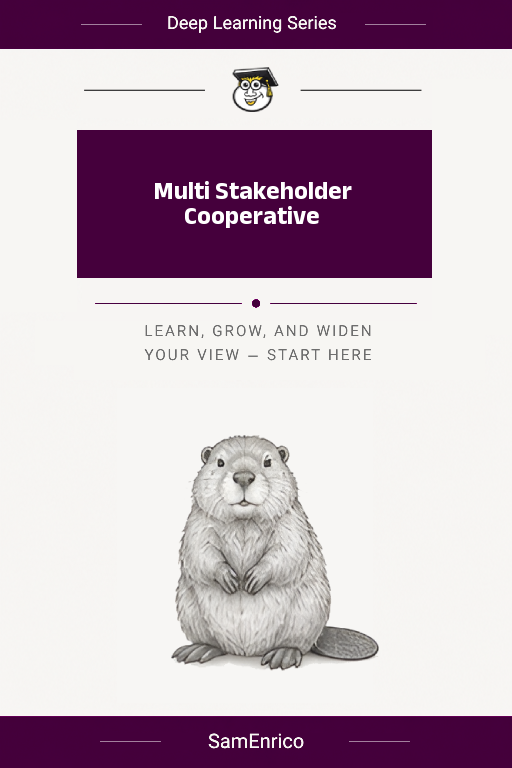
Non-FictionBusiness BriefAlternative Structures
Multi Stakeholder Cooperative eBook
Form multi-stakeholder cooperatives with different
by Yu Jackelyn
Form multi-stakeholder cooperatives with different member classes. Producers, workers, and consumers together.
Formats
Free sample
Chapter 1: The Ownership Trap--–- On a humid July morning in 2018, a third-generation dairy farmer named Elena stood in front of her cooperative's board and asked a question that made everyone in the room go silent. "Why," she said, "does my family make less money today than we made twenty years ago, while the grocery store down the road just built its third parking lot?" The board members—all farmers, like her—shifted uncomfortably. They had no answer. Their cooperative, a classic single-stakeholder co-op, had done exactly what it was designed to do: protect farmers from predatory milk buyers. And yet, Elena's family was losing ground.
Her workers were leaving for warehouse jobs that paid better. And her customers, the families who bought the cheese made from her milk, were complaining that prices kept rising while quality stayed flat. Everyone was losing except the middlemen she never saw.This book begins with Elena's question because it reveals a truth that most business books refuse to acknowledge. The structure of ownership determines the distribution of prosperity. And right now, most structures are rigged.The Great Lie You Have Been Sold You have been told, your entire adult life, that there are only two ways to organize a business.
The first is the investor-owned corporation, where shareholders who contribute nothing but capital own everything and capture all the upside. The second is the single-stakeholder cooperative, where one group—farmers, workers, or consumers—owns the enterprise and fights for its own interests. These two models, you have been assured, represent the full spectrum of possibility. If you don't like the cruelty of shareholder primacy, join a co-op. If you don't like the inefficiency of collective ownership, start a corporation.
Case closed.This is a lie. It is a lie told by people who profit from your inability to imagine alternatives. And it is a lie that has kept millions of people trapped in businesses that exploit them, even when those businesses are called "cooperatives."Let us be precise about why this lie persists. The investor-owned corporation has a single legal mandate: maximize shareholder value. This sounds neutral, even benevolent.
But in practice, it means that every decision—every wage negotiation, every supplier contract, every price tag—is optimized to extract value from everyone who is not a shareholder. Workers are paid as little as the labor market allows. Suppliers (producers) are squeezed until their margins disappear. Customers (consumers) are charged as much as the market will bear. The shareholders, who contributed nothing but money, take the difference.
This is not greed. This is the law. Corporate directors have a fiduciary duty to act this way. If they don't, shareholders can sue them.The single-stakeholder cooperative was supposed to fix this. And for one group, it does.
A farmer-owned co-op raises prices for farmers. A worker-owned co-op raises wages for workers. A consumer-owned co-op lowers prices for shoppers. But here is the dirty secret that cooperative literature rarely mentions: when you protect only one stakeholder, you inevitably exploit the others.The Farmer, The Picker, and The Shopper Return to Elena's dairy farm. She belongs to a classic agricultural cooperative.
The co-op negotiates milk prices with processors, provides bulk supplies at discount, and distributes surplus back to farmer-members at the end of the year. By every measure of traditional cooperative success, this co-op is thriving. Farmer members earn more than non-member farmers. The co-op has reserves in the bank. The board is democratically elected.So why is Elena struggling?
Because the people who work her farm—the milkers, the feeders, the cleaners—are not members. They have no vote. No one at the co-op board table speaks for them. When the co-op negotiates higher milk prices for Elena, those higher prices come from somewhere. They come from the processor, who passes them to the grocery store, who passes them to the consumer.
But they also come from the farm's operating budget. To keep her farm profitable at higher milk prices, Elena has to keep labor costs down. So wages stagnate. Her workers leave. The farm becomes harder to run.Meanwhile, the consumers buying Elena's cheese have no voice either.
They cannot vote on quality standards, ecological practices, or animal welfare. If they want to pay more for grass-fed, humanely raised dairy, there is no mechanism for them to express that preference through ownership. They are passive customers, not active co-owners.Everyone loses except the middlemen. The processor still takes its cut. The distributor still takes its cut.
The grocery store still marks up the final price. And the co-op, which was supposed to liberate Elena from these middlemen, has simply made her a slightly less exploited version of the same system.This is the Ownership Trap. You reorganize ownership for one group, and you assume the problem is solved. But the trap snaps shut when you discover that your solution created new victims. The farmer co-op exploits workers.
The worker co-op squeezes suppliers. The consumer co-op demands impossibly low prices. The trap is not malice. It is structure.The Invisible Third Path Now consider a different business. It is a grocery store in a medium-sized city.
The people who stock the shelves (workers) own a third of the votes. The farmers who grow the food (producers) own another third. The families who shop there (consumers) own the final third. No group can make a decision without at least one other group agreeing. Wages, prices, and supplier contracts are set by committees that include all three classes.
Surplus profit is divided three ways: some goes to workers as bonuses, some goes back to producers as higher prices, and some goes to consumers as lower prices or store credit.This business exists. It is called a multi-stakeholder cooperative. And it is the most important business innovation you have never heard of.Multi-stakeholder cooperatives—MSCs for short—are legally incorporated enterprises with at least three distinct member classes, each with governance rights. They are not charities. They are not nonprofits.
They are for-profit businesses that have redesigned the rules of ownership to prevent any single class from exploiting the others. They have been operating successfully for over thirty years, under formal law, in countries ranging from Italy to Canada to Japan to Ecuador. They have survived financial crises, pandemics, and supply chain collapses with failure rates forty percent lower than conventional businesses.And yet, in most of the English-speaking world, almost no one knows they exist.This book exists to fix that. Over the next twelve chapters, you will learn exactly how to build an MSC, from the first conversation with potential co-founders to the final signing of your articles of incorporation. You will learn how to structure voting so that no class dominates.
You will learn how to raise capital without selling your soul to investors. You will learn how to handle the inevitable conflicts between workers who want higher wages and consumers who want lower prices. You will learn from real-world case studies in agriculture, manufacturing, digital platforms, and renewable energy.But before we get to the how, we must understand the why. And the why begins with three crises that are not separate but are in…
This is the end of the free sample. Get the eBook to keep going. Buy now
About this book
Details
- Author
- Yu Jackelyn
- Publisher
- SamEnrico
- Language
- English
- Genre
- Non-Fiction, Business Brief, Alternative Structures
- Released
- 2026-05-29
- Pages (approx.)
- 140
- Available as
- eBook, Audiobook

Read better in the ZLOADR app
Your eBooks on your phone or tablet. Sign in with your SamEnrico account and start reading.
More by Yu Jackelyn
 Internal Comms Risk RegisterYu Jackelyn$11.99
 Anger for ChefsYu Jackelyn$11.99
 Mindfulness for WorkaholicsYu Jackelyn$11.99
 The AgTech Investment OutlookYu Jackelyn$11.99
 The Stoneworkers' Secret: How Medieval Masons Built Cathedrals for the BirdsYu Jackelyn$11.99
 Understanding Spondyloepiphyseal Dysplasia Nephrotic SyndromeYu Jackelyn$17.99
 Humming and Vibration BreaksYu Jackelyn$12.99
 Arrowroot HarvestingYu Jackelyn$11.99
 How to Become a Contract AdministratorYu Jackelyn$11.99
You may also like
 Hong Kong Handover 1997Dunn Johnnie$11.99
 Zumba For Postnatal Recovery CourseNeal Christian$11.99
 Zumba for BeginnersLadner Nikia$11.99
 YouTube Comment Mining GuideHumes Pandora$12.99
 Worry Box MeditationCarlin Rudy$11.99
 Workplace Stress MeditationNguyen Lynn$11.99
 Workplace Stress and Sleep RepairHawley Ivory$11.99
 Workplace Perfectionism CureDelaney Jeffry$11.99
 Workplace Injustice Anger GuideWallen Isabelle$11.99
 Work Addiction and Burnout LinkGreenwood Ester$11.99
 Women in Yoga and WellnessBeattie Galina$11.99
 Women in Stand Up ComedyChun Evangeline$11.99