
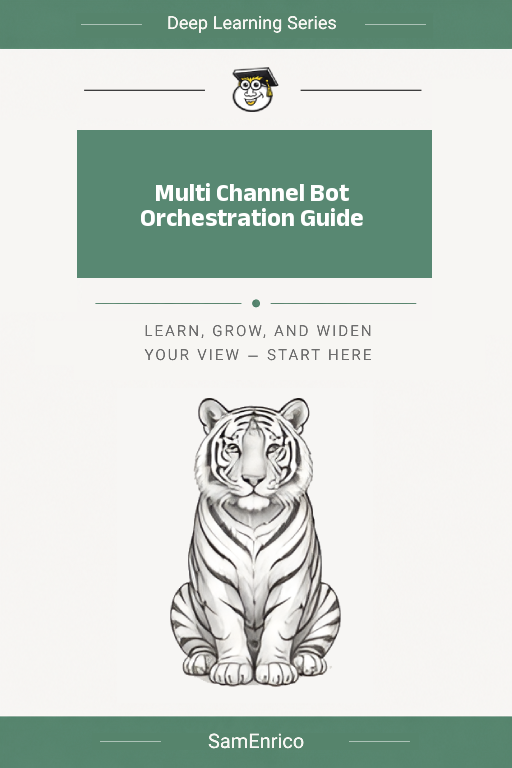
Non-FictionAI OperatorOmnichannel SupportConversation Design
Multi Channel Bot Orchestration Guide eBook
Deploy consistent AI agents across chat, email, an
Deploy consistent AI agents across chat, email, and social messaging. Preserve conversation context as customers switch channels mid-interaction.
Formats
Free sample
Chapter 1: The Amnesia Epidemic--Every sixty seconds, a customer types their order number into a chatbot. They have already typed it twice before—once on Whats App, once on email. The bot asks again anyway. The customer closes the window. A competitor gains a lead.
Multiply this by millions of interactions daily, across every industry, and you begin to understand the scale of the problem this book exists to solve.This is not a book about chatbots. This is not a book about artificial intelligence theory. This is a book about a specific, expensive, maddeningly fixable failure: the inability of customer-facing AI to remember one conversation from the next when a customer switches channels.By the time you finish this chapter, you will understand why seventy-three percent of customers experience this frustration weekly, what it costs your organization (hint: more than you think), and why the window to fix it is closing fast. You will also meet the architecture that solves it—not in theory, but in production code that you will build in later chapters.The Woman Who Talked to Three Bots and Got Nowhere Let me tell you about Sarah.Sarah is not a real person, but she is every customer your organization has failed. On a Tuesday morning, standing in an airport security line, she opens Whats App and messages your airline's support bot.
Her luggage didn't arrive on flight BA247. The bot asks for her confirmation number. She types it—a tedious sixteen-character string of letters and numbers. The bot says it will look into the matter and asks her to wait.Her flight is called for boarding. She closes Whats App.In the air, with nothing else to do, she opens email on her phone and forwards the confirmation email to your airline's support address, adding a note: "Following up on my lost luggage from flight BA247.
Please help."Your email bot receives the message. It scans for a confirmation number. It finds one. It sends an automated reply: "Thank you for contacting support. For security purposes, please provide your confirmation number."Sarah stares at the screen.
The confirmation number is in the email she just sent. The bot has it. The bot is asking for it anyway.After landing, frustrated and tired, she opens Instagram and DMs your brand account. "Can anyone help with lost luggage? Flight BA247." A third bot responds within seconds: "I'd love to help!
Can you please provide your confirmation number?"Sarah closes all three apps. She calls your competitor's customer service line. She is not rude on the phone. She is worse than rude—she is quiet, efficient, and done with your brand forever.This is not an edge case. This is not a rare scenario.
This is how your customers behave every single day. They channel-hop. They expect you to keep up. You do not.The cost of this failure is not theoretical. Every time a customer repeats information they have already provided, you burn trust.
You burn time. You burn money. According to aggregated customer experience data from across enterprise support operations, the average cost of a single unnecessary repetition—factoring in agent time, customer frustration, and increased churn risk—is $41. That is not the cost of a resolved issue. That is the cost of asking for an order number twice.Multiply $41 by the number of customers who experience channel-switching friction daily.
The number is staggering. And it is entirely preventable.The Siloed Bot Nightmare What happened to Sarah is not a technology failure. It is an architecture failure. Specifically, it is the failure of what I call the Siloed Bot Nightmare.Most organizations today deploy customer AI the same way they deployed websites fifteen years ago: one instance per channel, each built separately, each maintained separately, each with its own memory, its own configuration, its own personality. The Whats App bot lives in one codebase.
The email bot lives in another. The web chat bot lives in a third. They do not share session state. They do not share conversation history. They do not even know the others exist.This architecture made sense in 2020.
Back then, "chatbot" meant a rules-based decision tree that could handle exactly one question at a time. Channels were siloed because the technology was siloed. But today, customers expect seamlessness. Your architecture has not caught up.The result is predictable and expensive. When a customer switches from Whats App to email, the email bot has no idea that the customer just spent ten minutes explaining their problem.
It starts from zero. It asks for the same information. The customer feels unheard. The customer leaves.I have seen this pattern at companies ranging from startups to Fortune fifty enterprises. It is the single most common reason that customer AI projects fail to deliver ROI.
Not because the AI is dumb—modern large language models are remarkably capable—but because the architecture around the AI is fragmented.Let me show you exactly how this failure scales.The Mathematics of Fragmentation Imagine a company with one million customer interactions per month. Of those, thirty percent involve a channel switch—the customer starts on one channel and continues on another. That is three hundred thousand channel-switching interactions per month.If the average customer needs to provide only two pieces of information per channel switch (a confirmation number and a reason for contact), that is six hundred thousand unnecessary repetitions per month. At 41perrepetition,themonthlycostoffragmentationis41 per repetition, the monthly cost of fragmentation is 41perrepetition,themonthlycostoffragmentationis24.6 million. Annually, that approaches $300 million.These are not small numbers.
This is not a rounding error. This is money leaving your business because your bots do not remember what your customers already told them.Three Case Studies: What Success and Failure Look Like Let me ground this in real examples. I have anonymized some details where confidentiality requires it, but the lessons are drawn from actual deployments.Case Study One: The Airline That Lost $47 Million A major international airline deployed separate AI agents for Whats App, web chat, and email. Each agent was individually capable. The Whats App agent could rebook flights.
The web chat agent could process refunds. The email agent could issue travel vouchers. Individually, they worked.But when customers switched channels mid-journey—which thirty-four percent of their support interactions involved—everything fell apart. The most common failure pattern was exactly Sarah's experience: customer starts on Whats App, provides confirmation number, switches to email, gets asked for confirmation number again, abandons support, complains on social media.The airline measured the impact over a single quarter. The direct costs—additional agent time, escalated manual reviews, compensation for botched rebookings—totaled $47 million.
That is not counting the reputational damage or the customers who quietly stopped flying with them.The root cause was not the language model. It was the lack of a unified session binding layer that could link cross-channel interactions into a single conversation. The airline has since rebuilt their architecture. The results: a sixty-eight percent reduction in ticket resolution time and a measurable increase in customer satisfaction scores. But they lost a quarter and nearly fifty million dollars learning the lesson.Case Study Two: The Retailer Whose Bot Approved a 4,700Refundona4,700 Refund on…
This is the end of the free sample. Get the eBook to keep going. Buy now
About this book
Details
- Author
- Wilkins Nadine
- Publisher
- SamEnrico
- Language
- English
- Genre
- Non-Fiction, AI Operator, Omnichannel Support, Conversation Design
- Released
- 2026-06-01
- Pages (approx.)
- 148
- Available as
- eBook, Audiobook

Read better in the ZLOADR app
Your eBooks on your phone or tablet. Sign in with your SamEnrico account and start reading.
More by Wilkins Nadine
 Concierge MVP Validation MethodWilkins Nadine$11.99
 TM for AccountantsWilkins Nadine$11.99
 Bipolar Relationship Healing CourseWilkins Nadine$11.99
 Team Silent StormingWilkins Nadine$11.99
 Academic Faculty Stress GuideWilkins Nadine$11.99
 Intermittent Fasting for PregnancyWilkins Nadine$11.99
 Teen Rejection RecoveryWilkins Nadine$11.99
 Nancy Pelosi SpeakershipWilkins Nadine$11.99
 GH Research Future DirectionsWilkins Nadine$11.99
 The Last Broadcast: The Day the Internet VanishedWilkins Nadine$11.99
 Zero Day: The Untold Story of the Stuxnet CyberwarWilkins Nadine$11.99
 The Frozen Equations: Alhazen’s Arctic RevelationsWilkins Nadine$11.99
You may also like
 Hong Kong Handover 1997Dunn Johnnie$11.99
 Zumba For Postnatal Recovery CourseNeal Christian$11.99
 Zumba for BeginnersLadner Nikia$11.99
 YouTube Comment Mining GuideHumes Pandora$12.99
 Worry Box MeditationCarlin Rudy$11.99
 Workplace Stress MeditationNguyen Lynn$11.99
 Workplace Stress and Sleep RepairHawley Ivory$11.99
 Workplace Perfectionism CureDelaney Jeffry$11.99
 Workplace Injustice Anger GuideWallen Isabelle$11.99
 Work Addiction and Burnout LinkGreenwood Ester$11.99
 Women in Yoga and WellnessBeattie Galina$11.99
 Women in Stand Up ComedyChun Evangeline$11.99