
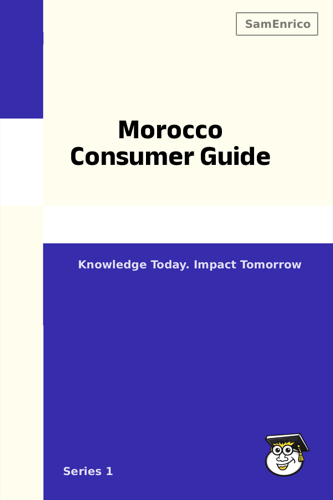
Non-FictionForecast & OutlookMorocco
Morocco Consumer Guide eBook
Track spending in North Africa's most stable and i
Track spending in North Africa's most stable and industrialized economy.
Formats
Free sample
Chapter 1: The Seven Faces--Every morning, before the sun crests the Atlantic and turns Casablanca’s whitewashed facades to gold, Fatima says goodbye to her husband Ahmed and walks fifteen minutes to the Marjane hypermarket on the edge of their working-class neighborhood. She pushes a cart through automatic doors, past pyramids of French yogurts and Spanish olive oils, past shelves stacked with imported laundry detergents promising “European whitening power.” She selects a single bottle of Garnier shampoo—the same brand her sister-in-law in Rabat uses, the same brand featured in the Cairo-produced drama series every family watches during Ramadan. She pays 49 dirhams at the register, receives a printed receipt, and walks home.On the way back, she stops at her neighbor’s hanout, the corner shop no wider than a shipping container, where Mustafa the grocer has known her family for twenty-two years. She buys a liter of unbranded olive oil—pressed locally, poured from a plastic jug into a reused water bottle, no label, no expiry date, no receipt. She pays 25 dirhams.
Mustafa writes nothing down. He trusts her, and she trusts the oil. Tomorrow, she will return for fresh khobz bread and perhaps a small bag of loose tea, and she will pay in cash, and no record of the transaction will exist anywhere except in the shared memory of two people who have never signed a contract.This is not a contradiction. This is Morocco.The foreign observer sees two economies: the modern and the traditional, the formal and the informal, the trackable and the invisible. The Moroccan consumer lives in only one economy.
She moves between its regions as easily as she moves between Darija and French, as easily as she adjusts her headscarf when entering a government building and loosens it when visiting her mother’s grave. The same woman who demands a warranty on a refrigerator will trust a verbal promise on a sack of couscous. The same family that finances a car through a bank will negotiate a wedding gift in cash, under the table, with nothing written and everything understood.To understand spending in Morocco, you must first understand that you are not looking for one consumer. You are looking for seven.The Myth of the Average Moroccan International brands make the same mistake repeatedly. They parachute into Morocco with spreadsheets full of aggregate data—average income, average age, average spending—and they design campaigns for a person who does not exist.
The “average Moroccan consumer” is a statistical ghost, a mathematical convenience that conceals more than it reveals. In Casablanca’s wealthiest enclaves, consumers spend more on a single weekend brunch than entire families in the eastern provinces spend on food in a month. In Tangier’s new business districts, twenty-five-year-old tech workers switch between English, French, and Arabic on their phones while ordering takeout through Glovo, while their parents in the same city still walk to the same baker they have visited since 1987.The average tells you nothing. The segments tell you everything.Drawing on decades of consumer research—including the foundational work of Amine and Gallouj in Consommateurs et pratiques de consommation au Maroc and Bouziane’s psychological profiles in Understanding the Moroccan Consumer—this chapter introduces the seven consumer types that actually exist in Morocco today. These are not academic abstractions.
They are your neighbors, your colleagues, your in-laws. They are the person across the negotiation table. They are, in different moments, you.Before we name them, understand what they are not. These are not rigid boxes. They are gravitational fields.
A single person may orbit closer to one type in the morning and another by evening. The price-driven Budgeteer who hunts for discounts at the hypermarket may become the Brand Champion who insists on a specific French cheese for a dinner party. The Changemaker who boycotts bottled water for political reasons may still buy Coca-Cola for her children because they cried at the checkout. The types describe tendencies, not prisons. But they are real tendencies, measurable and predictable, and once you learn to recognize them, you will never see Moroccan spending the same way again.Type One: The Budgeteer The Budgeteer is the most common consumer in Morocco, though you would never know it from looking at marketing campaigns aimed at the “emerging middle class.” The Budgeteer’s guiding principle is simple: every dirham must be justified.
She knows the price of tomatoes at three different shops within a ten-minute walk. She buys laundry detergent in bulk when it is on promotion and stores it under the sink for months. She does not buy brand names unless the generic alternative is unavailable or untrustworthy.The Budgeteer is not poor, necessarily. Many Budgeteers have comfortable incomes. They simply carry a mental ledger that never closes.
This is not miserliness; it is prudence shaped by decades of economic volatility, subsidy removals, and the memory—personal or inherited—of scarcity. The Budgeteer’s parents lived through the “Years of Lead” and the structural adjustment programs of the 1980s. The Budgeteer herself has watched inflation erode purchasing power year after year. She knows that prices rise and wages do not always follow. So she tracks, she compares, she waits for sales.Where does the Budgeteer shop?
Everywhere, but strategically. For shelf-stable staples (rice, flour, oil, sugar), she prefers discount chains like BIM or Kazyon, where prices are low and promotions are frequent. For fresh produce, she visits the weekly souk or the neighborhood street vendor, where she can inspect each tomato and negotiate small discounts on volume. For household cleaning products, she compares prices across hypermarkets, sometimes traveling an extra twenty minutes to save five dirhams on a bulk pack of laundry powder. For meat and poultry, she trusts the halal butcher her mother used, even if prices are slightly higher than the supermarket, because trust is a form of savings against future illness.The Budgeteer’s weakness is the promotion that is not actually a promotion.
She is exquisitely sensitive to price signals but vulnerable to anchoring—the retail tactic of showing an inflated “original” price next to a “sale” price that is merely the normal price. She will drive across town for a “buy one get one free” offer without calculating whether she would have bought the second item anyway. She clips digital coupons on apps like Glovo and Jumia, believing she is winning, while the platform captures her data and steers her toward higher-margin items. The Budgeteer is rational, but rational within a system designed to exploit rational calculation.Marketing to the Budgeteer requires demonstrating tangible value. She will not respond to emotional appeals about lifestyle or status.
She wants to know: how many washes per bottle? How many meals per kilogram? What is the price per unit compared to the competitor? Brands that succeed with the Budgeteer offer subscription models, loyalty points that convert to cash discounts, and transparent unit pricing. Brands that fail with the Budgeteer rely on vague claims of quality or prestige.Type Two: The Connected Shopper The Connected Shopper is the youngest of the seven types, though age is less a predictor than digital literacy.
She has never known a world without mobile internet. She shops with her thumbs. She compares prices on Jumia while…
This is the end of the free sample. Get the eBook to keep going. Buy now
About this book
Details
- Author
- Delossantos Elia
- Publisher
- SamEnrico
- Language
- English
- Genre
- Non-Fiction, Forecast & Outlook, Morocco
- Released
- 2026-06-07
- Pages (approx.)
- 158
- Available as
- eBook, Audiobook

Read better in the ZLOADR app
Your eBooks on your phone or tablet. Sign in with your SamEnrico account and start reading.
More by Delossantos Elia
 Ailurophobia Cat FearDelossantos Elia$11.99
 Affirmations For Financial Abundance CourseDelossantos Elia$11.99
 Religious Trauma TriggersDelossantos Elia$11.99
 The DEAR MAN DBT Interpersonal SkillDelossantos Elia$11.99
 The Collapse of the Iron Spires: How Western Engineering Saved CivilizationDelossantos Elia$11.99
 Understanding Pancreatic DiseasesDelossantos Elia$17.99
 Customer Experience SupervisorDelossantos Elia$11.99
 Dario Amodei GuideDelossantos Elia$12.99
 Collaborative Ads First GuideDelossantos Elia$12.99
 How to Start a Hobby in Yo-yoingDelossantos Elia$11.99
You may also like
 Hong Kong Handover 1997Dunn Johnnie$11.99
 Zumba For Postnatal Recovery CourseNeal Christian$11.99
 Zumba for BeginnersLadner Nikia$11.99
 YouTube Comment Mining GuideHumes Pandora$12.99
 Worry Box MeditationCarlin Rudy$11.99
 Workplace Stress MeditationNguyen Lynn$11.99
 Workplace Stress and Sleep RepairHawley Ivory$11.99
 Workplace Perfectionism CureDelaney Jeffry$11.99
 Workplace Injustice Anger GuideWallen Isabelle$11.99
 Work Addiction and Burnout LinkGreenwood Ester$11.99
 Women in Yoga and WellnessBeattie Galina$11.99
 Women in Stand Up ComedyChun Evangeline$11.99