
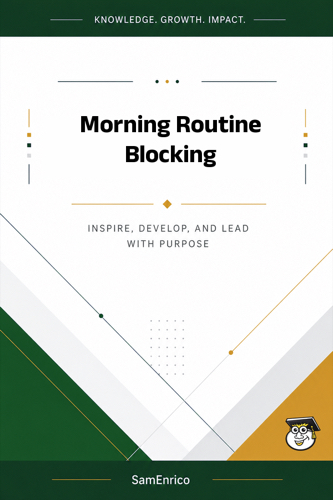
Non-FictionSelf-HelpMorning Routine
Morning Routine Blocking eBook
Reserves first 90 minutes for consistent daily rit
Reserves first 90 minutes for consistent daily rituals.
Formats
Free sample
Chapter 1: The Snooze Tax--–- The sound is familiar. Probably the most familiar sound in your life, more consistent than your own heartbeat. A sharp, insistent beeping. Or perhaps a gentle chime. Or maybe that horrible radio station you set as your alarm five years ago and never changed.
Your hand emerges from beneath the blankets like a creature surfacing from deep water. It searches blindly. It finds the phone. It performs a motion so practiced it has become reflexive: swipe, tap, or press. Silence.–- Then you roll over.
Nine minutes later, the sound returns. You repeat the motion. Perhaps you do this once. Perhaps three times. Perhaps, on the worst mornings, you do this until the last possible moment before you absolutely must leave for work, at which point you launch yourself out of bed like a cannonball, brush your teeth in forty-five seconds, and sprint out the door with a granola bar clenched between your teeth.–- You tell yourself: It was only nine minutes.
What harm could nine minutes possibly do?–- Everything. It can do everything.–- This chapter is about what I call the Snooze Tax—the invisible, cumulative, neurological debt you incur every time you fragment your awakening. It is about why the first ten minutes of your day determine the next ten hours. And it is about why the solution to your morning chaos is not more willpower, not a better alarm clock app, not a "just get up" mentality, but something far more effective: a Block.The Mathematics of the Snooze Button–- Let us begin with arithmetic, because the arithmetic is simple and the arithmetic is devastating. The average person who hits snooze believes they are losing approximately nine minutes per day.
Over a year, that is fifty-four hours—a little over two full days. This is already not trivial. Two days per year spent in a state of half-sleep, hitting a button, and rolling over.–- But the arithmetic is wrong. Not slightly wrong. Completely, catastrophically wrong.–- The true cost of snoozing is not the nine minutes you spend between alarms.
The true cost is what happens to your brain during those nine minutes and, more critically, what happens to your brain after them. This requires a brief journey into a field of neuroscience called sleep inertia research.–- Sleep inertia is the technical term for that groggy, disoriented, foggy state you experience upon waking. It is the reason you sometimes stare at your toothbrush for five seconds before remembering what it is for. It is the reason you have, at some point in your life, put the milk in the pantry and the cereal in the refrigerator. It is not a moral failing.
It is not laziness. It is your brain slowly rebooting.–- The average human brain requires approximately thirty-five minutes to fully clear sleep inertia. During this time, your prefrontal cortex—the part of your brain responsible for decision-making, impulse control, and planning—is operating at reduced capacity. Your reaction times are slower. Your working memory is impaired.
Your emotional regulation is compromised. You are, in a very real sense, not fully yourself.–- Here is where the snooze button becomes a weapon aimed at your own cognitive function. When you hit snooze and fall back asleep—even for nine minutes—you restart the sleep inertia clock. Your brain begins the process of descending back into a sleep state. Then the alarm sounds again, and you jerk awake, and your brain must begin the thirty-five-minute clearance process all over again.
From zero.–- If you hit snooze twice, you have added eighteen minutes of fragmented sleep and forced your brain through two complete sleep inertia cycles. The result is not grogginess that lasts until breakfast. It is grogginess that lasts until lunch. Sometimes until two in the afternoon.–- I call this the Re-entry Delay. It is the period between waking and full cognitive function.
For the average person who does not snooze, the Re-entry Delay is approximately thirty-five minutes. For the average person who snoozes twice, the Re-entry Delay can stretch to seventy or even ninety minutes. That is an hour and a half of your morning spent in a neurologically impaired state.–- But the snooze button is only the first offender. It is not even the worst one.The Real Villain: The Glowing Rectangle–- Within ten seconds of waking, the average person reaches for their phone. Not to make a call.
Not to check the time—the clock is on the lock screen. They reach for their phone because something inside them has been trained to crave the dopamine hit of a notification. A text message. An email. A like on a social media post.
A news alert. A sports score. A weather update that could have waited.–- This is not your fault. This is behavioral engineering. The world's largest technology companies have spent billions of dollars studying how to make their products as addictive as possible.
They have learned that variable rewards—not knowing what you will get when you check your phone—are more addictive than predictable rewards. A slot machine pays out unpredictably, which is why people sit at them for hours. Your phone is a slot machine. Every time you pull down the notification shade, you are pulling the lever.–- And you are pulling that lever within ten seconds of opening your eyes.–- The problem with this is not merely that you are losing time to scrolling. The problem is that you are fragmenting the most neurologically vulnerable period of your entire day.
Remember the sleep inertia window? The thirty-five minutes during which your prefrontal cortex is offline? That is precisely when you are feeding your brain a firehose of low-stakes, high-dopamine, emotionally charged digital noise.–- Each notification acts like a small hammer on a newly poured concrete foundation. The concrete—your brain's attentional capacity for the day—is still wet. It is still setting.
And every time you glance at a notification, you drive a tiny crack into that foundation. By the time you finally put your phone down—perhaps twenty minutes later, perhaps forty—the foundation is not smooth and solid. It is pockmarked. It is fissured.–- I call this Cognitive Erosion.Cognitive Erosion: The Prolonged Weakening of Attention–- Let me be precise about what Cognitive Erosion is and what it is not.–- Cognitive Erosion is the prolonged weakening of your ability to focus deeply, caused by fragmenting your first waking moments with low-stakes digital noise. It is called erosion because it works like water on stone: not destroying all at once, but wearing away, grain by grain, until what was once a solid barrier is now a permeable sieve.–- The word "prolonged" matters here.
I am not saying that checking your phone in the morning causes permanent brain damage. The brain is remarkably plastic; it can heal, it can recover, it can rebuild. But the damage from a single fragmented morning lasts for the duration of that day. Sometimes longer. If you consistently fragment your mornings—day after day, week after week—the erosion becomes the baseline.…
This is the end of the free sample. Get the eBook to keep going. Buy now
About this book
Details
- Author
- Carlson Warren
- Publisher
- SamEnrico
- Language
- English
- Genre
- Non-Fiction, Self-Help, Morning Routine
- Released
- 2026-06-07
- Pages (approx.)
- 132
- Available as
- eBook, Audiobook

Read better in the ZLOADR app
Your eBooks on your phone or tablet. Sign in with your SamEnrico account and start reading.
More by Carlson Warren
 Lowe's Renovation ComparisonCarlson Warren$11.99
 The First Time Founder Tax GuideCarlson Warren$11.99
 Sam Cooke Wonderful WorldCarlson Warren$11.99
 Email Vacation Filter CreationCarlson Warren$11.99
 Breath Awareness for Surgery PrepCarlson Warren$11.99
 Time Blocking for Sales SupportCarlson Warren$11.99
 Scripting for LeadershipCarlson Warren$11.99
 The Fall of the Premier: New Zealand's First Political ScandalCarlson Warren$11.99
 The Iron Masters of Meroë: Forging an Empire in the Heart of AfricaCarlson Warren$11.99
 How to Start a Finish Carpentry Contractor BusinessCarlson Warren$11.99
 How to Produce DollsCarlson Warren$11.99
 Black Medick: Harvesting Small-seed LegumeCarlson Warren$11.99
You may also like
 Hong Kong Handover 1997Dunn Johnnie$11.99
 Zumba For Postnatal Recovery CourseNeal Christian$11.99
 Zumba for BeginnersLadner Nikia$11.99
 YouTube Comment Mining GuideHumes Pandora$12.99
 Worry Box MeditationCarlin Rudy$11.99
 Workplace Stress MeditationNguyen Lynn$11.99
 Workplace Stress and Sleep RepairHawley Ivory$11.99
 Workplace Perfectionism CureDelaney Jeffry$11.99
 Workplace Injustice Anger GuideWallen Isabelle$11.99
 Work Addiction and Burnout LinkGreenwood Ester$11.99
 Women in Yoga and WellnessBeattie Galina$11.99
 Women in Stand Up ComedyChun Evangeline$11.99