
Non-FictionSelf-HelpMonthly Planning
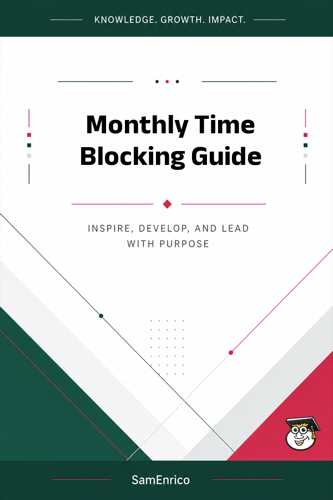
Monthly Time Blocking Guide eBook
Looks ahead 30 days to block major deadlines and e
Looks ahead 30 days to block major deadlines and events.
Formats
Free sample
Chapter 1: The 30-Day Lie--You believe you are busy. That is not your problem. Your problem is that you are blind to your own month. Every Sunday evening, millions of professionals open their calendars and feel a familiar dread rising in their chests. They see meetings stacked upon meetings, deadlines looming like storm clouds, and a to-do list that would require three of them to complete.
They tell themselves the same lie: “Next week, I will get organized. Next week, I will finally get ahead.” But next week always arrives with the same chaos, the same firefighting, the same exhausted collapse on Friday afternoon. This book exists because that cycle is not inevitable, and it is not your fault. The system you have been using—daily to-do lists, weekly planning sessions, the constant checking of email—was never designed to handle the complexity of modern work and life. It was designed for a simpler time, when tasks arrived one at a time and deadlines were measured in months, not hours.
That time is gone. Your planning system must evolve, or you will continue to drown in the shallows of urgency while the truly important work remains undone on the ocean floor.The central argument of this book is simple, almost uncomfortably so: the month is the most strategic unit of time you possess, and you are currently wasting it. Most people plan at two horizons: the day (what can I survive today?) and the week (what absolutely must happen by Friday?). Both horizons are reactive by nature. Daily planning asks you to respond to whatever has landed on your desk in the last twenty-four hours.
Weekly planning asks you to triage whatever deadlines have become unavoidable. Neither asks you to look ahead thirty days and ask the only question that matters: “What do I need to accomplish in the next month that will make my work and life meaningfully better?” When you cannot answer that question, you are not planning. You are merely reacting. And reaction, no matter how efficient, is not the same as progress.Consider a simple experiment. Right now, without closing this book, open your calendar on your phone or computer.
Look at the next thirty days. Count how many deadlines, deliverables, events, or commitments appear on your calendar that you had completely forgotten about until this moment. Be honest. For most people, the number is between five and fifteen. These are not new obligations.
They have been sitting there for weeks, sometimes months, quietly accumulating pressure while you focused on the urgent fires of the present moment. Each one represents a small betrayal of your future self. You told yourself you would remember. You did not. You told yourself you would prepare.
You will not, because by the time that deadline enters your weekly field of vision, it will be an emergency. This is not a moral failing. It is a structural failing. Your current system does not have a thirty-day field of view, so your thirty-day obligations simply do not exist in your conscious planning until they become seven-day emergencies.The psychology behind this blindness is well documented. Researchers have long known that humans suffer from what is called “temporal discounting” or “present bias”—the tendency to overweight immediate concerns and underweight future concerns, even when the future concern is objectively more important.
In one famous study, participants were offered two choices: one hundred dollars today or one hundred twenty dollars in one week. Nearly every participant chose the hundred dollars today, even though waiting seven days would yield a twenty percent return. When the same participants were asked about a choice between one hundred dollars in fifty-two weeks and one hundred twenty dollars in fifty-three weeks, they overwhelmingly chose to wait the extra day. The only variable that changed was distance from the present. When the reward was far away, they could think rationally.
When it was close, urgency hijacked their judgment. This is exactly what happens to your planning. When a deadline is thirty days away, you are rational. You know you should start early. You know you should break the project into pieces.
But as that deadline moves from thirty days to fourteen days to seven days to tomorrow, urgency floods your brain, and rational planning is replaced by panicked execution. The quality of your work suffers. Your stress skyrockets. And you promise yourself that next time will be different. But next time is not different because your planning horizon remains stuck at seven days.The solution is not to try harder.
The solution is to change the structure of your planning. This book introduces a practice called Monthly Time Blocking, which is the disciplined habit of looking ahead exactly thirty days and deliberately assigning blocks of time to your most important deadlines, events, and priorities before the week arrives to hijack your attention. Monthly Time Blocking is not another productivity fad. It is a structural intervention that forces your brain to engage with the thirty-day horizon whether it wants to or not. When you physically block time on your calendar for a deadline that is three weeks away, you are doing something remarkable: you are making the future visible.
You are taking an abstract obligation that could easily be forgotten and turning it into a concrete, colored rectangle on a grid. That rectangle will sit there, silently reminding you, until the day arrives to do the work. You do not need to remember. You do not need to will yourself to focus. You simply need to follow the blocks you created when you were rational.This approach is supported by a wide range of productivity research and best-selling books.
David Allen’s Getting Things Done emphasizes the importance of capturing every commitment outside your brain, because your brain is for having ideas, not holding them. Monthly Time Blocking extends this principle from the realm of tasks to the realm of time itself. Cal Newport’s Deep Work argues that the ability to focus without distraction is becoming increasingly valuable in the modern economy. Monthly Time Blocking ensures that your deep work actually happens by protecting it from the urgent but unimportant tasks that would otherwise consume your day. Stephen Covey’s The 7 Habits of Highly Effective People introduced the world to the distinction between urgent and important, noting that most people spend their lives responding to urgency while important work languishes.
Monthly Time Blocking forces you to schedule the important before the urgent has a chance to claim your attention. Gary Keller’s The One Thing asks a simple question: “What is the one thing you can do such that by doing it everything else will be easier or unnecessary?” Monthly Time Blocking asks a related question: “What is the one thing you must complete in the next thirty days to call this month a success?” That question, asked consistently, transforms how you allocate your time.Let us be precise about what Monthly Time Blocking is and what it is not. It is not a daily to-do list. Daily to-do lists are reactive and optimistic. They assume you will have time for everything you write down, which you will not.
It is not a weekly plan. Weekly plans are tactical. They help you survive the next five days, but they…
This is the end of the free sample. Get the eBook to keep going. Buy now
About this book
Details
- Author
- Caudill Dorinda
- Publisher
- SamEnrico
- Language
- English
- Genre
- Non-Fiction, Self-Help, Monthly Planning
- Released
- 2026-06-06
- Pages (approx.)
- 126
- Available as
- eBook, Audiobook

Read better in the ZLOADR app
Your eBooks on your phone or tablet. Sign in with your SamEnrico account and start reading.
More by Caudill Dorinda
 Attachment Style ConflictCaudill Dorinda$11.99
 Jimi Hendrix Electric LadylandCaudill Dorinda$11.99
 Congressional Retirement CalculationsCaudill Dorinda$11.99
 Mindfulness for Focus TrainingCaudill Dorinda$11.99
 Scripting for PTSD RecoveryCaudill Dorinda$11.99
 Meeting Async Status BoardCaudill Dorinda$11.99
 Time Blocking for Software DevsCaudill Dorinda$11.99
 The Hammer and the Anvil: The Battle of Stamford Bridge and the Fall of the Viking AgeCaudill Dorinda$11.99
 The Lion of Castile: Alfonso X and the Golden Age of SpainCaudill Dorinda$11.99
 Artichoke: Harvesting GuideCaudill Dorinda$11.99
 Supplier Evaluation SheetCaudill Dorinda$12.99
 French Stock Option Plan ComplianceCaudill Dorinda$12.99
You may also like
 Hong Kong Handover 1997Dunn Johnnie$11.99
 Zumba For Postnatal Recovery CourseNeal Christian$11.99
 Zumba for BeginnersLadner Nikia$11.99
 YouTube Comment Mining GuideHumes Pandora$12.99
 Worry Box MeditationCarlin Rudy$11.99
 Workplace Stress MeditationNguyen Lynn$11.99
 Workplace Stress and Sleep RepairHawley Ivory$11.99
 Workplace Perfectionism CureDelaney Jeffry$11.99
 Workplace Injustice Anger GuideWallen Isabelle$11.99
 Work Addiction and Burnout LinkGreenwood Ester$11.99
 Women in Yoga and WellnessBeattie Galina$11.99
 Women in Stand Up ComedyChun Evangeline$11.99