
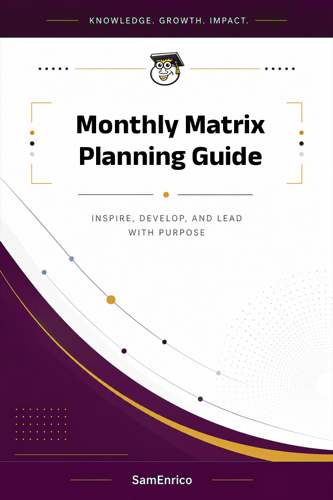
Monthly Matrix Planning Guide eBook
Teaches using Eisenhower for quarter and month goa
Teaches using Eisenhower for quarter and month goal setting.
Formats
Free sample
Chapter 1: The Urgency Trap--–- The email arrived at 7:14 AM. By 7:16 AM, you had already abandoned your plan for the day. By 7:30 AM, you had forgotten you ever had a plan at all. By noon, you felt busy but empty. By 5:00 PM, you were exhausted, wondering where the day went, unable to name a single thing you truly accomplished.
And by 10:00 PM, you promised yourself that tomorrow would be different.Tomorrow never is.This is not a failure of willpower. It is not a character flaw. It is not laziness, lack of discipline, or any of the other self-flagellating labels you have likely applied to yourself on those long, quiet evenings when the to-do list stares back at you, longer than when you started. This is something far more predictable, far more mechanical, and—here is the good news—far more fixable.This is the Urgency Trap.The Great Illusion of the To-Do List The modern knowledge worker operates under a seductive and completely false assumption: that writing things down is the same as making progress. The to-do list has become the sacred text of the overwhelmed.
We believe that if we can just capture every task, every obligation, every half-formed commitment on a piece of paper or a digital app, we have somehow taken control of our lives.We have not. We have simply catalogued our anxiety.Consider what a typical to-do list actually contains. A random Wednesday might include: "Finish quarterly report," "Respond to Sarah's email about the budget," "Buy cat food," "Schedule dentist appointment," "Review competitor analysis," "Follow up with client X," "Read that article about industry trends," "Call mom back," "Update project timeline," "Prepare for Thursday's meeting." This is not a plan. This is a brain dump organized by panic. Each item carries equal visual weight on the page, yet each has wildly different implications for your actual goals.
The to-do list flatters everything into the same typographical space. It cannot distinguish between "schedule dentist appointment" (a five-minute phone call) and "finish quarterly report" (a six-hour strategic endeavor). It cannot tell you which items move your career forward and which merely keep you busy. It cannot protect you from the gravitational pull of urgency.And so you do what every overwhelmed person does: you attack the easiest, loudest, most recent items first. The email that just arrived.
The Slack message from your boss with the red exclamation mark. The notification that someone has tagged you in a document. These are not necessarily important. But they are urgent, and urgency has a peculiar power over the human brain that importance does not.Why Your Brain Chooses Urgency Every Time To understand why we fail at time management, we must first understand something embarrassing about the organ we use to manage time: the brain is not a rational calculator. It is a survival machine wearing a business suit.The human brain evolved in an environment where urgency genuinely meant danger.
A rustle in the bushes was urgent because it might be a predator. A sudden drop in temperature was urgent because you might freeze. A cry from your child was urgent because they might be in peril. In that environment—the savanna, the cave, the small tribal settlement—there was no such thing as an artificial emergency. Everything urgent was genuinely important for survival.Your brain has not updated its software.Today, the "rustle in the bushes" has been replaced by the email notification.
The "sudden drop in temperature" has been replaced by the Slack message. The "cry from your child" has been replaced by the calendar reminder that a meeting starts in five minutes. Your brain releases the same stress hormones—cortisol, adrenaline, norepinephrine—in response to a low-priority email as it once released in response to a predator. The physiological response is nearly identical. Your heart rate increases.
Your pupils dilate. Your prefrontal cortex—the rational, planning part of your brain—actually down-regulates, handing control to more primitive structures that prioritize immediate action over strategic thinking.This is the Marshmallow Test for adults, but with a cruel twist. In the famous Stanford experiments, children who could resist eating one marshmallow now in exchange for two marshmallows later demonstrated better life outcomes. But those children were in a quiet room with no distractions. They were not being bombarded with a hundred "marshmallows" every hour, each one demanding immediate consumption.
The adult version of the Marshmallow Test is not about resisting a single temptation. It is about resisting a fire hose of temptations while also trying to do your actual job. You are not failing because you lack discipline. You are failing because the environment is engineered to make you fail.The Two Masters: Busyness vs. Effectiveness There is a crucial distinction that most productivity books mention and then immediately forget: the difference between being busy and being effective.Busyness is activity.
It is the number of emails sent. The number of meetings attended. The number of tasks checked off. Busyness feels productive because it produces dopamine in short, frequent bursts. Every time you check something off a list—even something trivial—you get a small neurological reward.
This is why people spend hours on low-value tasks and feel oddly satisfied about it. Their brains are being tricked.Effectiveness is progress. It is movement toward a meaningful goal. It is the quarterly report completed, not just started. It is the client relationship deepened, not just maintained.
It is the skill acquired, not just researched. Effectiveness produces dopamine less frequently but in much larger doses. The problem is that the delay between action and reward is measured in weeks or months, not seconds or minutes. Your brain, being a short-term optimization machine, will almost always choose the small, immediate reward of busyness over the large, delayed reward of effectiveness.This is not a moral failing. This is physics.The question is not whether you will fall into the Urgency Trap.
You will. Everyone does. The question is whether you will have a system that catches you before you hit the bottom.The Eisenhower Matrix: More Than a Grid Dwight D. Eisenhower, the 34th President of the United States and the Supreme Commander of Allied Forces in Europe during World War II, faced a problem that makes your email inbox look like a gentle stream. He had to decide, every day, which of a thousand urgent matters deserved his personal attention and which could be delegated, delayed, or discarded.
He could not afford to be busy. He had to be effective. The difference between those two words was measured in human lives.Eisenhower reportedly used a simple decision framework that later became known as the Eisenhower Matrix (though he never called it that). The matrix asks two questions of every task, project, or commitment:Is this urgent? (Does it demand immediate attention?)Is this important?
(Does it serve a long-term goal or value?)The answers to these two questions create four distinct quadrants. These quadrants are not merely academic categories. They are destinies. Where you spend your time determines what your life becomes.Quadrant 1: Urgent and Important – This is the crisis quadrant. A server is down.
A client is threatening to leave. A deadline is hours away. A child is sick. These tasks demand immediate attention…
This is the end of the free sample. Get the eBook to keep going. Buy now
About this book
Details
- Author
- Stidham Arianne
- Publisher
- SamEnrico
- Language
- English
- Genre
- Non-Fiction, Self-Help, Monthly
- Released
- 2026-06-08
- Pages (approx.)
- 139
- Available as
- eBook, Audiobook

Read better in the ZLOADR app
Your eBooks on your phone or tablet. Sign in with your SamEnrico account and start reading.
More by Stidham Arianne
 Cope Ahead for Emotions ManualStidham Arianne$11.99
 Franz Rosenzweig StarStidham Arianne$11.99
 Murdoch Children BiographyStidham Arianne$11.99
 Agnostic Twelve Step ParticipationStidham Arianne$11.99
 The Silk Road’s Last Empress: Wu Zetian’s Trade WarsStidham Arianne$11.99
 Echoes of the Deep: The Lost Tapes of the Titanic’s Final HoursStidham Arianne$11.99
 Jumia Category Approval ProcessStidham Arianne$12.99
 Kenyan Remote Performance ManagementStidham Arianne$12.99
 How to Become a Model-and-mold MakerStidham Arianne$11.99
 Understanding Bloom SyndromeStidham Arianne$17.99
 TMF SpecialistStidham Arianne$11.99
You may also like
 Hong Kong Handover 1997Dunn Johnnie$11.99
 Zumba For Postnatal Recovery CourseNeal Christian$11.99
 Zumba for BeginnersLadner Nikia$11.99
 YouTube Comment Mining GuideHumes Pandora$12.99
 Worry Box MeditationCarlin Rudy$11.99
 Workplace Stress MeditationNguyen Lynn$11.99
 Workplace Stress and Sleep RepairHawley Ivory$11.99
 Workplace Perfectionism CureDelaney Jeffry$11.99
 Workplace Injustice Anger GuideWallen Isabelle$11.99
 Work Addiction and Burnout LinkGreenwood Ester$11.99
 Women in Yoga and WellnessBeattie Galina$11.99
 Women in Stand Up ComedyChun Evangeline$11.99