
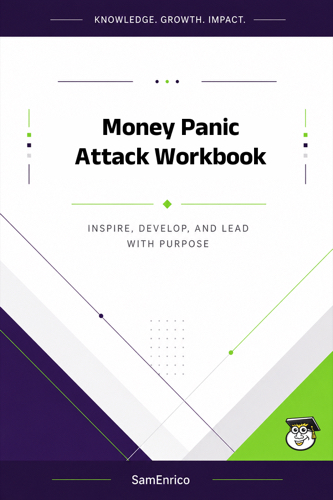
Non-FictionSelf-HelpPanicMoney
Money Panic Attack Workbook eBook
Recognize and stop financial triggered panic episo
Recognize and stop financial triggered panic episodes using grounding and breathing techniques.
Formats
Free sample
Chapter 1: The Wallet-Heart Connection...--–- You are not bad with money. You are not weak, irresponsible, or broken. The way your heart pounds when you open a banking app, the way your vision blurs when you see an overdraft fee, the way your stomach drops when you hear a payment reminder notification—none of these are character flaws. They are survival instincts. Your brain has simply made a terrible mistake: it has confused a number on a screen with a predator in the bushes.This chapter will teach you the neurobiology of financial panic.
You will learn why a spreadsheet can trigger the same fight-or-flight response as a car crash. You will understand what "financial fog" is and why it makes you feel stupid when you are anything but. And you will complete your first workbook exercise: the Soma Scan, a body map that reveals exactly where your money panic lives physically. By the end of this chapter, you will have permission to stop blaming yourself and start understanding the machinery beneath your fear.The Myth of the "Rational Financial Mind"There is a pervasive myth in personal finance culture that money is purely mathematical. If you just run the numbers, make a spreadsheet, and "be rational," you will make good decisions.
The corollary myth is that if you cannot do that—if you freeze, cry, or flee when faced with your own bank balance—there is something wrong with you.Both myths are dangerous lies.The human brain did not evolve to process 401(k) statements. It evolved to process immediate physical threats: a rustle in the grass that might be a snake, a shadow that might be a predator, a loud sound that might signal danger. Your brain’s threat-detection system is exquisitely fast—milliseconds fast—because your ancestors who hesitated did not live to pass on their genes.Now, that same ancient system is being asked to process compound interest, credit scores, debt-to-income ratios, and market volatility. It is not equipped for this. When you open a bill and your heart races, your brain is not failing at finance.
It is succeeding at survival. It just has the wrong target.This is the single most important truth of this entire workbook: Financial panic is not a financial problem. It is a survival response misdirected at a financial trigger.Once you understand this, you can stop trying to "reason your way out" of panic (which never works) and start using the tools in this workbook that actually match how your nervous system operates.The Amygdala Hijack: Why You Lose Your Mind Over Money Deep inside your brain, buried beneath the thinking, planning, reasoning prefrontal cortex, sits a small almond-shaped cluster of nuclei called the amygdala (pronounced ah-MIG-dah-lah). Its job is simple: detect threats and sound the alarm.The amygdala does not think. It does not reason.
It does not understand that a credit card statement is a piece of paper with ink on it. All it knows is pattern matching: Has something like this hurt me before? Could this hurt me now?When the amygdala detects a potential threat, it initiates a cascade of physiological events known as the fight-or-flight response. Within milliseconds:Adrenaline floods your bloodstream Your heart rate spikes Your breathing becomes shallow and rapid Blood rushes away from your digestive system and toward your large muscles Your pupils dilate Your peripheral vision narrows (tunnel vision)Your prefrontal cortex—the reasoning center—is partially shut down This last point is crucial. During an amygdala hijack, your ability to think logically, weigh evidence, consider alternatives, and plan ahead is significantly impaired.
This is why you cannot "just calm down." This is why telling yourself "it's just money" does not work. The part of your brain that would understand that sentence is currently offline.This is financial fog. It is not stupidity. It is not weakness. It is neurobiology.The Four Stages of a Money Panic Attack Not all financial panic looks the same.
Some people experience a slow build over hours. Others go from zero to full attack in seconds. Based on clinical research and thousands of case studies, financial panic attacks typically follow a four-stage pattern. Recognizing which stage you are in is the first step toward intervention.Stage 1: The Trigger Something happens that your amygdala has learned to associate with danger. Common financial triggers include:Opening a 401(k) statement after a market drop Seeing an overdraft fee notification Hearing a payment reminder sound Receiving a collections call Opening an envelope with a medical bill Logging into a student loan portal Seeing a rejected credit card application Getting an unexpected car repair estimate The trigger can be external (a specific envelope, a voicemail tone, a notification sound) or internal (a thought like "I'm a failure" or a memory of a past financial catastrophe).
Most readers will discover that their panic has a predictable "signature"—the same trigger produces the same response every time.Stage 2: The Physical Alarm Within seconds of the trigger, the amygdala activates the sympathetic nervous system. You may experience:Racing or pounding heart Sweating, especially palms and forehead Shortness of breath or feeling of choking Chest tightness or pain Nausea or stomach distress Dizziness, lightheadedness, or feeling faint Trembling or shaking Numbness or tingling sensations Chills or hot flashes These physical sensations are real. They are not "all in your head" in the sense of being imaginary. They are measurable physiological events. And because they are so intense, they often become triggers themselves—a phenomenon called "fear of fear." Your heart races, you notice your heart racing, you panic about panicking, and the spiral accelerates.Stage 3: The Catastrophic Thought As the physical alarm intensifies, your brain (or what is left of your reasoning capacity) frantically searches for an explanation.
Because your prefrontal cortex is impaired, the explanation is almost always catastrophic:"I am going to be homeless.""I will never retire.""Everyone will find out I'm broke.""I am a failure.""I will die broke.""The IRS will take everything."These thoughts feel like facts because they are accompanied by such intense physical sensations. But they are predictions, not evidence. And because your amygdala is in control, you cannot tell the difference in the moment.Stage 4: The Escape or Avoidance Behavior Finally, you do something to make the feeling stop. Common financial avoidance behaviors include:Closing the banking app immediately Throwing unopened mail into a drawer Hiding credit card statements Not answering calls from unknown numbers"Checking out" during financial conversations Drinking, eating, or scrolling social media to distract In the short term, avoidance works. The panic subsides.
You feel relief. And that relief teaches your brain a dangerous lesson: Avoiding this trigger kept me safe. Next time, the avoidance response will be stronger and faster. This is how financial panic becomes chronic. This is how a $0 balance becomes a full-blown phobia.The Vagus Nerve: Your Built-In Brake Pedal If the amygdala is the accelerator, the vagus nerve is the brake pedal.
The vagus nerve is the longest nerve in the autonomic nervous system, running from your brainstem down through your neck, chest, and abdomen. It is the primary pathway for the parasympathetic…
This is the end of the free sample. Get the eBook to keep going. Buy now
About this book
Details
- Author
- Jacobson Jadwiga
- Publisher
- SamEnrico
- Language
- English
- Genre
- Non-Fiction, Self-Help, Panic, Money
- Released
- 2026-06-08
- Pages (approx.)
- 151
- Available as
- eBook, Audiobook

Read better in the ZLOADR app
Your eBooks on your phone or tablet. Sign in with your SamEnrico account and start reading.
More by Jacobson Jadwiga
 The Anger Repair SequenceJacobson Jadwiga$11.99
 Chunking for Home OrganizationJacobson Jadwiga$11.99
 Water Dream Meanings CourseJacobson Jadwiga$11.99
 Workplace Assertiveness Without ConflictJacobson Jadwiga$11.99
 Silk & Steel: The Unseen Empire of the Han Dynasty's Maritime MerchantsJacobson Jadwiga$11.99
 Frozen Defiance: The Unlikely Journey of Will StegerJacobson Jadwiga$11.99
 Guest Services AttendantJacobson Jadwiga$11.99
 AI Art Redbubble AutomationJacobson Jadwiga$12.99
 SAFe for Airbus StartupsJacobson Jadwiga$12.99
 Understanding Eosinophilic CryptitisJacobson Jadwiga$17.99
 How to Become a Casting-machine-operator HelperJacobson Jadwiga$11.99
You may also like
 Hong Kong Handover 1997Dunn Johnnie$11.99
 Zumba For Postnatal Recovery CourseNeal Christian$11.99
 Zumba for BeginnersLadner Nikia$11.99
 YouTube Comment Mining GuideHumes Pandora$12.99
 Worry Box MeditationCarlin Rudy$11.99
 Workplace Stress MeditationNguyen Lynn$11.99
 Workplace Stress and Sleep RepairHawley Ivory$11.99
 Workplace Perfectionism CureDelaney Jeffry$11.99
 Workplace Injustice Anger GuideWallen Isabelle$11.99
 Work Addiction and Burnout LinkGreenwood Ester$11.99
 Women in Yoga and WellnessBeattie Galina$11.99
 Women in Stand Up ComedyChun Evangeline$11.99