
Non-FictionBusiness BriefInflation
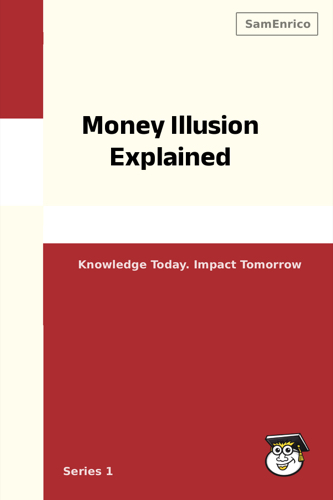
Money Illusion Explained eBook
Distinguishes nominal from real value.
by Holden Kory
Distinguishes nominal from real value.
Formats
Free sample
Chapter 1: The Shrinking Ruler...--Imagine waking up tomorrow to discover that every ruler in the world had shrunk overnight. Your twelve-inch ruler now measures exactly eleven inches. Your tape measure in the garage? Also eleven inches. The measuring stick the grocery store uses to price produce by the foot?
Eleven inches. Every single measurement tool on the planet has uniformly contracted by one inch.What would happen?At first, you might not notice. You would measure your child's height and exclaim, "My goodness, you've grown an inch overnight!" You would measure your living room for new furniture and think, "This room is getting larger!" You would step on a scale that now reads ten percent heavier because the internal measuring spring also shrank, and you would panic about mysterious weight gain.But eventually—probably quite quickly—you would figure it out. You would compare your shrunken ruler to an object you knew hadn't changed, like the width of a standard doorframe or the length of your kitchen counter. You would realize: The ruler changed.
The world did not.Now here is the disturbing question this entire book will answer: Why do we not do the same thing with money?Because the dollar is a ruler. It is a measuring stick for value. And just like that imaginary ruler, the dollar changes length constantly. Sometimes it shrinks a little each year—two percent, three percent, five percent. Sometimes it shrinks a lot—ten percent, twenty percent, fifty percent.
And in extreme cases, it shrinks so fast that by the time you finish reading this sentence, your cash has lost measurable purchasing power.But unlike the physical ruler, when the dollar shrinks, we do not blame the measuring stick. We blame the things being measured. Milk is more expensive? Blame the dairy farmers. Rent went up?
Blame the landlord. A car costs twice what it did a decade ago? Blame greedy corporations.This is the Money Illusion. And it is the single most expensive cognitive error you will ever make.The Great Misdiagnosis Every time prices rise across the economy—not just for one good, but broadly—people look for someone to blame. The list of usual suspects is remarkably consistent across centuries and countries: greedy businessmen, hoarders, speculators, unions, foreign producers, and most recently, "corporate greed" or "supply chain disruptions."These explanations have one thing in common.
They are all wrong.Not partially wrong. Not oversimplified. Wrong in a way that fundamentally misunderstands what inflation actually is. And this misunderstanding is not innocent—it is actively exploited by the very institutions that benefit most from your confusion.Let us be precise. The common person sees the price of bread rise from two dollars to three dollars and thinks, "The baker got greedy." But the baker sees the price of flour, yeast, salt, electricity, rent, and labor all rising simultaneously.
The baker is not getting richer—the baker is struggling to maintain the same real income while the numbers on the price tag chase a moving target.The landlord raising rent is not evil. The landlord has a mortgage payment that is fixed in nominal dollars but a maintenance cost that rises with inflation, a property tax bill that rises with assessed values, and a need to eat food whose price is also rising. The landlord is not winning. The landlord is treading water.The automobile manufacturer charging twice what it did a decade ago is not running a conspiracy. That manufacturer buys steel, aluminum, copper, rubber, glass, silicon chips, and labor—all of which have risen in nominal price because the dollar used to buy them has shrunk.When you blame the seller for rising prices, you are doing exactly what the Continental Congress did in 1779.
You are blaming the messenger for the message. You are blaming the thermometer for the fever.The Ruler, Revisited Let us return to our shrinking ruler for a moment because this analogy is the key that unlocks everything else in this book.Imagine you are a baker in a small town. You sell loaves of bread. For years, a loaf has cost one dollar. The town uses standard twelve-inch rulers.
Everything is stable.Then one day, every ruler in town shrinks to eleven inches. Not just the rulers in shops—every ruler. The one in the school, the one at the lumberyard, the one the tailor uses to measure inseams. All of them.What happens to the reported height of the town's children? They all appear to have grown by one inch overnight.
What happens to the reported length of every piece of lumber? It appears to have grown. What happens to the reported distance between two points? It appears to have increased.But nothing actually changed. The world is exactly as it was.
Only the measuring stick changed.Now here is where the analogy becomes precise. When the dollar shrinks—when the Federal Reserve increases the money supply faster than the economy produces new goods and services—every price measured in dollars appears to rise. But the underlying reality has not changed. The same number of loaves of bread exist. The same number of houses exist.
The same number of haircuts exist. Only the numbers attached to them have changed.Inflation is not prices going up. Inflation is the dollar going down.This is not a semantic distinction. It is the difference between seeing the world clearly and seeing it through a funhouse mirror. If you believe inflation is "prices going up," you will demand price controls (which create shortages), attack "greedy" corporations (which destroys the incentive to produce), and blame foreign countries (which distracts from domestic monetary policy).If you understand that inflation is "the dollar going down," you will ask very different questions.
How fast is the money supply growing? What is the central bank doing? How can I protect my purchasing power? These are the questions of someone who sees through the illusion.Relative Prices vs. Absolute Inflation Before we go further, we must make a critical distinction.
It is so important that misunderstanding it is the primary reason otherwise intelligent people fall for the Money Illusion.Some price changes are real. They carry information about the actual world. And some price changes are nominal. They carry information only about the currency.A relative price change happens when one good becomes more or less expensive compared to other goods because of changes in supply or demand. When a drought destroys the wheat crop, the price of bread rises relative to the price of milk.
That is real information. It tells you that wheat has become scarcer. It signals farmers to plant more wheat next year. It signals consumers to eat more rice and less bread. The price system is working exactly as it should.An absolute inflation happens when the general price level rises because the currency is losing value.
When the money supply doubles and every price doubles, no new information is transmitted. The wheat crop is unchanged. The milk supply is unchanged. The only thing that changed is the measuring stick.The Money Illusion tricks you into treating absolute inflation as if it were a series of relative price changes.…
This is the end of the free sample. Get the eBook to keep going. Buy now
About this book
Details
- Author
- Holden Kory
- Publisher
- SamEnrico
- Language
- English
- Genre
- Non-Fiction, Business Brief, Inflation
- Released
- 2026-06-06
- Pages (approx.)
- 155
- Available as
- eBook, Audiobook

Read better in the ZLOADR app
Your eBooks on your phone or tablet. Sign in with your SamEnrico account and start reading.
More by Holden Kory
 The Angry Parent Recovery PlanHolden Kory$11.99
 Portuguese Colonial WarsHolden Kory$11.99
 Empty Nest Relationship GuideHolden Kory$11.99
 From Immigrant To Ceo Success GuideHolden Kory$11.99
 The Assertiveness for Renters GuideHolden Kory$11.99
 Partner Emotion MirrorHolden Kory$11.99
 Heidi Roizen TCVHolden Kory$11.99
 Government of India Act 1858Holden Kory$11.99
 The Last Telegram: The Secret War of the CodebreakersHolden Kory$11.99
 Black Gold & Blood: The Untold Story of the First Coffee HeistHolden Kory$11.99
 The Marble Phantoms: Canova’s Ghostly PerfectionHolden Kory$11.99
 Growing LiatrisHolden Kory$11.99
You may also like
 Hong Kong Handover 1997Dunn Johnnie$11.99
 Zumba For Postnatal Recovery CourseNeal Christian$11.99
 Zumba for BeginnersLadner Nikia$11.99
 YouTube Comment Mining GuideHumes Pandora$12.99
 Worry Box MeditationCarlin Rudy$11.99
 Workplace Stress MeditationNguyen Lynn$11.99
 Workplace Stress and Sleep RepairHawley Ivory$11.99
 Workplace Perfectionism CureDelaney Jeffry$11.99
 Workplace Injustice Anger GuideWallen Isabelle$11.99
 Work Addiction and Burnout LinkGreenwood Ester$11.99
 Women in Yoga and WellnessBeattie Galina$11.99
 Women in Stand Up ComedyChun Evangeline$11.99