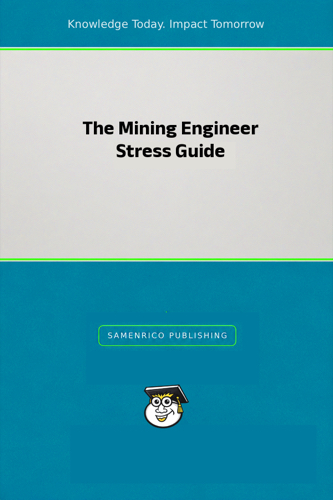
Mining Engineer Stress Guide eBook
Underground safety and production pressure.
Underground safety and production pressure.
Formats
Free sample
Chapter 1: The 3 AM Truth...–- The phone rings at 3:17 AM. You are already awake. You have been awake since 2:45, staring at the ceiling, running the numbers in your head for the fourteenth time. The stope is undercut. The hanging wall has been reporting spalling for three shifts.
The geotechnical monitor pinged a 1.8 millimeter displacement at midnight—double the alert threshold—but the overnight shift boss said it looked “probably fine.” The mine manager left a voicemail at 6 PM: “We need 1,200 tonnes out of that stope by morning shift or we miss the shipping deadline. Do what you need to do.”You are a production engineer. You have a degree in mining engineering. You have seven years underground. You have sat through forty-seven safety briefings.
You have signed thirty-one risk assessments. And right now, at 3:18 AM, with the phone buzzing against your nightstand, you are about to make a decision that will be logged in someone’s accident report if it goes wrong, or buried in production data if it goes right.You pick up the phone.The voice on the other end says: “Boss, the ground is talking. We’ve got new hairline cracks along the western rib. The drill sound changed about an hour ago—went from solid to that hollow ring you told us to watch for. I think we should stop.”And you have ten seconds to answer.The Weight of the Answer Every mining engineer knows this moment.
It comes at different times—sometimes at 3 AM, sometimes at 3 PM, sometimes in the middle of a shift change when the outgoing shift boss shrugs and says “seemed fine to me” and walks away. But it always comes. It is the moment when production pressure collides with ground conditions, and the engineer becomes the only person in the mine whose job is to say “no.”This book is about that moment. It is about the ten seconds between the warning and the answer. And it is about everything that leads up to those ten seconds—the mine design that created the stress, the bonus scheme that rewards the wrong behavior, the generational conflict that silences the youngest voice on the crew, and the slow, grinding exhaustion that makes “probably fine” sound like a reasonable answer at 3 AM.But let us start with a truth that most mining engineering textbooks will not tell you: the physical danger of underground mining is not the primary source of your stress.That sounds counterintuitive.
You work in an environment where the rock above your head weighs tens of thousands of tonnes. You breathe air that is circulated through kilometers of tunnels. You are surrounded by diesel equipment, explosives, and high-voltage cables. The physical danger is real. It is measurable.
It is the reason you wear a hard hat, a self-rescuer, and steel-toed boots.But the physical danger is not what keeps you awake at 3 AM.What keeps you awake is the tension between what you know is safe and what you are being paid to produce. It is the cognitive dissonance of believing in safety with your whole heart while acting for production with your whole schedule. It is the slow, corrosive awareness that every time you approve a “shortcut” to make tonnage, you are not just bending a rule—you are bending your own identity as someone who protects people.This is the 3 AM truth. And until you name it, you cannot manage it.The Real Stressor Is Not the Rock—It Is the Conflict Let us define our terms clearly. Stress is not the same as danger.
Danger is the presence of a physical threat—a loose hanging wall, a rising water level, a buildup of explosive gas. Danger triggers a physiological response: increased heart rate, dilated pupils, redirected blood flow. That response is called acute stress, and it is designed to help you survive. Your body floods with cortisol and adrenaline. Your senses sharpen.
You react.But the stress that burns out mining engineers is not acute stress from immediate danger. It is chronic stress from unresolved conflict—specifically, the structural conflict between safety and production.Here is the distinction. In a well-designed mine with adequate resources, a dangerous situation is met with a clear protocol: stop work, secure the area, remediate the hazard, resume work. The acute stress lasts minutes or hours. It resolves.
The engineer goes home tired but intact.In a mine where production pressure overrides safety protocols, a dangerous situation is met with a different response: stop work, report the hazard, receive pressure from management to resume, recalculate the risk with more optimistic numbers, approve a “limited entry” with “additional controls,” watch the hazard worsen, and finally—hours or days later—admit that the stop should have happened immediately. The chronic stress lasts days or weeks. It does not resolve. It accumulates.The difference is not the rock. The rock is the same.
The difference is the organizational and psychological environment in which the engineer operates.This book is built on a hierarchy of stress causes that will appear throughout every chapter. You need to understand this hierarchy before we go any further, because it explains why the solutions in this book are organized the way they are.The Stress Cascade: From Budget to Breakdown After analyzing dozens of mining stress cases across six continents and interviewing engineers who left the industry, one pattern emerges with brutal consistency. Stress does not begin at the rock face. It begins in the budget office. Here is the cascade:Level 1: Under-resourcing.
The mine operates with a budget that cuts preventive maintenance, reduces geotechnical monitoring, delays spare parts orders, and holds open positions unfilled. This is not malice—it is usually the result of commodity price cycles, corporate pressure, or simple math. But the effect is the same: the engineer begins each shift with fewer tools than needed.Level 2: Production pressure. Because resources are tight, every tonne matters. The mine manager sets targets that assume perfect conditions—no equipment failures, no ground delays, no crew absences.
When reality intervenes (as it always does), the production gap must be closed by someone. That someone is the engineer.Level 3: Corner-cutting. Faced with impossible targets and inadequate resources, the engineer begins to “make a plan.” A bolting pattern is reduced from four bolts per meter to three. A scaling inspection is shortened from fifteen minutes to five. A ventilation check is deferred until after the shift.
Each cut is small. Each cut feels justified. Each cut is logged in the engineer’s memory as a debt they will pay later.Level 4: Unpredictable ground conditions. The corner-cutting creates feedback loops. When bolting is reduced, the ground behaves differently.
When inspections are shortened, small warnings are missed. When ventilation is deferred, air quality degrades. The engineer, who was trying to save time, now spends more time managing unexpected failures.Level 5: Chronic hyper-vigilance. The engineer learns that the ground is no longer predictable. The warning signs that used to mean “stop” now mean “maybe.” The crew looks to the engineer for decisions that should be clear but are now ambiguous.
The engineer’s brain enters a state of constant alert—waiting for the next failure, scanning for the next warning, rehearsing the…
This is the end of the free sample. Get the eBook to keep going. Buy now
About this book
Details
- Author
- Mathews Alisa
- Publisher
- SamEnrico
- Language
- English
- Genre
- Non-Fiction, Self-Help, Mining
- Released
- 2026-06-07
- Pages (approx.)
- 154
- Available as
- eBook, Audiobook

Read better in the ZLOADR app
Your eBooks on your phone or tablet. Sign in with your SamEnrico account and start reading.
More by Mathews Alisa
 The Dual Citizenship CeremonyMathews Alisa$11.99
 Self Hypnosis for ResilienceMathews Alisa$11.99
 Destroyer Crew VeteransMathews Alisa$11.99
 The Courtly Harmonies: How Western Aristocracy Shaped the Classical CanonMathews Alisa$11.99
 How to Become a Pad-machine OffbearerMathews Alisa$11.99
 Sub Saharan Freemium StrategyMathews Alisa$12.99
 How to Produce Binding SuppliesMathews Alisa$11.99
 AEM ArchitectMathews Alisa$11.99