
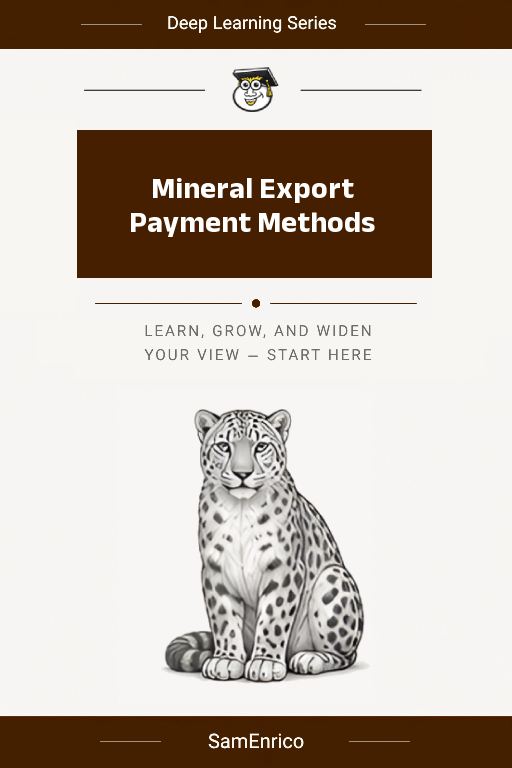
Mineral Export Payment Methods eBook
Handle cross-border payments for gold, cobalt, cop
Handle cross-border payments for gold, cobalt, copper, and lithium exports with chain-of-custody and provenance tracking.
Formats
Free sample
Chapter 1: The $47 Million Mistake...--–- The container ship MSC Alexandra had been steaming toward Rotterdam for seventeen days when the email arrived. It was 2:47 AM in Antwerp, 8:47 PM in Kinshasa, and somewhere in between, a forty-seven-million-dollar chain of trust snapped.The cargo was cobalt hydroxide – 1,200 wet metric tons, supposedly mined from a conflict-free site in Lualaba Province, processed at a certified facility, and sealed with tamper-evident tags witnessed by a reputable inspection company. The buyer, a European battery materials group, had paid a 15% premium for “fully verified provenance.” The exporter, a mid-sized Congolese trading house, had spent six months building a chain-of-custody system that would satisfy OECD guidelines, EU regulations, and the buyer’s own exacting ESG standards.The assay results attached to that 2:47 AM email told a different story.The cobalt wasn’t from Lualaba. The isotopic fingerprint matched a known artisanal mining zone three hundred kilometers away – a zone flagged for child labor, unsafe working conditions, and active smuggling networks. The tags had not been tampered with.
The seals were intact. The paperwork was flawless. And yet, somewhere between the mine gate and the shipping container, every single bag had been swapped.The buyer refused payment. The exporter faced immediate insolvency. The cobalt sat in a Rotterdam warehouse for fourteen months while lawyers fought over jurisdiction, force majeure clauses, and who bore the risk of “undetectable substitution.” By the time the courts ruled, the market price had dropped 22%.
Both sides lost. The only winner was the fraudster, who had long since disappeared.This book exists because of that shipment, and a thousand others like it.The Paradox at the Heart of Mineral Trade Here is the uncomfortable truth that no one says out loud at industry conferences: you cannot pay for what you cannot prove. For most of human history, mineral trade operated on a simple premise – trust the person in front of you, verify the documents when they arrive, and sort out disputes after the fact. That model, which we might call “Trust but Verify,” worked reasonably well when supply chains were short, counterparties knew each other for decades, and the only thing that mattered was weight.Those days are over.Today’s critical mineral supply chains span seven, eight, or nine jurisdictions. The gold in a single London Good Delivery bar might have originated in four different artisanal mines, been aggregated by two different cooperatives, and processed at a refinery that sources from seventeen countries simultaneously.
The copper cathode labeled “Chilean origin” might actually contain concentrate from a Peruvian mine with a suspended license. The “conflict-free” cobalt might have passed through a trader in Rwanda who commingled bags without telling anyone.The traditional payment instruments – Letters of Credit, Documents against Payment, open account terms – were designed for a world where the Bill of Lading was the ultimate proof. But a Bill of Lading proves quantity, not quality. It proves weight, not provenance. It proves that a container was sealed at the port of origin, but not what was inside it when the seal was applied.This mismatch between what buyers actually need to know and what traditional documents actually prove creates what I call The Entropy of Payment – the fundamental uncertainty that flows from geological assays, propagates through financial contracts, and ultimately determines everything from your payment terms to your interest rate to whether your bank will finance the shipment at all.What This Book Will Do For You If you are reading these words, you already know that mineral exports are different from selling soybeans or steel pipes.
The assay destroys the sample. The value is probabilistic until the furnace confirms it. The chain of custody can be broken by a single dishonest employee with a roll of replacement tags.This book is not an academic treatise. It is an operational manual for people who actually move minerals across borders – exporters, traders, financiers, compliance officers, and logistics providers who wake up at 3:00 AM wondering if the shipment that just left the port will ever result in a settled payment.Over the next twelve chapters, we will build a complete framework for mineral export payments, from the basic building blocks of provenance architecture to the cutting edge of smart contract escrow and stablecoin settlements. You will learn:How to audit a supplier’s chain-of-custody system and identify the weak points where fraud typically occurs (Chapter 2)Why traditional Letters of Credit fail on quality, and how to write “Green L/Cs” that require Digital Product Passports (Chapter 3)The true cost of “orphaned assets” – the dead period between shipment arrival and final assay – and how pre-export finance can unlock capital days or weeks earlier (Chapter 4)When to use blockchain-based escrow vs.
traditional escrow, with a master taxonomy of smart contract triggers (Chapter 5)How stablecoins can settle million-dollar trades in hours instead of days, without triggering compliance red flags (Chapter 6)Why gold is fundamentally different from base metals, and why confusing doré with refined bars has cost traders millions (Chapter 7)How to write ESG and AML triggers directly into your payment terms, so compliance failures automatically freeze or reduce payment (Chapter 8)The right way to pay artisanal miners without creating conflict mineral exposure, including the distinction between verified aggregation points and unverified aggregators (Chapter 9)The three most common fraud schemes – high-grade trap, tag swap, and transshipment smuggle – and how to detect each one before you release payment (Chapter 10)How to structure a three-tranche payment that aligns incentives, reduces your cost of capital, and protects both buyer and seller (Chapter 11)Where the industry is going – autonomous supply chains where Io T sensors trigger instant machine-to-machine payments without human intervention (Chapter 12)But before we get to any of that, we need to understand the landscape we are operating in. The risks. The regulations. The sheer scale of what is at stake.The Size of the Prize (and the Risk)Let us start with numbers, because numbers focus the mind.In 2024, global trade in the four minerals covered in this book – copper, lithium, cobalt, and gold – exceeded 800billion.Copperaloneaccountsforroughly800 billion. Copper alone accounts for roughly 800billion.Copperaloneaccountsforroughly350 billion annually, driven by the electrification of everything from cars to grid infrastructure.
Lithium, the smallest of the four by volume but the fastest-growing, has seen its trade value increase sixfold since 2019 as battery gigafactories scramble for supply. Cobalt, the troubled cousin, hovers around 30billionbutcarriesoutsizedreputationalriskbecauseofitsconcentrationinthe Democratic Republicof Congo.Andgold,theoldking,remainsabove30 billion but carries outsized reputational risk because of its concentration in the Democratic Republic of Congo. And gold, the old king, remains above 30billionbutcarriesoutsizedreputationalriskbecauseofitsconcentrationinthe Democratic Republicof Congo.Andgold,theoldking,remainsabove200 billion in annual physical trade, not counting derivatives or ETF flows.For every dollar of mineral that crosses a border, roughly twelve cents is spent on financing, verification, insurance, and dispute resolution. That is nearly $100 billion annually in transaction costs. Some of that is necessary – assays cost money, inspectors need to eat, lawyers have billable hours.
But a significant portion is waste: duplicated verification, delayed payments that force expensive bridge loans, disputed assays that tie up capital for months, and outright fraud that never gets recovered.The regulatory pressure is increasing faster than most market participants realize. The European Union’s Critical Raw Materials Act…
This is the end of the free sample. Get the eBook to keep going. Buy now
About this book
Details
- Author
- Noble Milford
- Publisher
- SamEnrico
- Language
- English
- Genre
- Non-Fiction, Business Brief
- Released
- 2026-06-01
- Pages (approx.)
- 155
- Available as
- eBook, Audiobook

Read better in the ZLOADR app
Your eBooks on your phone or tablet. Sign in with your SamEnrico account and start reading.
More by Noble Milford
 CIA Operations Officer StressNoble Milford$11.99
 The Imposter Syndrome WorkbookNoble Milford$11.99
 The IBS Flare Recovery PlanNoble Milford$11.99
 Cultural Expectations and Parental AngerNoble Milford$11.99
 The Values And Mission Alignment RemoteNoble Milford$11.99
 The Stone Weavers of Great Zimbabwe: Builders of a Kingdom in StoneNoble Milford$11.99
 How to Start a Double Glazing (retail) Business (Beginners Guide)Noble Milford$11.99
 Free Landing Page ValidationNoble Milford$12.99
 Understanding ThrombastheniaNoble Milford$17.99
 RecyclerNoble Milford$11.99
You may also like
 Hong Kong Handover 1997Dunn Johnnie$11.99
 Zumba For Postnatal Recovery CourseNeal Christian$11.99
 Zumba for BeginnersLadner Nikia$11.99
 YouTube Comment Mining GuideHumes Pandora$12.99
 Worry Box MeditationCarlin Rudy$11.99
 Workplace Stress MeditationNguyen Lynn$11.99
 Workplace Stress and Sleep RepairHawley Ivory$11.99
 Workplace Perfectionism CureDelaney Jeffry$11.99
 Workplace Injustice Anger GuideWallen Isabelle$11.99
 Work Addiction and Burnout LinkGreenwood Ester$11.99
 Women in Yoga and WellnessBeattie Galina$11.99
 Women in Stand Up ComedyChun Evangeline$11.99