
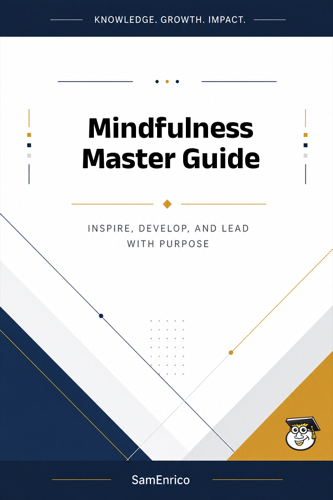
Mindfulness Master Guide eBook
Complete reference for meditation and pain managem
by Leyva Karin
Complete reference for meditation and pain management.
Formats
Free sample
Chapter 1: The Two Arrows...--The first time you felt it, you probably thought it would go away. A twinge. A pull. A burning sensation that you could dismiss as a fluke, a strained muscle, a bad night’s sleep. You took a hot shower, stretched, maybe popped an ibuprofen.
And for a while, that worked. But then the twinge came back. It stayed longer. It brought friends. And somewhere along the way—perhaps on a morning when you woke up and realized you couldn't remember the last day you felt nothing—the pain stopped being an event and became a condition.
It became the backdrop of your life. The quiet hum beneath every thought, every plan, every hope.If you are reading this book, you already know that pain is more than a sensation. It is a thief. It has stolen your sleep, your patience, your ability to focus on a conversation without wincing, your willingness to make plans next week because you don't know what your body will feel like. It has strained your relationships, eroded your confidence, and forced you to cancel so many commitments that you've stopped making them in the first place.
You are exhausted—not just from the pain itself, but from the constant vigilance against it. The strategies you have tried—ignoring it, fighting it, numbing it, bargaining with it—have all failed. And now, you may be doing the most dangerous thing of all: you are starting to believe that this is simply who you have become.Stop right there.This chapter makes a radical promise, and it will be the foundation for everything that follows in this book. Here it is: The physical sensation of pain is not the same thing as the suffering you feel about that pain. These two experiences—raw sensation and emotional suffering—are processed by entirely different circuits in your brain.
They can be separated. And once you learn to see that separation with your own direct experience, you will have taken the single most important step toward reclaiming your life.This is not positive thinking. This is not denial. This is not pretending the pain doesn't exist. It is, instead, a precise and practical skill: the ability to hold pain in awareness without being consumed by the fear, rage, and catastrophic stories that usually accompany it.
The Buddhist tradition calls this the teaching of the two arrows. The first arrow is the physical sensation of pain—inevitable, universal, part of being alive in a body. The second arrow is the one we shoot into ourselves: the resistance, the catastrophizing, the "why me," the narrative of a ruined future, the belief that we cannot handle what is happening. And here is the truth that changes everything: you cannot stop the first arrow, but you have been pulling the trigger on the second arrow yourself.This chapter will teach you to see that process clearly. It will dissect the neurophysiology of the pain-mind loop that has been keeping you stuck.
It will introduce the concept of the anticipatory flinch—a muscular and psychological contraction that actually creates much of the pain you fear. And it will give you a single, transformative question—a question you can ask yourself in any moment of suffering—that will begin the lifelong practice of separating sensation from story. By the end of this chapter, you will not be pain-free. That is not the goal. But you will see your pain differently.
And that difference—between fighting a monster and observing a weather pattern—is the difference between suffering and simply feeling.The Architecture of an Illusion: Why Pain Is Not What You Think It Is Let us begin with a surprising fact that most people never learn: pain is not a direct transmission from your body to your brain. There is no cable running from your lower back to your cerebral cortex. There is no little red light that turns on in your knee when you twist it. Instead, pain is an inference—a best guess that your brain makes about what is happening in your body, based on a messy, incomplete, and often delayed stream of data.Here is how it actually works. When you injure a tissue—say, you stub your toe or strain a ligament—specialized nerve endings called nociceptors send a signal up your spinal cord toward your brain.
But that signal is not "pain." It is simply a burst of electrochemical activity: something has changed, and it might be dangerous. That signal travels to the thalamus, a sort of relay station in the center of your brain, which then distributes the information to several different regions simultaneously. One region, the somatosensory cortex, maps the location and intensity of the sensation. Another region, the anterior cingulate cortex, evaluates how unpleasant or distressing that sensation is. A third region, the prefrontal cortex, interprets what the sensation means in the context of your life, your memories, and your fears.Your conscious experience of pain—the thing you actually feel—is the result of these regions talking to one another.
And crucially, that conversation is shaped by factors that have nothing to do with your toe. Your mood matters. Your expectations matter. Your past experiences with pain matter. Whether you feel safe or threatened in this moment matters.
The brain asks: Have I felt this before? What happened next? Is there danger nearby? Am I alone? Then it synthesizes all of that data into a single, coherent output: pain.This is why two people with identical injuries can have wildly different experiences of pain.
This is why the same injury can feel unbearable when you are exhausted or anxious and merely annoying when you are rested and calm. This is not "all in your head" in the dismissive sense—the sensation is real, the nociceptive signal is real. But the experience of pain is always, inevitably, constructed by your brain. And because your brain built it, your brain can learn to rebuild it.The most powerful evidence for this comes from neuroimaging studies of chronic pain patients. When researchers compare the brain scans of people with chronic back pain to those of healthy controls, they do not see a simple "pain signal" lighting up.
Instead, they see a whole network of regions involved in attention, emotion, memory, and threat detection all firing together in a coordinated loop. Over time, this network becomes more efficient—like a path through a forest that becomes a highway after enough traffic—until the brain generates the experience of pain even when the original injury has long since healed. This is called neuroplasticity, and it can work for you or against you. Against you, it locks in chronic pain. For you, it offers a path out.The Two Arrows: A Teaching for Our Time The ancient Buddhist parable of the two arrows captures this neurological reality with startling precision.
The Buddha famously asked his followers: "When a person is struck by an arrow, does it hurt?" They answered yes. "And when that same person is struck by a second arrow immediately afterward, does it hurt more?" Again, yes. Then the Buddha revealed the teaching: the first…
This is the end of the free sample. Get the eBook to keep going. Buy now
About this book
Details
- Author
- Leyva Karin
- Publisher
- SamEnrico
- Language
- English
- Genre
- Non-Fiction, Health & Wellness, Complete
- Released
- 2026-06-09
- Pages (approx.)
- 139
- Available as
- eBook, Audiobook

Read better in the ZLOADR app
Your eBooks on your phone or tablet. Sign in with your SamEnrico account and start reading.
More by Leyva Karin
 Widow Guilt Release GuideLeyva Karin$11.99
 Imposter Remote Work FixLeyva Karin$11.99
 Bloodstain Pattern Reconstruction CasesLeyva Karin$11.99
 Pomodoro for TeachersLeyva Karin$11.99
 Natalie Portman Child ProfessionalLeyva Karin$11.99
 Disaster Preparedness Disability AdvocateLeyva Karin$11.99
 Peg System For PresidentsLeyva Karin$11.99
 The Last Broadcast: Orson Welles and the War of the Worlds PanicLeyva Karin$11.99
 The Bloodhound of Sydney Cove: A K9’s War on the Sicilian UnderworldLeyva Karin$11.99
 Research Proposal Resubmission Strategy GuideLeyva Karin$12.99
 College Application Essay EthicsLeyva Karin$12.99
 Mastering The Posterior DeltoidLeyva Karin$11.99
You may also like
 Men's Master GuideGass Viviana$11.99
 Injury Master GuideStuckey Berenice$11.99
 Macronutrient Master GuideTillery Carlita$11.99
 Sleep Master GuideDesantis Dominique$11.99
 PCOS Master GuideOtoole Sierra$11.99
 Flexibility Master GuideSamples Lawrence$11.99
 IBS Master ReferenceBolin Meryl$11.99
 Hormonal Master GuideOswald Elda$11.99
 Food Intolerances Complete GuideTitus Earleen$11.99
 Beginner Fitness MasterSharkey Vinita$11.99
 Napping Complete Health GuideEnnis Laronda$11.99
 Group Fitness MasterHolly Lashawnda$11.99