
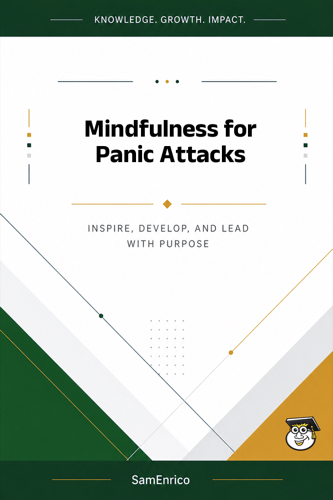
Mindfulness for Panic Attacks eBook
Grounding scripts to use during acute panic episod
by Alves Janee
Grounding scripts to use during acute panic episodes for safety.
Formats
Free sample
Chapter 1: The Smoke Detector...--–- You are not dying.Let me say that again, because your body is telling you the opposite right now, or it will the next time panic arrives: you are not dying. Your heart is not about to stop. You are not having a stroke. You are not going crazy. You are not losing control in any permanent or dangerous way.What you are experiencing is a biological false alarm.
It feels like an earthquake because, inside your nervous system, it is an earthquake—but it is an earthquake with no epicenter, no damage, and no lasting consequence except the memory of having felt it. The problem is that your brain does not know the difference between a real threat and a remembered threat, and when it misfires, it does so with the full force of a system designed to save your life from a predator that does not exist.This chapter will dismantle the single most damaging belief about panic attacks: that they mean something is wrong with you. They do not. They mean your amygdala—a tiny, almond-shaped cluster of neurons deep in your brain—has learned to sound the fire alarm for burnt toast. That is all.
And once you understand this, you have already taken the first and most important step toward freedom: you have stopped fighting the alarm and started reading its manual.The Body's Smoke Detector Let us begin with a simple analogy you will remember even when your heart is pounding at 140 beats per minute.Imagine your brain has a smoke detector. This is your amygdala. Its only job is to detect threats. It does not think. It does not reason.
It does not ask questions like, "Is this actually a fire or just someone burning popcorn?" It just senses something unusual—a rapid heartbeat, a dizzy spell, a tight chest—and screams.In a real fire, this smoke detector saves your life. It floods your body with adrenaline, speeds up your heart so blood moves faster to your muscles, dilates your pupils so you can see better in the dark, and shuts down non-essential systems like digestion and rational thinking. You are now a survival machine. This is the fight-or-flight response, and it is beautiful in its efficiency.Here is the problem. Your smoke detector cannot tell the difference between a real fire and a memory of a fire.
It cannot tell the difference between a racing heart caused by danger and a racing heart caused by too much coffee, a skipped meal, or simply the natural cortisol spike of waking up. It cannot tell the difference between dizziness from hyperventilation and dizziness from a brain tumor—because it does not have access to that information. It only has access to the signal: "Something is unusual. Sound the alarm."So it sounds the alarm. And now you are standing in your kitchen, or sitting in a meeting, or lying in bed at 4 AM, fully convinced that you are about to die, while your smoke detector screams at a perfectly safe, perfectly ordinary, perfectly explainable set of bodily sensations.That is a panic attack.
It is not a heart attack. It is not a stroke. It is not a sign of weakness. It is a false alarm.The Anatomy of a False Alarm Let me walk you through exactly what happens in your body during a panic attack, because naming the mechanism strips it of its terror.It begins with a trigger. The trigger can be anything—a thought ("What if I have a panic attack right now?"), a physical sensation (your heart skips a beat), an environmental cue (a crowded room where you once panicked before), or sometimes nothing at all.
The amygdala does not need a good reason. It just needs a signal.Once the amygdala sounds the alarm, it sends a distress signal to your hypothalamus, which activates your sympathetic nervous system—the gas pedal of your autonomic nervous system. Within seconds, your adrenal glands release a flood of adrenaline and cortisol.Now your body is in full fight-or-flight mode. Your heart rate jumps from 70 to 120 or higher. Your breathing becomes shallow and rapid because your body is trying to oxygenate your blood for sprinting.
Your palms sweat. Your mouth goes dry. Your pupils dilate. Blood rushes away from your stomach and toward your large muscles, which is why you might feel nauseous or have that "dropping" sensation in your gut. Your peripheral vision narrows.
Your rational brain—the prefrontal cortex—literally gets less blood flow, which is why thinking clearly becomes difficult.All of this happens in less than two seconds.Now here is where the panic loop begins. You feel your heart racing, and because you do not know it is just adrenaline, you think: "I am having a heart attack." That thought—a catastrophic interpretation—is detected by your amygdala as another threat. So it releases more adrenaline. Your heart races even faster. You think: "Now I am definitely dying." More adrenaline.
Faster heart. More terror.This is the panic loop: physical sensation → catastrophic interpretation → more adrenaline → worse physical sensation → even more catastrophic interpretation.The loop does not stop until one of two things happens. Either your body naturally metabolizes the adrenaline (which takes about 10–20 minutes), or you interrupt the loop by changing your interpretation of the sensation. The problem is that you cannot "think your way out" of a panic attack in the middle of it—not by arguing with yourself, not by repeating "I am safe" like a mantra, not by trying to reason with your amygdala. The amygdala does not process language.
It processes threat.But you can do something else. You can recognize the loop for what it is. You can name it. And naming it—simply saying "This is a false alarm"—engages just enough of your prefrontal cortex to gently put a finger on the amygdala's alarm button. Not to turn it off completely, but to turn down the volume.The Difference Between Panic and Emergencies Before we go any further, we need to address the question that every person with panic disorder asks: "But what if this time it is real?"This is a valid question.
Panic attacks mimic serious medical conditions. The chest pain, shortness of breath, racing heart, dizziness, and numbness can feel identical to a heart attack. So let me give you clear, practical guidelines for when to seek medical help—not because panic attacks are dangerous, but because your fear of missing a real emergency will keep you trapped in the panic loop.A panic attack typically peaks within 10 minutes and then begins to subside. A heart attack does not. If your symptoms come in waves, rise sharply, and then begin to fade after 10–15 minutes, that pattern strongly suggests panic.
If the pain is crushing, radiates to your jaw or left arm, and does not change with breathing or position, seek emergency care immediately.Panic attacks cause shortness of breath that feels like you cannot get enough air. However, if you can speak full sentences, you are getting enough oxygen. A true medical emergency involving your lungs (like a pulmonary embolism) typically…
This is the end of the free sample. Get the eBook to keep going. Buy now
About this book
Details
- Author
- Alves Janee
- Publisher
- SamEnrico
- Language
- English
- Genre
- Non-Fiction, Self-Help / Panic
- Released
- 2026-06-06
- Pages (approx.)
- 141
- Available as
- eBook, Audiobook

Read better in the ZLOADR app
Your eBooks on your phone or tablet. Sign in with your SamEnrico account and start reading.
More by Alves Janee
 Financial Stress for Restaurant WorkersAlves Janee$11.99
 Catherine Great Postal ReformAlves Janee$11.99
 Counseling Student StressAlves Janee$11.99
 The Visionaries of Stone and Sand: The Architectural Genius of the Swahili CoastAlves Janee$11.99
 Logit and Probit Models WorkbookAlves Janee$12.99
 How to Produce Auto Racing Fan AccessoriesAlves Janee$11.99
 Exploring Rock PoolsAlves Janee$11.99
 How to Become a PourerAlves Janee$11.99
You may also like
 Hong Kong Handover 1997Dunn Johnnie$11.99
 Zumba For Postnatal Recovery CourseNeal Christian$11.99
 Zumba for BeginnersLadner Nikia$11.99
 YouTube Comment Mining GuideHumes Pandora$12.99
 Worry Box MeditationCarlin Rudy$11.99
 Workplace Stress MeditationNguyen Lynn$11.99
 Workplace Stress and Sleep RepairHawley Ivory$11.99
 Workplace Perfectionism CureDelaney Jeffry$11.99
 Workplace Injustice Anger GuideWallen Isabelle$11.99
 Work Addiction and Burnout LinkGreenwood Ester$11.99
 Women in Yoga and WellnessBeattie Galina$11.99
 Women in Stand Up ComedyChun Evangeline$11.99