
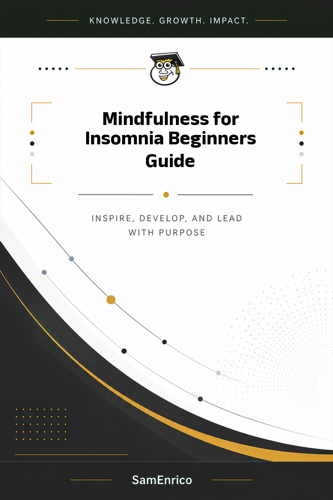
Non-FictionSelf-HelpSleep Hygiene
Mindfulness for Insomnia Beginners Guide eBook
Uses meditation to calm racing thoughts and prepar
Uses meditation to calm racing thoughts and prepare for sleep.
Formats
Free sample
Chapter 1: The 2 AM Club--–- The clock on your nightstand reads 2:47 AM. You have been awake for what feels like an eternity, though in reality it has been seventy-three minutes. Your mind is not merely active—it is performing a kind of tortured gymnastics, vaulting from the mistake you made at work yesterday to the awkward thing you said in 2017 to the email you forgot to send to the conversation you should have handled differently to the ominous sensation in your left shoulder that is almost certainly nothing but what if it is something? Your partner is breathing the slow, rhythmic breath of the deeply asleep. The dog, sprawled across the foot of the bed, occasionally twitches in pursuit of dream-squirrels.
The house is silent. The neighborhood is silent. The whole world, it seems, is asleep except for you.You are not alone. You are part of a vast, exhausted, and largely invisible fellowship: the 2 AM Club. Its members include executives and artists, new parents and retirees, nurses working night shifts and teachers lying awake before the first day of school.
They share no demographic profile except this one: they are bone-tired, and their brains will not shut off. If you are reading this book, you are almost certainly a card-carrying member. Welcome. The first thing you need to know is that you are not broken.The second thing you need to know is that the answer to your sleeplessness is not what you think. It is not a better mattress, though a good mattress helps.
It is not cutting out caffeine after 2 PM, though that also helps. It is not melatonin, or CBD, or chamomile tea, or a weighted blanket, or any of the dozens of products marketed to exhausted people who just want to sleep. These things are fine. They are not the solution. The solution is something far more counterintuitive, far more difficult, and far more effective: you must stop trying to fall asleep.The Nightmare of Mental Hyperarousal Let us name the enemy.
In the sleep medicine literature, the condition that plagues you is called mental hyperarousal. It is a state in which the brain remains excessively alert even when the body is exhausted. Your eyelids are heavy. Your limbs feel like sandbags. Your yawning is uncontrollable.
And yet your mind races as though it is 2 PM and you are trying to solve a complex problem under a deadline. This is not a failure of willpower. It is not a character flaw. It is a specific, measurable, physiological condition involving elevated levels of cortisol and adrenaline, increased metabolic rate in the brain's default mode network, and a sympathetic nervous system that refuses to stand down.Here is what happens, step by step. During the day, your brain is occupied.
Work, conversations, emails, news, social media, errands, chores—these external demands keep your attention directed outward. Your brain processes what it needs to process and ignores the rest. But at night, when the lights go out and the distractions fade, something shifts. With no external demands on your attention, your brain turns inward. And what does it find?
Everything you have been too busy to feel. The worry about your aging parents. The resentment about that comment your colleague made. The anxiety about your finances. The grief you have not fully processed.
The to-do list for tomorrow that never seems to end.Your brain's default mode network—the system that becomes active when you are not focused on an external task—lights up like a Christmas tree. It begins replaying memories, simulating future scenarios, and generating an endless stream of narrative. This is what your brain is designed to do. It is not malfunctioning. The problem is that this internal narrative becomes attached to emotion, and the emotion becomes attached to wakefulness, and the wakefulness becomes attached to anxiety about sleep itself.
Now you are not just awake. You are awake and worried about being awake. And that worry—that performance anxiety about sleep—is the gasoline on the fire.The Insult of Circadian Timing If you have ever wondered why you can fall asleep easily at 11 PM only to wake at 2 AM feeling strangely alert, the answer lies in your circadian rhythms. Your body runs on an internal clock that orchestrates rises and falls in alertness throughout the 24-hour day. Most people experience a natural dip in sleep drive—the biological pressure to sleep—in the early morning hours.
This dip is accompanied by a small, normal rise in cortisol, the stress hormone. For someone without insomnia, this is barely noticeable. They might stir slightly, roll over, and sink back into sleep. For someone with mental hyperarousal, however, that small cortisol spike is enough to push an already-alert brain into full wakefulness.This is the cruel trick of middle-of-the-night insomnia. The timing is not random.
It is built into your biology. You are not a bad sleeper. You are a normal human whose brain has learned a pattern of vigilance that the rest of the population has not. The good news—and there is good news, I promise—is that patterns can be unlearned. The brain is plastic.
It changes with experience. What you are about to learn in this book is not a collection of pleasant relaxation techniques. It is a systematic retraining of your brain's relationship with wakefulness, with thoughts, and with sleep itself.The Performance Anxiety Trap Here is the most important concept in this entire book, so I want you to read it twice. Ready? Trying to fall asleep is the single most reliable way to stay awake.
I will say it again: trying to fall asleep is the single most reliable way to stay awake.Think about what happens when you decide that you absolutely must fall asleep. Maybe you have an important meeting tomorrow. Maybe you only have four hours before the alarm goes off. Maybe you have already had three bad nights in a row and you cannot afford another one. So you lie there, and you try.
You command your brain to be quiet. You demand that your body relax. You mentally rehearse the steps of falling asleep as though it were a recipe you could follow. And the result? Your nervous system interprets this effort as a threat.
Sleep becomes a high-stakes performance. Your sympathetic nervous system—the fight-or-flight response—activates. Cortisol surges. Your heart rate increases. Your muscles tense.
You are now physiologically incapable of sleep, and you are also furious about it.This is the insomnia loop. It looks like this: you are tired, so you worry about not sleeping. The worry triggers a stress response. The stress response creates alertness. The alertness prevents sleep.
The lack of sleep makes you more tired. And the cycle begins again, tighter and more destructive each time. The only way out is to break the loop at its weakest point: the worry about not sleeping. But you cannot simply decide to stop worrying. Worry is not a light switch.
You need a different strategy entirely. You need to learn how to let go of the goal of falling asleep. You need to learn how to rest without demanding…
This is the end of the free sample. Get the eBook to keep going. Buy now
About this book
Details
- Author
- Byrne Margarite
- Publisher
- SamEnrico
- Language
- English
- Genre
- Non-Fiction, Self-Help, Sleep Hygiene
- Released
- 2026-06-06
- Pages (approx.)
- 133
- Available as
- eBook, Audiobook

Read better in the ZLOADR app
Your eBooks on your phone or tablet. Sign in with your SamEnrico account and start reading.
More by Byrne Margarite
 Gratitude for Past SelfByrne Margarite$11.99
 Senior Gratitude Esteem GuideByrne Margarite$11.99
 Emotional Intelligence for BurnoutByrne Margarite$11.99
 Birthday Without PartyByrne Margarite$11.99
 The Lioness of Djenne: The Untold Love and War of Queen TassaditByrne Margarite$11.99
 Understanding Myocardium DisorderByrne Margarite$17.99
 Interest Formula HandbookByrne Margarite$12.99
 Amazon SWOT Analysis Library GuideByrne Margarite$12.99
 How to Become a Label RemoverByrne Margarite$11.99
 Automotive Finance And Insurance ManagerByrne Margarite$11.99
You may also like
 Hong Kong Handover 1997Dunn Johnnie$11.99
 Zumba For Postnatal Recovery CourseNeal Christian$11.99
 Zumba for BeginnersLadner Nikia$11.99
 YouTube Comment Mining GuideHumes Pandora$12.99
 Worry Box MeditationCarlin Rudy$11.99
 Workplace Stress MeditationNguyen Lynn$11.99
 Workplace Stress and Sleep RepairHawley Ivory$11.99
 Workplace Perfectionism CureDelaney Jeffry$11.99
 Workplace Injustice Anger GuideWallen Isabelle$11.99
 Work Addiction and Burnout LinkGreenwood Ester$11.99
 Women in Yoga and WellnessBeattie Galina$11.99
 Women in Stand Up ComedyChun Evangeline$11.99