
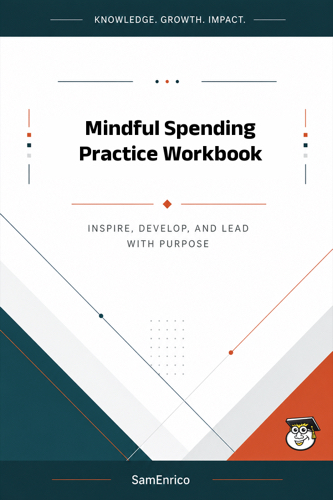
Non-FictionSelf-HelpMindful Consumption
Mindful Spending Practice Workbook eBook
Trains delayed purchasing, pre-purchase reflection
Trains delayed purchasing, pre-purchase reflection questions, and spending audits.
Formats
Free sample
Chapter 1: The Receipt That Changed Everything--You are not bad with money. You are being hunted by machines designed to outsmart your brain.Before we open a single workbook page, before you answer a single reflection question, before you log your first purchase, we need to name the enemy. Because the moment you blame yourself for every impulse buy, you lose. The moment you say "I have no willpower" or "I'm just bad with money," you hand victory to an opponent you don't even know exists.That opponent is not your credit card company. It is not your student loans.
It is not your rent or your grocery bill.Your opponent is the trillion-dollar attention economy that has turned your smartphone, your email inbox, and your social media feed into a slot machine designed to extract your money before you have time to think.This chapter is not about budgeting. It is not about spreadsheets or coupons or austerity. This chapter is about waking up from a trance. Because you cannot fix a problem you cannot see, and right now, most of your spending decisions are being made by a part of your brain that evolved to chase berries and run from lions—not to resist one-click ordering, Buy Now Pay Later apps, and algorithms that know your emotional weak spots better than your own spouse does.By the end of this chapter, you will understand exactly how modern commerce hijacks your ancient reward system. You will learn a simple four-letter framework for catching yourself before you click "buy." And you will complete the first of twelve exercises that will begin to rewire your relationship with money—not through deprivation, but through awareness.Let us begin with a story.
It is a true story. And it might be your story, too.The $3,200 Confession Sarah was thirty-four years old, a high school teacher in Columbus, Ohio, making $54,000 a year. She had never missed a credit card payment. She had never been late on rent. By every external measure, she was a responsible adult.Then one Tuesday evening, sitting on her couch with her laptop, she opened her bank statements from the past ninety days.
She was not an impulsive person, she told herself. She was careful. She compared prices. She read reviews.What she found made her close the laptop, walk to her kitchen, and stand in the dark for ten minutes without moving.In the past ninety days, she had spent $3,200 on things she could not remember buying.Not a car. Not a vacation.
Not medical bills. Just... things. A sixty-dollar sweater from an Instagram ad that she had worn once and shoved in the back of her closet. Fourteen dollars for a mobile game she played for three days and then forgot.
Ninety-seven dollars at a home goods store for candles she never lit. A forty-dollar subscription to a meal kit service that sent her three boxes before she cancelled—and she had used none of them.Each individual purchase was small. Harmless, even. Who hasn't spent thirty dollars on a whim?But thirty dollars, forty times, becomes twelve hundred dollars. Sixty dollars, fifteen times, becomes nine hundred dollars.
And when you add the subscriptions she forgot to cancel, the "free trial" that turned into a sixty-dollar charge, the late fee on a bill she meant to pay, the two pairs of shoes she bought because they were on sale even though she already had four pairs she never wore... it added up to $3,200.Three thousand two hundred dollars that could have been a down payment on a used car, a flight to see her sister, six months of gym membership, or simply the difference between living paycheck to paycheck and having breathing room.Sarah was not stupid. She was not lazy. She was not financially illiterate. She was a teacher who helped students understand algebra every single day.Sarah was being outsmarted by systems designed to bypass her rational brain.And so are you.The Architecture of the Impulse Machine To understand why you spend money you wish you hadn't, you need to understand how your brain works—and how corporations have weaponized that knowledge.The Dopamine Loop Deep within your skull, buried under layers of gray matter, sits a cluster of neurons called the nucleus accumbens.
This is your brain's reward center. When you experience something pleasurable—eating food, laughing with a friend, winning a game—this region releases a neurotransmitter called dopamine.Dopamine feels good. That is its job. It evolved to reinforce behaviors that kept our ancestors alive: eating calories, finding shelter, forming social bonds.But here is the cruel trick: dopamine is not released when you receive a reward. It is released when you anticipate a reward.
The hunt releases more dopamine than the kill. The chase feels better than the capture.This is why scrolling through an online store feels pleasurable even when you don't buy anything. This is why adding items to your cart gives you a little hit of excitement. This is why the moment before you click "purchase" feels electric.And this is why, thirty seconds after you click, you sometimes feel... nothing.
Or worse, you feel a vague sense of unease. Regret. Shame.You were chasing dopamine. The purchase was never going to deliver what the anticipation promised.Variable Rewards: The Slot Machine in Your Pocket In the 1950s, a psychologist named B.F. Skinner discovered something remarkable about pigeons.
When he gave them a button that dispensed food every single time they pecked it, they pecked only when they were hungry. But when he made the button dispense food randomly—sometimes after one peck, sometimes after ten, sometimes after fifty—the pigeons pecked obsessively. They pecked until they collapsed from exhaustion.This is called a variable reward schedule. It is the most powerful behavioral reinforcement mechanism ever discovered. And it is built into every single social media app, shopping site, and email marketing campaign you interact with.When you open Instagram, you do not know whether you will see a funny video, a sad post, or an ad for shoes you did not know you wanted.
That uncertainty keeps you scrolling.When you check your email, you do not know whether you will find a boring newsletter or a "flash sale: 40% off for the next three hours." That urgency keeps you checking.When you browse Amazon, you do not know whether the item you are looking at will be available tomorrow or will sell out by the time you decide. That manufactured scarcity keeps you buying.Every time you see a countdown timer, every time you see "only 3 left in stock," every time you see "free shipping for the next 24 hours," you are being manipulated by a variable reward schedule designed to short-circuit your rational brain.The Pain of Paying Neuroscientists have discovered that the act of paying money activates the same brain regions that process physical pain. Specifically, the insula—a region associated with disgust and discomfort—lights up when you hand over cash or watch money leave your account.Here is where it gets diabolical. The companies that want your money have spent billions of dollars figuring out how to disable…
This is the end of the free sample. Get the eBook to keep going. Buy now
About this book
Details
- Author
- Hillman Eldora
- Publisher
- SamEnrico
- Language
- English
- Genre
- Non-Fiction, Self-Help, Mindful Consumption
- Released
- 2026-06-08
- Pages (approx.)
- 154
- Available as
- eBook, Audiobook

Read better in the ZLOADR app
Your eBooks on your phone or tablet. Sign in with your SamEnrico account and start reading.
More by Hillman Eldora
 Russian Diamond Blood TradeHillman Eldora$11.99
 Emotional Labeling PracticeHillman Eldora$11.99
 Dream Taste and Smell LogHillman Eldora$11.99
 Food Addiction in VeganismHillman Eldora$11.99
 Bones and Badges: The Dog Who Solved the Great Train RobberyHillman Eldora$11.99
 The Forgotten Voyagers: Polynesian Navigators and the Medieval PacificHillman Eldora$11.99
 Understanding Congenital Adrenal Hyperplasia Due to 11β-hydroxylase DeficiencyHillman Eldora$17.99
 How to Start a Mouldings for Upholstery Made of Rubber Business (Beginners Guide)Hillman Eldora$11.99
 Affordable Last Mile LogisticsHillman Eldora$12.99
 Investment and Retirement SpecialistHillman Eldora$11.99
You may also like
 Hong Kong Handover 1997Dunn Johnnie$11.99
 Zumba For Postnatal Recovery CourseNeal Christian$11.99
 Zumba for BeginnersLadner Nikia$11.99
 YouTube Comment Mining GuideHumes Pandora$12.99
 Worry Box MeditationCarlin Rudy$11.99
 Workplace Stress MeditationNguyen Lynn$11.99
 Workplace Stress and Sleep RepairHawley Ivory$11.99
 Workplace Perfectionism CureDelaney Jeffry$11.99
 Workplace Injustice Anger GuideWallen Isabelle$11.99
 Work Addiction and Burnout LinkGreenwood Ester$11.99
 Women in Yoga and WellnessBeattie Galina$11.99
 Women in Stand Up ComedyChun Evangeline$11.99