
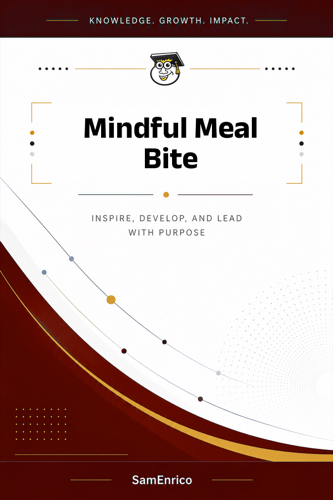
Mindful Meal Bite eBook
Takes three mindful bites before eating to slow do
Takes three mindful bites before eating to slow down.
Formats
Free sample
Chapter 1: The Dopamine Trap--–- You sit down with a full plate. You pick up your fork. The next thing you know, the plate is empty.You don't remember picking up the fork for the seventh time. You don't remember chewing the middle third of the meal. You don't remember swallowing the last five bites at all.
The food is gone, and you are left with a vague sense of unease – a quiet voice asking: Did I even taste that?This is not a character flaw. It is not a lack of willpower. It is not a sign that you are broken or undisciplined or secretly addicted to food. This is autopilot eating, and it is the default setting of the human brain.Every single day, the average adult makes more than two hundred decisions about food. What to eat.
When to eat. How much to eat. Whether to eat at all. But here is the astonishing truth that the food industry does not want you to know: less than fifteen percent of those decisions are made consciously. The rest are executed by a neural pathway called the Default Mode Network – or as I will call it throughout this book, autopilot.Autopilot is not evil.
It is efficient. It evolved to save your brain's limited processing power for genuine emergencies. When your ancestors were running from a predator, autopilot kept their hands moving, their legs pumping, their survival instincts humming without conscious effort. The problem is that autopilot cannot distinguish between a life-threatening emergency and a bag of chips. It treats both the same way: move, consume, repeat, do not stop to think.And so you eat.
Not because you are hungry. Not because the food tastes good. But because your hand is on autopilot, your fork is moving, and your brain has checked out of the building.The Million-Dollar Question If you have ever dieted – and statistically, you have – you have experienced a version of the following cycle.Monday: You wake up full of resolve. This time will be different. You download the app.
You measure the portions. You say no to the office cake. You feel powerful, virtuous, in control.Wednesday: You are hungry. Not the gentle, pleasant hunger of anticipation, but a low-grade, gnawing, relentless irritation. You eat a cookie.
It was not in the plan. The voice in your head says: You already messed up. You might as well eat the whole box.Friday: You binge. Not because you want to, but because the scarcity alarm in your brain has been ringing for days. You eat foods you do not even like.
You eat past fullness into discomfort. You eat while telling yourself to stop.Saturday: Guilt. Shame. The scale is up two pounds. You promise to start over on Monday.Monday: Repeat.This is the Eat-Repent-Repeat cycle.
It has been called by many names – the what-the-hell effect, the abstinence violation effect, the rebound phenomenon – but the underlying mechanism is always the same. Restriction creates rebellion. When you tell your brain "never," your brain interprets that as a famine threat. And the brain's number one job is to keep you alive during a famine. So it overrides your willpower.
It sends cravings. It makes the forbidden food sing to you from the pantry.Every diet you have ever tried has failed for this exact reason. Not because you lacked discipline. Not because you were weak. But because diets are built on a foundation of deprivation, and deprivation is neurologically unsustainable.The question, then, is not how do I try harder?
The question is how do I stop trying altogether and start something entirely different?The Answer Lives in the First Three Bites Let me introduce you to a neurological phenomenon that will change everything about how you understand eating. It is called sensory-specific satiety, and it is the single most important fact about human appetite that almost nobody knows.Here is what sensory-specific satiety means: The first three bites of any food deliver the highest dopamine response and the most intense taste perception. After that, the pleasure curve drops dramatically.Let me say that again. Bite number one? Explosion of flavor, satisfaction, reward.
Bite number two? Still excellent, but slightly less intense. Bite number three? Noticeably diminished. And bite number four?
Bite number four delivers roughly seventy percent of the pleasure of bite number one. Bite number eight delivers less than half.Your brain habituates. It gets bored. It has received the information it needed – this is food, it is safe, it tastes like this – and it moves on, shifting its attention elsewhere. But your hand does not move on.
Your hand keeps reaching for the fork. Your mouth keeps chewing. Your stomach keeps expanding. You continue eating, not because the food is still delicious, but because you are chasing a memory of pleasure that peaked three bites ago.Think about the last time you ate something truly indulgent. A slice of warm chocolate cake.
A bowl of creamy pasta. A bag of salty, crunchy chips. Do you remember the first bite? Of course you do. It was glorious.
Do you remember the tenth bite? Probably not. Do you remember the twentieth bite? Almost certainly not. By the end of the bag, you were not tasting.
You were performing an automated feeding behavior, like a machine whose off switch has broken.Sensory-specific satiety is the neurological reason why the first bite of pizza is transcendent and the last bite is merely fuel.Now here is the radical implication: You do not need to eat the entire plate to get the full pleasure of the meal. The best-tasting bites are bites one, two, and three. Everything after that is diminishing returns. The rest of the plate is not giving you more joy. It is giving you momentum.
And momentum is not hunger.The Method Defined: The 3-Bite Rule The Mindful Meal Bite method is a brain reset. It is not a diet. It is not a set of restrictions. It is not another set of rules to fail at and feel guilty about. It is a single, simple, neurologically precise practice that you can begin in this moment.Here is the entire method, stated simply:Before you eat any meal or snack, you pause.
You take three mindful bites as your anchor. During these three bites, you remove all external distractions – no phone, no TV, no reading, no active conversation. (A gentle nod or smile at a dining companion is fine. Your primary attention, however, is on the food.) After these three bites, you pause again. You check in with your body.
If you are still physically hungry, you continue eating – but without rushing, without screens, and with continued awareness. If you are satisfied, you stop. The three bites are never a limit or a restriction. They are simply the place where you begin paying attention.That is it. That is the entire practice.
It takes less than two minutes. It requires no special equipment, no expensive supplements, no meal prep service, no app subscription. It is free, portable, and available at your very next meal.But do not let the simplicity fool you. This single practice, repeated…
This is the end of the free sample. Get the eBook to keep going. Buy now
About this book
Details
- Author
- Bright Ivelisse
- Publisher
- SamEnrico
- Language
- English
- Genre
- Non-Fiction, Self-Help
- Released
- 2026-06-10
- Pages (approx.)
- 150
- Available as
- eBook, Audiobook

Read better in the ZLOADR app
Your eBooks on your phone or tablet. Sign in with your SamEnrico account and start reading.
More by Bright Ivelisse
 The Subscription vs OwnershipBright Ivelisse$11.99
 Mental Health Days Policy GuideBright Ivelisse$11.99
 Dirty Keto Pitfalls GuideBright Ivelisse$11.99
 Active Listening for Customer ServiceBright Ivelisse$11.99
 Networking for ConsultantsBright Ivelisse$11.99
 SAD And DeclutteringBright Ivelisse$11.99
 Peer De escalation TrainingBright Ivelisse$11.99
 The Colossal Vision: How Rome Built the First Sports EmpireBright Ivelisse$11.99
 Laughter and Love: The Unlikely Marriage of Fannie Brice and Nicky ArnsteinBright Ivelisse$11.99
 How to Start a Precision Chain Business (Beginners Guide)Bright Ivelisse$11.99
 How to Produce LeeksBright Ivelisse$11.99
 How to Produce Wall Light FixturesBright Ivelisse$11.99
You may also like
 Hong Kong Handover 1997Dunn Johnnie$11.99
 Zumba For Postnatal Recovery CourseNeal Christian$11.99
 Zumba for BeginnersLadner Nikia$11.99
 YouTube Comment Mining GuideHumes Pandora$12.99
 Worry Box MeditationCarlin Rudy$11.99
 Workplace Stress MeditationNguyen Lynn$11.99
 Workplace Stress and Sleep RepairHawley Ivory$11.99
 Workplace Perfectionism CureDelaney Jeffry$11.99
 Workplace Injustice Anger GuideWallen Isabelle$11.99
 Work Addiction and Burnout LinkGreenwood Ester$11.99
 Women in Yoga and WellnessBeattie Galina$11.99
 Women in Stand Up ComedyChun Evangeline$11.99