
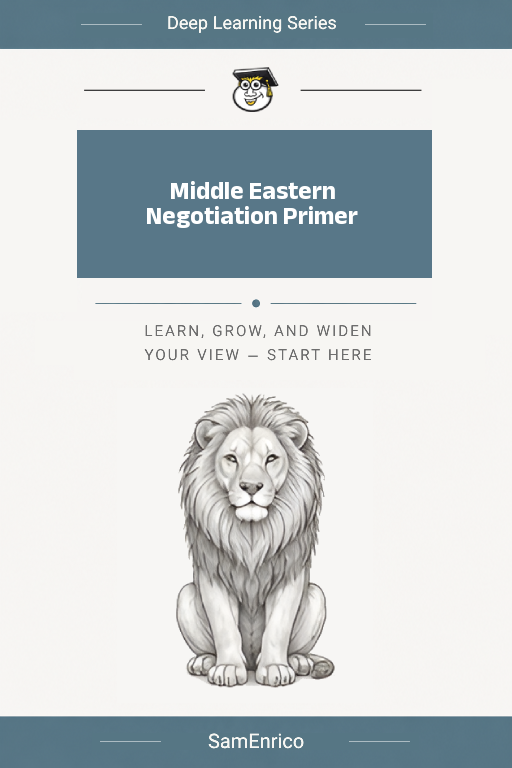
Non-FictionBusiness BriefNegotiation
Middle Eastern Negotiation Primer eBook
Master extended bargaining, face saving concession
by Kurtz Freeda
Master extended bargaining, face saving concessions, and final verbal commitments before written contracts.
Formats
Free sample
Chapter 1: The Handshake That Never Came--–- The first time I watched a German procurement director lose a twelve-million-dollar deal, it took less than ninety minutes. He flew into Dubai from Düsseldorf with a thirty-seven-page slide deck, a signed authority matrix from his CFO, and a stopwatch. I was there as an observer, invited by the Emirati family office to witness what they called “the Western machine.” The German shook hands, sat down, opened his laptop, and said: “Thank you for your time. I have a tight schedule, so let me begin with our proposal.” He clicked to slide three – a discounted cash flow analysis – before anyone had finished the first cup of coffee. The Emirati patriarch, a man who had built a trading empire over forty years, did not interrupt.
He listened. He nodded. He poured tea for his nephew. And when the German finished his presentation, the patriarch smiled and said: “You have given me much to think about. We will consider and call you.” They never called.
The German flew home believing he had done everything right: clear terms, competitive pricing, efficient use of time. What he had actually done was fail the most basic test of Middle Eastern negotiation – the relational prerequisite. He had treated the meeting as a transaction. The Emiratis had treated it as the beginning of a courtship. And because those two realities never touched, the deal died before it was ever alive.This chapter is about why that happens and how to prevent it.
It is the foundation upon which every other skill in this book rests – the recognition that in Middle Eastern business culture, you cannot negotiate what you have until you have proven who you are. Get this wrong, and nothing else in this book will save you. Get it right, and you will close deals that your competitors walk away from, using the same terms they rejected.The Three Pillars Framework: Your North Star for Every Chapter Before we go any further, let me give you the framework that structures this entire book. Every chapter will return to these three concepts, and by the end, they will feel like second nature. Think of them as three dials on a control panel – every negotiation requires you to adjust all three, but different situations emphasize different dials.The Three Pillars of Middle Eastern Negotiation1.
Wasta (Connection) – Your network is your net worth. Unlike Western networking, which is transactional (“What can we do for each other?”) and symmetrical (“I’ll introduce you to my client if you introduce me to your supplier”), Wasta is familial, honor-based, and asymmetrical. You cannot buy it. You cannot fake it. You inherit it through family or earn it through years of demonstrated character.
Wasta is the reason that a phone call from a mutual friend opens doors that a hundred cold emails cannot. It is the reason that a Saudi prince will take a meeting with someone his cousin vouches for, while ignoring identical proposals from strangers. Throughout this book, whenever you see the word Wasta, think: connection as currency.2. Sabr (Patience) – Strategic patience is not passive waiting; it is active endurance. In Middle Eastern business, time is abundant, and the party who shows urgency loses leverage.
Sabr is the ability to sit in silence while the other party weighs their options. It is the willingness to return after a rejection. It is the discipline to wait for them to say “now.” Westerners often mistake Sabr for inefficiency, laziness, or indecision. This mistake costs them millions. Throughout this book, whenever you see the word Sabr, think: patience as power.3.
Wajh (Face) – Public dignity is more valuable than money. A loss of face – being embarrassed, corrected in front of others, or shown to be wrong – destroys deals permanently. Wajh explains why the word “no” does not exist in Arab business vocabulary. It explains why concessions must look painful. It explains why a handshake in front of witnesses is more binding than a twenty-page contract drafted by the best lawyers in London.
If you remember only one pillar, remember this: never make the other party look small. Throughout this book, whenever you see the word Wajh, think: dignity above dollars.This chapter focuses primarily on Wasta, but the other two pillars are never far behind. A successful first meeting builds connection (Wasta), requires patience (Sabr), and preserves dignity (Wajh) for both parties. As you read, notice how the German procurement director violated all three pillars in ninety minutes: he showed no interest in connection (no Wasta), he rushed (no Sabr), and he treated the Emirati patriarch as a checkpoint rather than a partner (no Wajh). Three pillars, three failures, one dead deal.Why “Time is Money” Fails in the Majlis The Western business mindset treats time as a scarce resource.
Minutes have dollar values. Agendas have timestamps measured in five-minute increments. The goal is to move from greeting to signature as efficiently as possible. This approach works in low-context cultures like Germany, the United States, the Netherlands, and Scandinavia, where directness is valued, relationship is secondary to terms, and a contract is the finish line.In Middle Eastern business culture, the opposite is true.Time is not linear and scarce; it is cyclical and abundant. A meeting that runs three hours longer than scheduled is not a waste – it is an opportunity.
A negotiation that takes six months is not a delay – it is a courtship. A counterparty who asks to meet again next month without discussing price is not wasting your time – they are investing in the relationship.And a counterparty who rushes? They are not efficient. They are suspicious.Why does rushing trigger suspicion? Because in a culture where relationships precede transactions, someone who tries to skip the relationship phase is sending a clear signal: I am not interested in you.
I am interested in what I can get from you. That signal is not interpreted as efficiency. It is interpreted as disrespect, desperation, or dishonesty.Let me break down the three interpretations, because understanding them will change how you think about every minute of every meeting.Interpretation One: Insecurity When you rush to present your proposal, the counterparty thinks: “This person does not trust their own product or price. They want to close before I discover the flaws.” In Western negotiation, speed can signal confidence (“I know my value, let’s get this done”). In Middle Eastern negotiation, speed signals the opposite.
If you are confident in your offering, why are you afraid to let it sit on the table while we drink tea? Why are you unwilling to let me think about it overnight? The willingness to wait is the ultimate signal of confidence. The unwillingness to wait is the ultimate signal of insecurity.Interpretation Two: Desperation When you push for a quick decision, the counterparty thinks: “This person has no other options. They are trying to force a deal because they cannot afford to walk away.” Desperation destroys leverage.
Once the counterparty senses that you need the deal more than they do, every term moves in their direction. They will wait you out. They will let you sweat. They will watch you…
This is the end of the free sample. Get the eBook to keep going. Buy now
About this book
Details
- Author
- Kurtz Freeda
- Publisher
- SamEnrico
- Language
- English
- Genre
- Non-Fiction, Business Brief, Negotiation
- Released
- 2026-06-01
- Pages (approx.)
- 153
- Available as
- eBook, Audiobook

Read better in the ZLOADR app
Your eBooks on your phone or tablet. Sign in with your SamEnrico account and start reading.
More by Kurtz Freeda
 Emotional Vulnerability FactorsKurtz Freeda$11.99
 Self Esteem for Tall WomenKurtz Freeda$11.99
 Cravings Decoded HandbookKurtz Freeda$11.99
 Mendeleev Periodic Law DiscoveryKurtz Freeda$11.99
 Emotional Eating for TeensKurtz Freeda$11.99
 Semiconductor Capital AllocationKurtz Freeda$11.99
 Senior Community Sensory SupportKurtz Freeda$11.99
 Financial Ruin After MurderKurtz Freeda$11.99
 The Bloodstained Evidence: How Spatter Analysis Cracked the Case of the 'House of Horrors'Kurtz Freeda$11.99
 Whispers of the Silk Road: The Lost Caravan of the Jade PhoenixKurtz Freeda$11.99
 How to Setup and Launch a Trade FairKurtz Freeda$11.99
 How to Produce Sewing PatternsKurtz Freeda$11.99
You may also like
 Hong Kong Handover 1997Dunn Johnnie$11.99
 Zumba For Postnatal Recovery CourseNeal Christian$11.99
 Zumba for BeginnersLadner Nikia$11.99
 YouTube Comment Mining GuideHumes Pandora$12.99
 Worry Box MeditationCarlin Rudy$11.99
 Workplace Stress MeditationNguyen Lynn$11.99
 Workplace Stress and Sleep RepairHawley Ivory$11.99
 Workplace Perfectionism CureDelaney Jeffry$11.99
 Workplace Injustice Anger GuideWallen Isabelle$11.99
 Work Addiction and Burnout LinkGreenwood Ester$11.99
 Women in Yoga and WellnessBeattie Galina$11.99
 Women in Stand Up ComedyChun Evangeline$11.99