
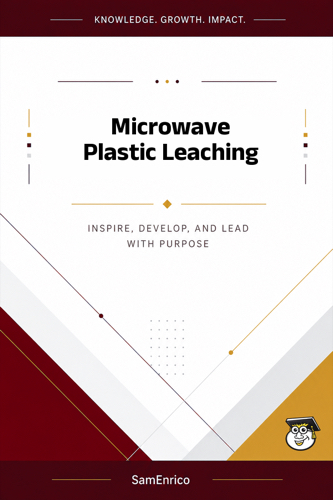
Microwave Plastic Leaching eBook
Never microwave plastic containers; transfer food
Never microwave plastic containers; transfer food to glass or ceramic.
Formats
Free sample
Chapter 1: The Frozen Lasagna Trap--–- The microwave beeped. Three minutes, the box had promised. Sarah peeled back the plastic film, and a cloud of steam rose into her face. She prodded the frozen lasagna with a fork, watching the cheese bubble in its black plastic tray. Her two-year-old daughter was tugging at her pant leg, whining for dinner.
Her phone was buzzing with an email from her boss. The dishwasher needed emptying. It was 6:47 PM on a Tuesday, and like forty million other American households that night, Sarah was about to serve a meal that had been nuked in plastic.She had no way of knowing that her family's dinner contained an invisible cocktail of synthetic chemicals and microscopic plastic fragments. The tray was labeled "microwave safe." She had bought it from a reputable grocery store. She was following the instructions on the box.
She was a good mother, a responsible adult, doing her best in a culture that equates convenience with survival.And yet, according to peer-reviewed research published in Environmental Science & Technology, that three-minute heating cycle had just released somewhere between 326,000 and 534,000 microplastic particles per square centimeter of container into her family's dinner. That is not a typo. Half a million particles. In one meal. In one tray.
On one Tuesday.This book is not here to make you feel guilty. Guilt is useless. Guilt is what happens when you are given a problem without a solution. This book is here to give you the solution, and it is startlingly simple: transfer your food to glass or ceramic before you press start. That is it.
That is the entire revolution. Thirty seconds of effort to eliminate over ninety-five percent of your microwave-related plastic exposure.But before you commit to that thirty-second habit, you need to understand why it matters. You need to understand the science that the plastic industry does not want you to know. You need to understand the regulatory failures that have left you holding a "microwave safe" container that is, in fact, anything but safe. You need to understand how we arrived at this moment, where convenience has been weaponized against health, and where a lie printed on a label has become a daily dose of toxins for millions of unsuspecting families.This chapter is called The Frozen Lasagna Trap because it is not just about lasagna.
It is about every frozen meal, every reheated leftover, every plastic cup of coffee spun in an office microwave, every plastic bowl of soup. It is about the quiet, invisible, cumulative poisoning that happens not in dramatic chemical spills or industrial accidents, but in the mundane rituals of modern life. It is about the trap we have all walked into, not realizing the floor was wired.The Convenience Revolution That Became a Health Crisis Let us rewind. The microwave oven was commercialized in the 1950s, but it did not become a household staple until the 1970s and 1980s. By 1997, over ninety percent of American homes had one.
The promise was simple: hot food in minutes, not hours. It was a triumph of postwar consumer technology, right up there with the dishwasher and the automatic washing machine.Alongside the microwave came the rise of plastic. Tupperware parties in the 1950s taught a generation of homemakers that plastic was the future—lightweight, shatterproof, colorful, and endlessly reusable. By the 1980s, plastic had colonized the refrigerator. By the 1990s, it had colonized the freezer.
By the 2000s, the frozen food aisle was a cathedral of plastic trays, plastic films, plastic sleeves, and plastic wraps.The marriage of microwave and plastic was inevitable. Food manufacturers realized they could sell frozen meals in plastic containers that went directly from freezer to microwave to table. No dishes to wash. No transfer required. Just peel, heat, and eat.
It was marketed as liberation from drudgery. It was, in fact, the opposite.Here is what the marketing materials did not tell you. Plastics are not inert. They are not stable. They are complex chemical concoctions—polymers mixed with plasticizers, stabilizers, colorants, and flame retardants—held together by bonds that weaken when exposed to heat, acid, or fat.
A microwave heats unevenly, creating hot spots that can exceed 212 degrees Fahrenheit inside the food. Those hot spots are pressed directly against the plastic container. The plastic gets hot. The chemical bonds begin to break. Molecules that were locked into the polymer matrix break free and migrate into the food.This is not a theory.
This is settled science, confirmed by hundreds of peer-reviewed studies across multiple decades and multiple countries.The "Microwave Safe" Lie Let us be very precise about what "microwave safe" actually means, because most people have been miseducated by the term.When a manufacturer tests a plastic container for "microwave safety," they are testing for structural integrity. They want to know if the container will warp, melt, crack, or deform when exposed to microwave radiation for a specified period. That is it. The test does not measure chemical migration. The test does not measure microplastic shedding.
The test does not measure endocrine disruption. The test does not measure long-term health effects.This is not a secret. It is written in the testing standards published by the American Society for Testing and Materials (ASTM) and the International Organization for Standardization (ISO). These standards explicitly focus on physical properties—dimensional stability, resistance to melting, resistance to deformation. They do not require any assessment of whether chemicals leach into food, nor do they require any toxicological evaluation of leached substances.The United States Food and Drug Administration (FDA) does regulate food contact substances, including plastics.
However, the FDA's regulatory framework was largely developed in the 1950s and 1960s, before microplastics were understood as a route of exposure, before endocrine disruption was a recognized phenomenon, and before many of the chemicals now known to be hazardous were in widespread use. The FDA assumes that if a plastic is "generally recognized as safe" (GRAS) for food contact at room temperature, it is also safe for microwave use—unless the manufacturer's own testing shows otherwise.Notice the loophole. The manufacturer does not have to prove safety. The manufacturer only has to avoid proving unsafety. And since manufacturers control their own testing, they can design tests that minimize the appearance of leaching—using short heating times, low-fat foods (fat is a powerful solvent that pulls more chemicals out of plastic), and pristine containers that have not been scratched or dishwashed.In other words, the "microwave safe" label is a structural warranty, not a health warranty.
It tells you the container won't melt. It tells you nothing about what will end up in your dinner.The Regulatory Gap: Why Your Government Has Not Protected You You might reasonably ask: why hasn't the FDA updated its standards? Why hasn't Congress passed a law requiring real safety testing? Why are European regulators, who are generally more precautionary than their American counterparts, also allowing "microwave safe" labels on plastic?The answer is a combination of regulatory inertia, industry lobbying, and the inherent difficulty of studying long-term, low-dose exposures. Let us examine each.First, regulatory inertia.
The FDA's food contact substance notification program processes thousands of submissions each year. Re-evaluating every plastic already on the market…
This is the end of the free sample. Get the eBook to keep going. Buy now
About this book
Details
- Author
- Hartman Prudence
- Publisher
- SamEnrico
- Language
- English
- Genre
- Non-Fiction, Health & Wellness
- Released
- 2026-06-09
- Pages (approx.)
- 138
- Available as
- eBook, Audiobook

Read better in the ZLOADR app
Your eBooks on your phone or tablet. Sign in with your SamEnrico account and start reading.
More by Hartman Prudence
 Success Without Burnout for ParentsHartman Prudence$11.99
 Soup Kitchen Pioneer StoryHartman Prudence$11.99
 Spotting Major Depressive Disorder Signs EarlyHartman Prudence$11.99
 Loving Kindness for Vaccination FearHartman Prudence$11.99
 Slave Trade Economics ProfitsHartman Prudence$11.99
 Growing Up in Foster Care HomesHartman Prudence$11.99
 Russell Means BiographyHartman Prudence$11.99
 The Siege of the Dutch Factory: Blood and Betrayal in NagasakiHartman Prudence$11.99
 The Outback Odyssey: How Australian Pioneers Tamed the WildernessHartman Prudence$11.99
 Service Providers Guide to Newsletter ProductionHartman Prudence$11.99
 How to Produce Livestock FeedHartman Prudence$11.99
 A Collector's Handbook to the Mg B Gt V8Hartman Prudence$11.99
You may also like
 Hong Kong Handover 1997Dunn Johnnie$11.99
 Zumba For Postnatal Recovery CourseNeal Christian$11.99
 Zumba for BeginnersLadner Nikia$11.99
 YouTube Comment Mining GuideHumes Pandora$12.99
 Worry Box MeditationCarlin Rudy$11.99
 Workplace Stress MeditationNguyen Lynn$11.99
 Workplace Stress and Sleep RepairHawley Ivory$11.99
 Workplace Perfectionism CureDelaney Jeffry$11.99
 Workplace Injustice Anger GuideWallen Isabelle$11.99
 Work Addiction and Burnout LinkGreenwood Ester$11.99
 Women in Yoga and WellnessBeattie Galina$11.99
 Women in Stand Up ComedyChun Evangeline$11.99