
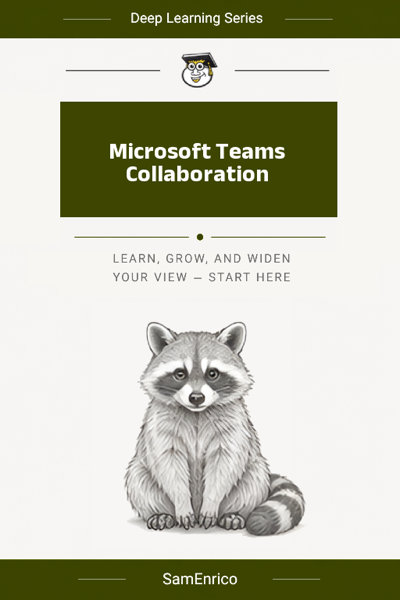
Non-FictionInformativeEducational
Microsoft Teams Collaboration eBook
A Coursebook on Microsoft Teams Collaboration
A Coursebook on Microsoft Teams Collaboration
Formats
Free sample
Chapter 1: Beyond the Inbox...--For most professionals, the workday begins the same way it has for more than two decades. You open your laptop, your browser loads, and there it is: the inbox. A fresh cascade of messages, some urgent, some passive-aggressive, some carbon-copied onto conversations that have nothing to do with you. You scroll. You triage.
You reply to a few. You flag others for “later” — a later that never comes. By 10 a.m., you have answered thirty-seven emails and accomplished nothing that moved your actual projects forward. This is not collaboration. This is survival.The numbers tell a grim story.
According to a 2023 study by the Mc Kinsey Global Institute, the average knowledge worker spends 28 percent of the workweek — nearly eleven hours — reading and answering email. Only 14 percent of that time is spent on tasks that directly connect to strategic goals. The rest is what researchers call “context switching,” “redundant communication,” and “information foraging.” In plain English: you are working hard, but you are not working smart. And the culprit is not laziness or lack of focus. The culprit is the tool that was supposed to make you productive in the first place.Email was revolutionary in 1995.
It was faster than postal mail, more efficient than the telephone for non-urgent matters, and it created a written record of decisions that paper memos could not match. But email was designed for a world of discrete, one-off exchanges between two people. It was never architected for persistent team conversations, real-time document collaboration, or the complex, many-to-many workflows of modern organizations. This is why your inbox feels like a dumpster fire. It is not your fault.
It is the tool’s fault.Microsoft Teams is not just an alternative to email. It is a fundamentally different paradigm for how humans work together. This chapter will walk you through that paradigm — not as a feature list, but as a mindset shift. You will learn why persistent conversations outperform threaded emails, why channels beat distribution lists, and why real-time co-authoring eliminates the curse of “final_final_v3_REALLY_FINAL.docx.” By the end, you will understand not just what Teams does, but why it matters for your sanity, your team’s velocity, and your organization’s bottom line.The Hidden Costs of Email-Centric Work Before we can appreciate what Microsoft Teams offers, we must honestly confront what email costs us. These costs are rarely captured on a profit-and-loss statement, but they bleed out in every meeting that runs long, every deliverable that arrives late, and every employee who quietly burns out.Cost One: Broken Context.
When you send an email about a project, the context for that email lives only in the heads of the sender and the recipients. A new team member joining the project receives none of the prior history unless someone remembers to forward a chain of forty-seven replies. Decisions get repeated. Questions get re-asked. The same debate happens three times because no one can find the thread from last month where the debate was already settled.
Email fragments context across individual mailboxes, turning collective knowledge into a scavenger hunt.Cost Two: Asynchronous Overload. Email is asynchronous by design — you send, and the recipient responds when convenient. But the convenience for the sender becomes an anxiety for the receiver. Every unread message is an open loop, a nagging reminder of work not yet done. Studies from the University of California, Irvine, show that after an email interruption, it takes an average of twenty-three minutes to refocus on the original task.
If you check email ten times a day — a conservative estimate for most professionals — you lose nearly four hours of focused cognitive work every week. You are not multitasking. You are task-switching into exhaustion.Cost Three: Visibility Black Holes. In an email-centric workflow, it is nearly impossible to answer basic questions about team progress. Who is working on what?
Which decisions have been made? Where is the latest version of the proposal? The answers are scattered across individual inboxes, local hard drives, and shared network folders that no one has organized since 2019. Managers ask for status updates not because they enjoy interrupting you, but because email provides no dashboard, no kanban board, no single source of truth. So you write another email, which creates another interruption, which generates another status request next week.Cost Four: The Tyranny of “Reply All.” The single most destructive button in business software is “Reply All.” It transforms a conversation between two people into a firehose of irrelevant noise for thirty bystanders.
The cost of this button is not just annoyance; it is the systematic desensitization of your team to important information. When everything is flagged urgent, nothing is urgent. When every email includes the entire department, your team learns to ignore the inbox altogether. Critical messages get buried in the noise, and you discover them three weeks later when a client asks why nothing happened.These costs are not theoretical. They are the texture of your Tuesday morning.
And they are entirely avoidable.The Persistent Collaboration Paradigm Microsoft Teams replaces the email paradigm with something fundamentally different: persistent collaboration. In a persistent model, conversations do not disappear into individual inboxes. They live in shared spaces — called channels — where every team member can see the full history, search past discussions, and understand the context of a decision without having been present when it was made.Imagine a physical office. You have a conference room where meetings happen, a whiteboard where ideas are sketched, a filing cabinet where documents live, and a water cooler where casual conversations occur. In the email model, each of these spaces is replaced by a linear stream of messages sent to your personal address.
You have to remember where the whiteboard photo was attached. You have to search your sent folder for the filing cabinet link. You have to scroll through last week’s water cooler chat to find the lunch order.In the Teams model, the conference room, whiteboard, filing cabinet, and water cooler all exist in the same shared space. Anyone can walk in, look at the whiteboard, pull a file from the cabinet, and see what was discussed at yesterday’s meeting — all without interrupting the people who were there. This is not a minor improvement.
It is a categorical shift in how teams hold and share knowledge.Persistent conversations mean that a topic started on Monday can be picked up on Thursday without anyone saying, “Can you forward me that thread?” Everything is already there, searchable by keyword, date, or participant. Persistent files mean that the version of the budget you see is the version everyone sees — no more “I thought you were working from the October draft.” Persistent context means that a new hire on her first day can scroll through the project’s channel and absorb six weeks of decisions, trade-offs, and rationale in an afternoon, rather than scheduling six hours of “knowledge transfer” meetings.This persistence does not just save time. It democratizes information. In email-centric organizations, knowledge is power, and power is hoarded in individual inboxes. In persistent collaboration, knowledge is shared, and power comes from what you do with it.The Core Components of Teams…
This is the end of the free sample. Get the eBook to keep going. Buy now
About this book
Details
- Author
- Merrick Ashlea
- Publisher
- SamEnrico
- Language
- English
- Genre
- Non-Fiction, Informative, Educational
- Released
- 2026-05-11
- Pages (approx.)
- 154
- Available as
- eBook, Audiobook

Read better in the ZLOADR app
Your eBooks on your phone or tablet. Sign in with your SamEnrico account and start reading.
More by Merrick Ashlea
 ED Journal WorkbookMerrick Ashlea$11.99
 The Parent Anger JournalMerrick Ashlea$11.99
 Validation For Housing InsecurityMerrick Ashlea$11.99
 Twelve Step Anniversary RecoveryMerrick Ashlea$11.99
 The Forensic Behavioral Analysis GuideMerrick Ashlea$11.99
 The Frozen Gambit: Charles XII’s Lost Victory at PoltavaMerrick Ashlea$11.99
 How to Become a Log InspectorMerrick Ashlea$11.99
 Register .us Domain HandbookMerrick Ashlea$12.99
 PR for Healthtech StartupsMerrick Ashlea$12.99
 The Breeder's Guide to Old English Game ChickensMerrick Ashlea$11.99
You may also like
 Hong Kong Handover 1997Dunn Johnnie$11.99
 Zumba For Postnatal Recovery CourseNeal Christian$11.99
 Zumba for BeginnersLadner Nikia$11.99
 YouTube Comment Mining GuideHumes Pandora$12.99
 Worry Box MeditationCarlin Rudy$11.99
 Workplace Stress MeditationNguyen Lynn$11.99
 Workplace Stress and Sleep RepairHawley Ivory$11.99
 Workplace Perfectionism CureDelaney Jeffry$11.99
 Workplace Injustice Anger GuideWallen Isabelle$11.99
 Work Addiction and Burnout LinkGreenwood Ester$11.99
 Women in Yoga and WellnessBeattie Galina$11.99
 Women in Stand Up ComedyChun Evangeline$11.99