
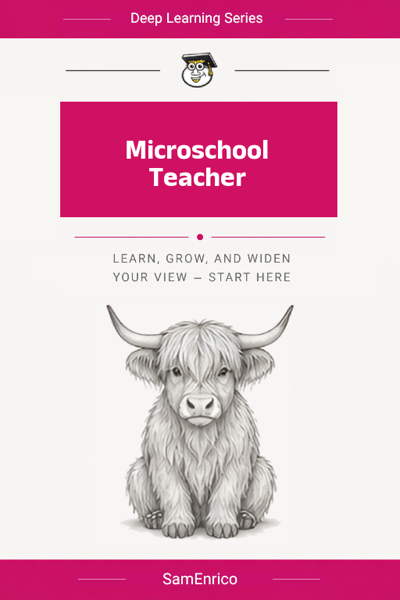
Non-FictionInformativeEducational
Microschool Teacher eBook
A Coursebook on Microschool Teacher
by Parris Olene
A Coursebook on Microschool Teacher
Formats
Free sample
Chapter 1: The Smallest Classroom...--The email arrived at 11:47 on a Tuesday night. I was sitting on my living room floor surrounded by twenty-three pages of state homeschooling regulations, a half-eaten bowl of oatmeal, and the growing realization that I had no idea what I was doing. The subject line read: "We're in. When do we start?" Two families. Four children.
Zero classrooms. One former public school teacher with a dream that felt somewhere between visionary and delusional.That was seven years ago. Today, that living room operation has grown into a thriving microschool with twelve students, a waiting list, and a reputation that draws families from three neighboring towns. But more importantly, it taught me something that no education school ever prepared me for: the smallest classroom is often the most powerful one.This book is not a theoretical treatise on educational reform. It is a coursebook for the person who is ready to build something real.
You are reading this because you have felt the frustration of crowded classrooms where differentiation is a buzzword rather than a practice. You have watched talented teachers burn out under the weight of standardized testing and administrative paperwork. You have wondered, perhaps late at night like I did, whether there might be a different way.There is. It is called the microschool.Before we dive into the operational details of running a small-scale, learner-driven educational environment, we must first understand why small is not just a matter of size but a fundamentally different philosophy of teaching and learning. This chapter will dismantle the assumptions that have guided conventional schooling for over a century and build in their place a new framework for what education can become when we prioritize relationships over ratios, mastery over minutes, and purpose over protocols.The Five Defining Characteristics of a Microschool Let us begin with clarity.
A microschool is not simply a small private school, nor is it a tutoring center with a fancy name. Through years of studying successful models across the United States, including the work of Acton Academy, Wildflower Schools, and the Prenda learning pod network, I have identified five characteristics that distinguish microschools from every other educational arrangement.First, microschools are intentionally small. While definitions vary, the research consistently shows that the optimal size ranges from five to fifteen students. Below five, the social dynamics become too limited for meaningful collaboration. Above fifteen, the teacher can no longer maintain the depth of relationship required for personalized learning.
This is not an arbitrary number. Educational psychologist Lee Shulman's research on "signature pedagogies" demonstrated that class size directly impacts the kinds of teaching moves available to the instructor. In a group of thirty, lecture and worksheets become survival strategies. In a group of twelve, Socratic dialogue and project-based learning become possible.Second, microschools are mixed-age by design. Unlike traditional schools that segregate children by birth year, microschools deliberately blend ages across spans of three to six years.
A typical microschool might serve children ages six through eleven in a single room. This arrangement is not a compromise forced by low enrollment but a pedagogical advantage. Older students consolidate their learning by teaching younger ones. Younger students benefit from peer modeling that is closer to their own development than adult instruction. Mixed-age classrooms also eliminate the artificial competition of grade-level ranking and replace it with a collaborative culture where progress is measured against personal mastery rather than peer performance.Third, microschools are agile.
This means they can change direction quickly based on student interest, community need, or external circumstances. When a traditional school decides to adopt a new curriculum, the process takes years of committee meetings, pilot programs, and textbook adoption cycles. A microschool teacher can decide on Monday to launch a two-week deep dive into local ecology and be at the creek with clipboards by Wednesday. This agility extends to schedules as well. Microschools operate on four-day weeks, six-week intensive blocks, year-round calendars, or any other structure that serves their community.
There is no central office mandating a 180-day academic year.Fourth, microschools are community-based. They draw resources, field trip locations, guest experts, and often physical space from the neighborhoods they serve. A church basement, a storefront, a community center, or a teacher's own home can become a microschool. This embeddedness reduces costs, increases relevance, and builds natural accountability. When the local baker teaches fractions through bread ratios, the learning is not abstract.
When the retired engineer mentors the robotics club, the connection is not transactional.Fifth, and most importantly, microschools are purpose-driven. Every successful microschool has articulated a clear "why" that goes beyond academics. Some adopt the Hero's Journey framework, casting students as protagonists on a quest for mastery and character. Others emphasize environmental stewardship, social justice, or entrepreneurial thinking. Whatever the specific purpose, it is not a marketing slogan but an operational principle.
It shapes curriculum choices, hiring decisions, conflict resolution, and daily rituals.The Teacher-Leader Versus The Employee Mindset Here is the most difficult truth in this book: you cannot run a microschool with the mindset of an employee. Traditional schools train teachers to execute a script. You receive a curriculum map, a pacing guide, a set of standards, and a schedule. Your job is compliance with fidelity. Your success is measured by student test scores and administrator observations.
You are a replaceable part in a machine designed for standardization.The microschool teacher is something else entirely. You are a designer, a conductor, an entrepreneur, and a community builder. You do not wait for permission to try something new. You do not blame the system when something fails. You own the outcomes because you own the decisions.
This is terrifying and liberating in equal measure.I have watched talented public school teachers struggle to make this transition. They are brilliant at classroom management within the traditional framework. They know how to write lesson plans, differentiate instruction, and build positive relationships with difficult students. But when they step into a microschool, they freeze. They ask, "Where is the curriculum?" They want a manual.
They want someone to tell them what to do next Tuesday at 10:15 AM.The answer is that there is no manual. There is only a set of principles, a collection of tools, and your own judgment. You will make mistakes. You will plan units that flop. You will have days when you wonder why you ever left the security of a union contract and a pension.
But you will also experience moments of genuine educational magic that are impossible in a classroom of thirty-two.Let me be specific about what the teacher-leader mindset requires. First, it requires comfort with ambiguity. You will not know exactly what next month looks like because it depends on what your students discover this week. Second, it requires a bias toward action. When something is not working, you change it immediately rather than waiting for the end of the quarter.
Third, it requires financial literacy. You must understand your break-even enrollment, your fixed and variable costs, and the difference between revenue and profit. This is not optional. The most pedagogically brilliant microschool in the world will close if it runs out of money.Fourth, and perhaps most…
This is the end of the free sample. Get the eBook to keep going. Buy now
About this book
Details
- Author
- Parris Olene
- Publisher
- SamEnrico
- Language
- English
- Genre
- Non-Fiction, Informative, Educational
- Released
- 2026-06-02
- Pages (approx.)
- 141
- Available as
- eBook, Audiobook

Read better in the ZLOADR app
Your eBooks on your phone or tablet. Sign in with your SamEnrico account and start reading.
More by Parris Olene
 ABCDE for Vacation PlanningParris Olene$11.99
 The Family Walking MeditationParris Olene$11.99
 International Franchise Case Study LibraryParris Olene$11.99
 Eisenhower Matrix For Holiday PlanningParris Olene$11.99
 The Rheumatoid Arthritis Heart GuideParris Olene$11.99
 The Ice and Blood of the Volga: Batu Khan's River Campaign (1236-1237)Parris Olene$11.99
 Understanding Rigid Mask Like Face Deafness PolydactylyParris Olene$17.99
 VAT Reverse Charge MechanismParris Olene$12.99
 Public Health ACE GuideParris Olene$12.99
 How to Become a Plug-cutting-machine OperatorParris Olene$11.99
You may also like
 Hong Kong Handover 1997Dunn Johnnie$11.99
 Zumba For Postnatal Recovery CourseNeal Christian$11.99
 Zumba for BeginnersLadner Nikia$11.99
 YouTube Comment Mining GuideHumes Pandora$12.99
 Worry Box MeditationCarlin Rudy$11.99
 Workplace Stress MeditationNguyen Lynn$11.99
 Workplace Stress and Sleep RepairHawley Ivory$11.99
 Workplace Perfectionism CureDelaney Jeffry$11.99
 Workplace Injustice Anger GuideWallen Isabelle$11.99
 Work Addiction and Burnout LinkGreenwood Ester$11.99
 Women in Yoga and WellnessBeattie Galina$11.99
 Women in Stand Up ComedyChun Evangeline$11.99