
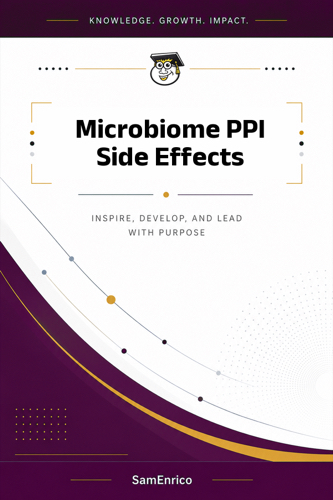
Non-FictionHealth & WellnessPPI Effects
Microbiome PPI Side Effects eBook
Tests microbiome changes from acid reducers.
Tests microbiome changes from acid reducers.
Formats
Free sample
Chapter 1: The Silent Epidemic--–- Jennifer had never considered herself a “sick person.” At forty-nine, she taught two yoga classes a week, walked her Labrador retriever five miles every morning, and could still touch her palms to the floor with her legs straight. She ate kale salads with quinoa, drank kombucha before it was trendy, and had a resting heart rate that made her primary care physician raise an eyebrow with approval. By every conventional measure, Jennifer was the picture of vibrant, proactive health.So when she began experiencing a burning sensation behind her sternum after spicy tacos and late-night glasses of red wine, she dismissed it as exactly what it was: occasional heartburn. Nothing more. Nothing to worry about.
Her mother had suffered from reflux for years and managed it with over-the-counter antacids. Jennifer followed the same path, chewing chalky Tums tablets that tasted like melted birthday candles. For a while, that worked.But the heartburn became more persistent. It stopped being “occasional” and started being “every time she ate anything with tomatoes, garlic, or the faintest hint of black pepper.” She mentioned it to her gynecologist during an annual exam, almost as an aside. The doctor nodded, typed something into the electronic health record, and said the words that would unknowingly alter the next seven years of Jennifer’s life: “You might as well start on a proton pump inhibitor.
Take it every morning. It’s very safe. Many of my patients have been on them for years.”The prescription was for omeprazole, 20 milligrams, once daily. Jennifer picked it up from the pharmacy alongside a coupon that saved her three dollars. She swallowed the first capsule the next morning, twenty minutes before her breakfast smoothie, just as the label instructed.Within three days, her heartburn vanished.She felt triumphant.
She told her friends about the “miracle pill.” She recommended it to her sister, who also had occasional reflux. She stopped thinking about her stomach entirely, which she interpreted as proof that the drug was working exactly as intended. And why wouldn’t she? The medical establishment had assured her of its safety. The FDA had approved it.
Millions of Americans took the same medication every day. What could possibly go wrong?The Scale of the Silence The answer to that question—what could go wrong—requires first understanding how many people are standing on the same precipice. As of 2024, approximately one in ten Americans takes a prescription proton pump inhibitor. That is roughly thirty-three million people. If you include over-the-counter sales of omeprazole (Prilosec OTC), esomeprazole (Nexium 24HR), and lansoprazole (Prevacid 24HR), the number climbs to nearly forty million.
To put that in perspective, more Americans take PPIs than vote in primary elections.This is not a niche medication for a rare condition. It is one of the most commonly prescribed drug classes in the world, generating over ten billion dollars in annual global sales. And yet, despite its ubiquity, a 2022 survey published in the Journal of the American Medical Association found that nearly two-thirds of long-term PPI users—defined as those taking the medication for eight or more consecutive weeks—could not remember why they had started it in the first place. Even more alarming: only twenty-three percent reported that their prescribing physician had ever discussed a plan for discontinuing the drug.Jennifer fell squarely into that majority. She had no memory of her gynecologist mentioning a stop date, no printed handout about tapering, no follow-up appointment to assess whether she still needed the medication.
The omeprazole simply became part of her morning routine, as automatic as brushing her teeth. She refilled the prescription automatically through her pharmacy’s online portal. Her new primary care physician—she had switched practices when she moved across town—saw the medication on her list and asked only, “Still having reflux?” Jennifer said, “It’s much better now,” and the doctor nodded and moved on.This is the silent epidemic. Not the heartburn itself. Not the reflux.
But the decades-long, medically sanctioned, casually perpetuated use of a powerful gastric acid suppressant in the absence of any ongoing indication. Jennifer did not need omeprazole. She had never needed omeprazole. Her occasional, mild, lifestyle-triggered heartburn could have been managed with dietary changes, weight management, or—at most—a short course of H2 blockers like famotidine. Instead, she was seven years into a medication that was fundamentally reshaping her internal ecosystem without her knowledge or consent.The Prescribing Cascade: How One Pill Becomes Three One of the most insidious mechanisms by which PPIs entrap patients is a phenomenon known in medical literature as the “prescribing cascade.” The term was first coined by geriatricians who noticed that older adults often received a new medication to treat the side effects of an existing medication, with the original drug never questioned or deprescribed.
The cascade flows downhill, and it picks up speed as it goes.Here is how it played out for Jennifer.By year three of her omeprazole use, she began noticing an uncomfortable bloating that started in the late afternoon and worsened into the evening. Her abdomen would distend so significantly that her yoga pants left red marks on her skin. She assumed she was developing a food intolerance. She tried eliminating dairy, then gluten, then eggs. Nothing helped.
The bloating was accompanied by unpredictable bowel habits—some days she had diarrhea three times before noon, other days she went four days without a bowel movement.She returned to her primary care physician, who ordered a basic metabolic panel, a complete blood count, and a celiac disease antibody test. All came back normal. The doctor shrugged and said, “It might be irritable bowel syndrome. Try this.” She prescribed dicyclomine, an antispasmodic medication that relaxes the smooth muscle of the intestine.The dicyclomine helped slightly with the abdominal cramping but did nothing for the bloating. Jennifer began keeping a food diary and noticed that her symptoms were worse on days she ate high-fiber foods like beans, apples, and onions.
She googled this and found the low-FODMAP diet, which she attempted with moderate success. But the restriction was exhausting, and she missed apples.Meanwhile, the constipation became more dominant. Her physician added polyethylene glycol 3350 (Miralax), a laxative, to her regimen. Jennifer was now taking omeprazole (for the original heartburn she no longer had), dicyclomine (for the cramping that might be related to the omeprazole), and Miralax (for the constipation that was almost certainly caused by the dicyclomine). Three medications.
Zero of them addressing the root cause.The root cause was small intestinal bacterial overgrowth, or SIBO, induced by seven years of gastric acid suppression. This is not speculation. A 2024 meta-analysis from Nicolaus Copernicus University found that long-term PPI users—again, defined as eight or more consecutive weeks—have a 2.4-fold higher risk of SIBO compared to non-users. For methane-predominant SIBO (also known as IMO, or intestinal methanogen overgrowth), the risk is 3.1-fold higher. Jennifer almost certainly had SIBO.
But no one tested her for it. And no one asked the most important question: Do you still need the omeprazole?Appropriate Versus Inappropriate Use: A Necessary Distinction Before proceeding further, a critical distinction must be made. This book is…
This is the end of the free sample. Get the eBook to keep going. Buy now
About this book
Details
- Author
- Mauro Shaunta
- Publisher
- SamEnrico
- Language
- English
- Genre
- Non-Fiction, Health & Wellness, PPI Effects
- Released
- 2026-06-07
- Pages (approx.)
- 159
- Available as
- eBook, Audiobook

Read better in the ZLOADR app
Your eBooks on your phone or tablet. Sign in with your SamEnrico account and start reading.
More by Mauro Shaunta
 The Mayor's Homeless Shelter WarsMauro Shaunta$11.99
 Revenue Per Employee RemoteMauro Shaunta$11.99
 Parent Intimacy Self Care GuideMauro Shaunta$11.99
 Sleep And Motor MemoryMauro Shaunta$11.99
 Jumia Fraud Prevention GuideMauro Shaunta$11.99
 Thyroid and Hair LossMauro Shaunta$11.99
 Financial Stress for Immigrants GuideMauro Shaunta$11.99
 Government Crisis ManagementMauro Shaunta$11.99
 The Forgotten War: How a 1950s Conflict Reshaped the Modern WorldMauro Shaunta$11.99
 The First Fleet: Founding Australia’s Western FrontierMauro Shaunta$11.99
 Shopify Conversion Rate OptimizationMauro Shaunta$11.99
 Subscription Model Inflation DefenseMauro Shaunta$12.99
You may also like
 Hong Kong Handover 1997Dunn Johnnie$11.99
 Zumba For Postnatal Recovery CourseNeal Christian$11.99
 Zumba for BeginnersLadner Nikia$11.99
 YouTube Comment Mining GuideHumes Pandora$12.99
 Worry Box MeditationCarlin Rudy$11.99
 Workplace Stress MeditationNguyen Lynn$11.99
 Workplace Stress and Sleep RepairHawley Ivory$11.99
 Workplace Perfectionism CureDelaney Jeffry$11.99
 Workplace Injustice Anger GuideWallen Isabelle$11.99
 Work Addiction and Burnout LinkGreenwood Ester$11.99
 Women in Yoga and WellnessBeattie Galina$11.99
 Women in Stand Up ComedyChun Evangeline$11.99