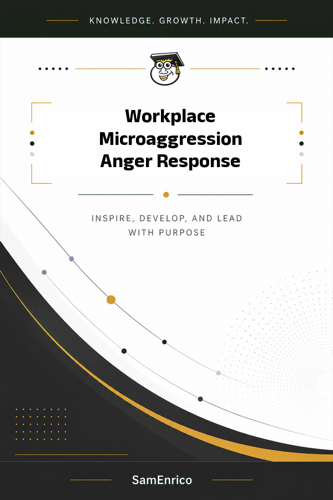
Microaggression Response Confidence eBook
Address subtle slights professionally without over
Address subtle slights professionally without over explaining.
Formats
Free sample
Chapter 1: The Cumulative Tax...--Every morning, Maya walks into her open-plan office, coffee in hand, and braces herself not for a crisis, but for a sigh. Not her own sigh—the sigh of her colleague, David, who sits two desks over and has a habit of exhaling loudly whenever Maya speaks in team meetings. It is not a word. It is not a slur. It is not something she could ever take to HR.
But it is there, every Tuesday and Thursday, a small auditory punctuation mark that says: You are taking up space you shouldn't take up.By Thursday afternoon, Maya has run the calculation seven times. Did that really happen? Yes. Is it a pattern? She isn't sure.
Should I say something? To whom? About a sigh?By Friday, she is exhausted. Not because she worked late, not because her project is behind schedule, but because she has spent four days managing the ambient emotional weight of a two-second exhalation. This is the hidden tax of subtle slights.Welcome to the first chapter of Microaggression Response Confidence.
Before we teach you a single script, before we walk you through a single breathing technique or a single "I" statement, we need to name the thing that is already draining you. Because you cannot respond confidently to something you have been taught to dismiss as "not a big deal." And you cannot build resilience around a wound you have been told does not exist.This chapter does three things. First, it reframes microaggressions not as isolated, trivial moments but as a cumulative psychological tax—a slow, steady leak in the boat of your professional energy. Second, it introduces the critical distinction between intent and impact, and explains why focusing on the former has become a convenient escape hatch for people who would rather not change. Third, it presents the research on harm—burnout, turnover, insomnia, hypertension—not to scare you, but to validate you.
You are not being too sensitive. These moments are not "no big deal." And the exhaustion you feel is a rational response to a real occupational hazard.Let us begin.The Death of a Thousand Paper Cuts There is a reason the metaphor "death by a thousand cuts" appears so often in writing about microaggressions. It is not because any single cut is fatal. It is because the cumulative effect—the stacking, the compounding, the relentless smallness of each wound—is what finally breaks a person.Overt conflict is easy to identify. If a coworker shouts a racial slur at you, you know what happened.
Your heart races, your adrenaline spikes, and you have a clear villain, a clear victim, and a clear path to escalation (HR, management, legal). Overt conflict is a sledgehammer to the window. There is glass everywhere. Everyone sees it.A microaggression is not a sledgehammer. It is a hairline fracture.
It is the third-floor window that was installed slightly crooked, letting in a draft you cannot quite locate. It is the door that sticks in August but works fine in December. You spend so much time explaining that something happened that you have no energy left to address what happened.Consider these real-world examples drawn from workplace studies over the past decade:A Black software engineer is asked by a white colleague, "How did you get this job?" The implication, unspoken but unmistakable: You do not belong here on merit.A woman in a finance meeting makes a recommendation that is ignored. Thirty seconds later, a male colleague makes the exact same recommendation and is praised for his "strategic thinking."A Latino executive is told by a client, "Your English is so good." The executive was born in Chicago.A Jewish employee hears, "You don't look Jewish," delivered as if it is a compliment.A visibly pregnant woman is told, "Are you sure you want to take on that project? Maybe we should give it to someone with more...
bandwidth."None of these statements is a slur. None of them would get someone fired on the spot. None of them is a smoking gun. And yet, each of them lands like a small weight on the chest of the person who hears it. One weight is nothing.
Five weights, over a week, are noticeable. Fifty weights, over a year, are exhausting. Five hundred weights, over a career, are crushing.This is the cumulative tax. It is not the cost of any single interaction. It is the cost of the pattern.
And the pattern is what this book is designed to interrupt.The Invisible Ledger: Tracking What You Cannot See Let us make this concrete. For the next sixty seconds, I want you to think about the past thirty days at your workplace, your university, your professional organization, or your community. Do not look for the big moments. Look for the small ones.How many times have you been interrupted?How many times has your idea been ignored only to be praised when repeated by someone else?How many times has someone asked you where you are "really" from?How many times has someone touched your hair, your clothing, your body without your permission?How many times has someone called you "emotional" or "aggressive" when you expressed a perfectly reasonable opinion?How many times has someone assumed your job title, your education level, or your competence based on your identity?Do not judge these moments. Do not minimize them.
Just count them.Now, for each moment, add a unit of energy. Not the energy of the moment itself—that is gone—but the energy you spent afterward. The replaying. The wondering. The conversation you had with your partner that night.
The five minutes you spent scrolling on your phone to distract yourself. The deep breath you took before walking back into the office the next day.This is your invisible ledger. No one else sees it. No one else tracks it. But you are paying into it every single day, and the interest rate is brutal.Research published in the Journal of Applied Psychology (2018) found that targets of microaggressions report significantly higher levels of emotional exhaustion than their peers, even when controlling for workload, hours worked, and job difficulty.
The exhaustion does not come from the work. It comes from the work of managing the work environment—the constant scanning for threat, the rehearsal of responses you never give, the calculation of whether today is the day you finally say something.This is not weakness. This is not fragility. This is a rational nervous system responding rationally to an unpredictable social environment. Your brain is designed to detect patterns.
When the pattern is "sometimes people say things that hurt me and I cannot predict when," your brain stays on high alert. That alertness costs calories, attention, and peace. It is the invisible tax.Intent vs. Impact: The Most Weaponized Distinction in Professional Life If there is a single phrase that has derailed more conversations about microaggressions than any other, it is this: "But that's not what I meant."Let us be very clear about something. The distinction between intent and impact is real.
It is important. And it has been weaponized so thoroughly that many targets of microaggressions have learned to preemptively apologize…
This is the end of the free sample. Get the eBook to keep going. Buy now
About this book
Details
- Author
- Hughes Derrick
- Publisher
- SamEnrico
- Language
- English
- Genre
- Non-Fiction, Self-Help, Diversity Equity
- Released
- 2026-06-10
- Pages (approx.)
- 136
- Available as
- eBook, Audiobook

Read better in the ZLOADR app
Your eBooks on your phone or tablet. Sign in with your SamEnrico account and start reading.
More by Hughes Derrick
 Coppola Godfather EpicHughes Derrick$11.99
 Workaholism in EngineeringHughes Derrick$11.99
 Urban Survival Kit for CommutersHughes Derrick$11.99
 Catherine the Great's Provincial Administration ManualHughes Derrick$11.99
 The Koresh Adoption NetworkHughes Derrick$11.99
 Memory Palace Design PrimerHughes Derrick$11.99
 Lloyd George DavidHughes Derrick$11.99
 ESG and IPO Pricing GuideHughes Derrick$11.99
 The Last Ride of the Cyclone: A Rollercoaster to OblivionHughes Derrick$11.99
 The Silk Road's Shadow: Spies, Merchants, and the Birth of Global EspionageHughes Derrick$11.99
 The Billion-Dollar Bet: How Ray Dalio’s Principles Reshaped Global FinanceHughes Derrick$11.99
 The Mineral Guide to ZinkeniteHughes Derrick$11.99