
Non-FictionSelf-HelpMen's Emotional Health
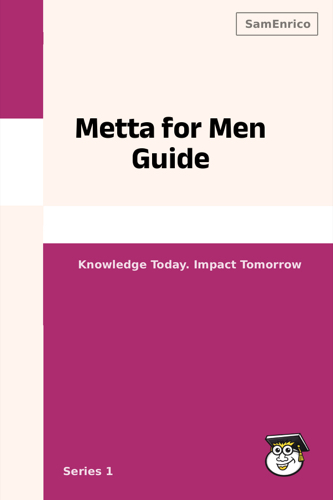
Metta for Men Guide eBook
Addresses cultural barriers men face with loving-k
Addresses cultural barriers men face with loving-kindness and offers accessible entry points.
Formats
Free sample
Chapter 1: The Lonely Hunter--The email came in at 11:47 on a Tuesday night. I remember because I was sitting in my parked car in my own driveway, having just driven home from a job I didn't hate, to a family I genuinely loved, feeling absolutely nothing.Not sadness. Not anger. Not even exhaustion.Just nothing.The email was from an old college roommate. We hadn't spoken in six years.
He was inviting me to a reunion. And as I stared at the screen, I realized I couldn't remember the last time I had a real conversation with another man. Not about sports. Not about work. Not about whose kid was winning which trophy.
A real conversation. The kind where someone says "I'm struggling" and the other person doesn't flinch.I sat there for twenty minutes. Then I drove around the block twice, went inside, kissed my wife on the forehead, and never mentioned the email to anyone.That was seven years before I started writing this book.Here is what I have learned since then: the strongest men I know are also the loneliest. And they have no idea that the two are connected.The Strength Trap You were taught a very specific definition of strength.It came from movies where the hero walks away from an explosion without looking back. From fathers who said "shake it off" when you scraped your knee and "man up" when you cried.
From coaches who told you that pain is weakness leaving the body and that the only acceptable emotions on a field are aggression and victory.You learned that strength means:Never asking for help Never showing fear Never admitting you don't know something Never crying in front of anyone Never needing anyone too much And here is the cruel irony: that definition works. For a while.It works in high school when you stuff down the humiliation of being rejected. It works in college when you drink instead of processing disappointment. It works in your twenties when you pour everything into work so you don't have to feel the quiet dread that maybe you're building a life nobody will really see.It works right up until the moment it doesn't.And then you wake up at forty-five, fifty, fifty-five, with a house and a retirement account and children who call once a week, and you realize you have no idea what you actually feel about any of it. Because you spent thirty years training yourself not to feel.That is not strength.That is a kind of living death.The Data They Don't Show You in the Man Box Let me put some numbers on the table.
Not to depress you. To wake you up.Men die by suicide at nearly four times the rate of women. In the United States, that's about one man every twelve minutes. The highest rates are not among young men, as the media sometimes suggests. They are among men aged forty-five to sixty-five.
Men who "have it all." Men who raised families, built careers, paid mortgages, and then found themselves standing on the edge of a life that felt like it belonged to someone else.A 2021 survey by the Survey Center on American Life found that fifteen percent of men reported having zero close friends. That is a fivefold increase from 1990. Zero. Not "a few." Not "not as many as I'd like." Zero.Another study asked men when they last told another man that they loved him. Not a romantic partner.
A friend, a brother, a father. The most common answer among men over forty? "I can't remember."And here is the part that breaks my heart: when researchers ask women about their emotional support networks, they typically list three to five people they could call in a crisis. When they ask men, the most common answer is "my wife." And when they ask divorced or widowed men? "I don't know."The wife is not a support network.
The wife is one person. And when she is gone, either through separation or death, millions of men discover that they outsourced their entire emotional lives to a single human being. Then they drown.This is not a moral failing. This is a design flaw in how we raise boys.The Stone Warrior I want you to imagine a warrior made entirely of stone.He is magnificent to look at. Muscles like granite.
A face that betrays nothing. He can withstand any blow. Arrows bounce off him. Swords shatter against his chest. Fire cannot burn him.
He is the perfect weapon.But here is what you cannot see from the outside: he cannot feel the sun on his face. He cannot taste his daughter's birthday cake. He cannot laugh until his stomach hurts. He cannot cry at a funeral. He cannot hug his wife and feel the warmth of her body against his.He is unbreakable and he is dead at the same time.That is the promise of traditional masculinity.
The promise is invulnerability. The price is aliveness.And the cruelest part is that you don't notice the price until it's too late. You spend your twenties and thirties building the stone armor. You get promoted. You buy the house.
You provide. You protect. And one day you look in the mirror and you don't recognize the man staring back. Not because he looks different. Because he looks like nothing.The philosopher and psychologist William James once wrote that a man's self is the sum total of all he can call his—his body, his family, his reputation, his work.
But James was writing in 1890, before we spent a century training men to disconnect from all of it. To treat their bodies as machines to be optimized rather than lived in. To treat their families as responsibilities rather than sources of joy. To treat their work as identity rather than activity.The stone warrior is the logical conclusion of that training. And this book is the chisel.The Four Walls of the Man Box Before we go any further, we need to name the cage.
Because you cannot escape a cage you refuse to see.Sociologists and psychologists who study masculinity have a term for the set of unwritten rules that govern male behavior. They call it the "Man Box." And it has four walls.Wall One: Don't show emotion (except anger).You are allowed to be angry. Anger is masculine. Anger is power. Anger is fuel.
But sadness? Fear? Disappointment? Loneliness? Tenderness?
Those are feminine. Those are weak. Those get you laughed at in the locker room and passed over for the promotion.The result is that men become experts at converting every emotion into anger. Someone hurts your feelings? Get angry.
You're scared about money? Get angry. You're lonely in your marriage? Get angry. Anger is the only tool in the box, so everything looks like a nail.Wall Two: Don't be perceived as gay or "feminine."This wall is the enforcer.
It's the reason boys learn to walk a certain way, talk a certain way, stand a certain way. It's the reason you crossed your legs differently in high school because someone said the…
This is the end of the free sample. Get the eBook to keep going. Buy now
About this book
Details
- Author
- Lemke Lynelle
- Publisher
- SamEnrico
- Language
- English
- Genre
- Non-Fiction, Self-Help, Men's Emotional Health
- Released
- 2026-06-08
- Pages (approx.)
- 130
- Available as
- eBook, Audiobook

Read better in the ZLOADR app
Your eBooks on your phone or tablet. Sign in with your SamEnrico account and start reading.
More by Lemke Lynelle
 Stress and Gut Health GuideLemke Lynelle$11.99
 Breath for Insomnia GuideLemke Lynelle$11.99
 Mindfulness For Hip PainLemke Lynelle$11.99
 The Quantum Leap That Almost Wasn't: How a 1994 Bet Saved the Future of ComputingLemke Lynelle$11.99
 General LaborLemke Lynelle$11.99
 How to Produce Button StudsLemke Lynelle$11.99
 Workers Comp Requirements for First EmployeeLemke Lynelle$12.99
 How to Become a Basin OperatorLemke Lynelle$11.99
You may also like
 Hong Kong Handover 1997Dunn Johnnie$11.99
 Zumba For Postnatal Recovery CourseNeal Christian$11.99
 Zumba for BeginnersLadner Nikia$11.99
 YouTube Comment Mining GuideHumes Pandora$12.99
 Worry Box MeditationCarlin Rudy$11.99
 Workplace Stress MeditationNguyen Lynn$11.99
 Workplace Stress and Sleep RepairHawley Ivory$11.99
 Workplace Perfectionism CureDelaney Jeffry$11.99
 Workplace Injustice Anger GuideWallen Isabelle$11.99
 Work Addiction and Burnout LinkGreenwood Ester$11.99
 Women in Yoga and WellnessBeattie Galina$11.99
 Women in Stand Up ComedyChun Evangeline$11.99