
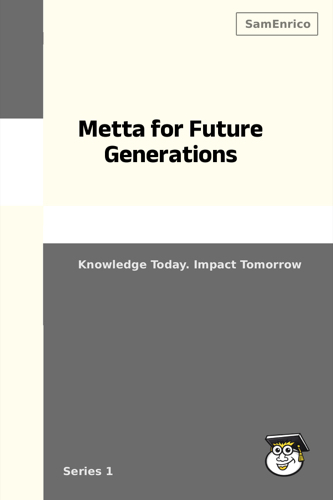
Metta for Future Generations eBook
Wish well for those not yet born.
Wish well for those not yet born.
Formats
Free sample
Chapter 1: The Apology We Never Speak--–- The woman sat on the edge of her daughter's bed at 11:47 on a Tuesday night, the blue glow of her phone still illuminating the latest climate report she had been too afraid to finish. Her daughter, age four, breathed the small, rhythmic breaths of deep childhood sleep, one hand curled around the ear of a stuffed rabbit. The mother wanted to wake her. She wanted to say something, though she did not know what. I'm sorry was what came to mind, though sorry for what exactly?
For the world her daughter would inherit? For the fact that she herself had driven a gasoline car to work that day? For the quieter, more terrible truth that she could not promise her daughter a stable future? She whispered nothing. She turned off the light.
And somewhere in that silence, a billion other parents, a billion other sleepless nights, a billion other unsent apologies to children not yet born—they all accumulated into a single question that no spiritual tradition had fully answered: How do you wish well for someone you will never meet?This book is an attempt to answer that question.The Unspoken Longing Every act of love contains an arrow of time. When you pack a lunch for your child, you are not feeding the child of this moment alone—you are feeding the child of three o'clock, when hunger will arrive. When you plant a tree, you are not shading yourself; you are shading a stranger decades from now. When you write a will, you are speaking to people who will read your words after your heart has stopped. These are ordinary, almost invisible acts of temporal love.
They require no meditation, no philosophy, no spiritual practice. They are simply what care does when it extends itself forward.And yet.There is a kind of love that our culture has no ritual for. It is the love you feel when you read about sea-level rise and think not of yourself but of a teenager in Bangladesh who has not been born yet. It is the love that makes you angry at a politician whose term will end before the worst consequences of their policy arrive. It is the love that whispers, Someone will live in the world I am making, and I will never know their name.
This love has no Valentine's Day. No greeting card. No anniversary. It lives in the margins of environmental reports, in the quiet moments after bad news, in the strange grief of caring deeply for people who, as far as we can prove, do not yet exist.This book names that love. It is called Metta for future generations.What This Chapter Is Not Before we go any further, a confession: this chapter will not give you a meditation technique.
It will not offer a five-step plan. It will not resolve your eco-anxiety in twenty minutes or less. Those things come later—in Chapter 5 (Existential Hope), Chapter 7 (the guided meditation), and Chapter 10 (political compassion). This chapter has a different, more foundational task. It must convince you that the love you already feel for the future is not naive, not sentimental, not a waste of emotional energy.
It must persuade you that your unsent apology—the one you whispered to no one at 11:47 on a Tuesday night—is not a symptom of hopelessness but the seed of a genuine ethical orientation.To do that, we have to go backward before we go forward. We have to ask where this love came from. And that means turning, perhaps surprisingly, to a meditation tradition that is over two thousand five hundred years old.A Short History of Loving-Kindness The Pali word metta (Sanskrit: maitri) is often translated as "loving-kindness." This is accurate but incomplete. Metta is not the warm feeling of romantic love. It is not the fierce protectiveness of a parent.
It is not even the compassionate recognition of shared suffering (that is karuna, a different Brahmavihara). Metta is, more precisely, the radical wish for others to be happy. It is the unconditional, non-romantic, non-exclusive desire that all beings—friends, strangers, enemies, insects, and yes, future generations—experience well-being.The traditional Metta Sutta, attributed to the Buddha, instructs the practitioner to radiate this wish in all directions:May all beings be happy and secure. May all beings be happy-minded. Whatever living beings there are—feeble or strong, long, stout, or medium, short, small, or large, seen or unseen, those dwelling far or near, those who are born or those who await birth—may all beings, without exception, be happy-minded.Pause on that phrase: those who await birth.
The Buddha included the unborn in his original vision of Metta. This is not a modern innovation, not a progressive reinterpretation, not a stretch of the text. The sutta explicitly names "those who await birth" as legitimate recipients of loving-kindness. And yet, for most of the history of Buddhist practice, this phrase has been quietly ignored. Practitioners radiate Metta to the left, to the right, in front, behind, above, below—but almost never forward in time.
Why?The answer is not theological but psychological. The unborn are difficult to love because they are difficult to imagine. They have no faces. They have no names. They have no cries that wake us at 2:00 AM.
They do not vote, do not buy products, do not appear in focus groups. They are, in the most literal sense, nobody. And human brains are exquisitely designed to care about specific somebodies while struggling to care about abstract nobodies. This is not a moral failing; it is a cognitive architecture. We evolved to respond to the cry of a hungry infant in our own tribe, not to the statistical suffering of millions who do not yet exist.But evolution is not destiny.
And meditation is, among other things, a technology for retraining the brain to care beyond its default settings.The Cognitive Barriers (A Brief Preview)Because Chapter 2 will explore these barriers in depth, I will only name them here. But you need to know what you are up against, or this chapter will feel like a pep talk in a burning building.Temporal discounting. Your brain values $10 today over $100 in ten years. It also values the relief of a solved problem today over the prevention of a catastrophe in 2100. This is not stupidity; it is a survival mechanism that worked beautifully on the savanna and works disastrously in the era of climate modeling.Optimism bias.
Your brain tells you that bad things are more likely to happen to other people. Future people, especially, will probably figure things out. They are smarter than us, right? They will have better technology. This bias allows you to sleep at night, but it also allows you to do nothing.The identifiable victim effect.
Give a face and a name to a single suffering child, and donations pour in. Describe a million anonymous future children, and the response is a shrug. Your brain's empathy circuits require concreteness. The future, by definition, is abstract.Empathy fatigue. Even when you do manage to care about the future, the scale of the suffering you imagine…
This is the end of the free sample. Get the eBook to keep going. Buy now
About this book
Details
- Author
- Finney Sanjuana
- Publisher
- SamEnrico
- Language
- English
- Genre
- Non-Fiction, Self-Help, Future
- Released
- 2026-06-08
- Pages (approx.)
- 119
- Available as
- eBook, Audiobook

Read better in the ZLOADR app
Your eBooks on your phone or tablet. Sign in with your SamEnrico account and start reading.
More by Finney Sanjuana
 Courage Under Fire MedalFinney Sanjuana$11.99
 HGH Decline Reversal HandbookFinney Sanjuana$11.99
 Walmart's Sam Walton LegacyFinney Sanjuana$11.99
 How to Become a Paste-up Artist ApprenticeFinney Sanjuana$11.99
 Franchise Cultural AdaptationFinney Sanjuana$12.99
 Coat Check Tagging SystemFinney Sanjuana$11.99
 How to Produce Bowling BallsFinney Sanjuana$11.99
You may also like
 Hong Kong Handover 1997Dunn Johnnie$11.99
 Zumba For Postnatal Recovery CourseNeal Christian$11.99
 Zumba for BeginnersLadner Nikia$11.99
 YouTube Comment Mining GuideHumes Pandora$12.99
 Worry Box MeditationCarlin Rudy$11.99
 Workplace Stress MeditationNguyen Lynn$11.99
 Workplace Stress and Sleep RepairHawley Ivory$11.99
 Workplace Perfectionism CureDelaney Jeffry$11.99
 Workplace Injustice Anger GuideWallen Isabelle$11.99
 Work Addiction and Burnout LinkGreenwood Ester$11.99
 Women in Yoga and WellnessBeattie Galina$11.99
 Women in Stand Up ComedyChun Evangeline$11.99