
Non-FictionSelf-HelpFirst Responder
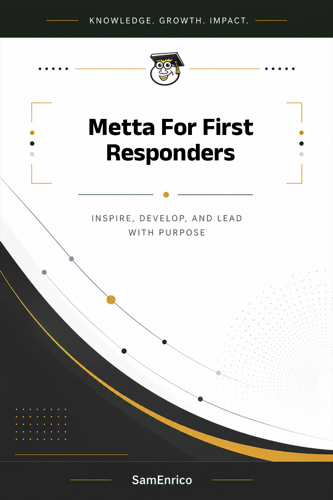
Metta For First Responders eBook
Processes trauma exposure with loving-kindness pra
Processes trauma exposure with loving-kindness practice.
Formats
Free sample
Chapter 1: The Weight We Carry...--The call came in at 2:17 a.m. on a Tuesday. For Captain Mike Reynolds, a twenty-year veteran of the fire service, it was supposed to be routine. Single-vehicle rollover on the interstate. Speeds estimated at seventy-five miles per hour.
The driver, a nineteen-year-old woman, had been ejected. When Mike's engine company arrived, she was still alive. He held pressure on a femoral artery bleed while his paramedic partner worked to establish an airway. The girl's eyes were open. She was conscious.
She said two words: "Help me." Then she stopped breathing. They worked the code for thirty-seven minutes. They got her back twice. She died in the back of the ambulance three blocks from the hospital. Mike cleaned the blood off his uniform in the station bathroom, poured himself a cup of coffee, and sat through the rest of his shift in silence.
He did not cry. He did not talk about it. When his wife asked him the next morning how his night went, he said, "Same old shit." Then he walked past her and went to bed.This chapter is not about that one call. It is about the five hundred calls like it. It is about the cumulative weight that does not announce itself with a single traumatic event but instead accumulates like sediment on the ocean floor—slowly, invisibly, until the floor itself collapses.
And it is about the lie that has been sold to first responders for generations: the lie that hardness is strength, that emotion is weakness, and that "what doesn't kill you makes you stronger."The Myth of Invincibility Every first responder knows the code. It is never written down in any policy manual, but it is enforced more strictly than any regulation. The code says: Do not show weakness. Do not ask for help. Do not admit that anything bothers you.
Laugh at the dark jokes. Drink off-duty to take the edge off. Sleep when you can. And above all, never—under any circumstances—let anyone see that you care too much.This code is not born of malice. It is born of survival.
The first generation of paramedics, the old-school cops who worked before body cameras, the firefighters who ran into burning buildings without SCBA tanks—they developed this emotional armor because they had to. They saw things that would break a normal human being, and they found a way to keep going. The problem is that armor, like any physical protection, has a hidden cost. It is heavy. It restricts movement.
And over time, it becomes impossible to take off.Captain Mike, the fictionalized composite who opens this chapter, is not a rare case. He is the rule. He is the thirty-year veteran who has not had a real conversation with his wife in a decade. He is the police officer whose adult children call him by his first name because "Dad" feels too intimate. He is the dispatcher who has taken thousands of emergency calls and now cannot feel anything when she hears a child scream.
He is the paramedic who has declared more patients dead than alive and has stopped remembering their faces—not because he is cold, but because remembering would drown him.The research bears this out. A 2018 study published in the Journal of Traumatic Stress found that first responders have rates of post-traumatic stress disorder that are three to five times higher than the general population. But PTSD is only the tip of the iceberg. Below the surface are moral injury, compassion fatigue, depression, anxiety, substance use disorders, and a suicide rate that has become the leading cause of line-of-duty death for police officers and firefighters in many jurisdictions. The code of hardness is not protecting anyone.
It is killing them.Three Enemies, One Wound To understand why the code fails, we must name the enemies. They are three distinct but overlapping forces that operate on the psyche of every first responder who has done the job long enough. The first is PTSD. The second is moral injury. The third is compassion fatigue.
Each requires its own definition, its own recognition, and its own path toward healing.Post-Traumatic Stress Disorder: The Fear-Based Wound Post-Traumatic Stress Disorder is the most familiar of the three, but also the most misunderstood. PTSD is not simply "being traumatized." It is a specific neurological condition that occurs when a traumatic event overwhelms the brain's ability to process memory. In a normal brain, a difficult experience is encoded as a memory—something that happened in the past, something that can be recalled but also set aside. In the PTSD brain, the traumatic event is not encoded as a memory. It is encoded as an ongoing threat.
The amygdala, the brain's fear alarm, remains activated. The hippocampus, which timestamps memories as "past," fails to do its job. The result is that the trauma does not feel like something that happened. It feels like something that is happening.For first responders, the triggers are everywhere. The sound of a siren.
The smell of burning rubber. The particular pitch of a child's cry. A date on the calendar. A street intersection. A patient's name that matches someone you lost.
The PTSD brain does not distinguish between "that was then" and "this is now." It responds to every trigger as if the original trauma is occurring in real time. The nightmares, the flashbacks, the hypervigilance, the explosive anger—these are not character flaws. They are neurological symptoms of a brain that has been rewired by horror.Consider the case of Officer James, a fifteen-year veteran of a metropolitan police department. James responded to a domestic disturbance call that turned into an active shooter situation. He took cover behind his patrol car.
The shooter fired thirty-seven rounds. James fired twelve. When it was over, the shooter was dead, and so was a five-year-old child who had been caught in the crossfire. James was cleared by the department's use-of-force review. He was hailed as a hero by the local news.
But he stopped sleeping. He started drinking a fifth of whiskey every night just to shut his brain off. He could not sit with his back to a door. He startled at every loud noise. His wife left him after he threw a dinner plate across the kitchen because she touched his shoulder unexpectedly.
James had PTSD. He did not know it for three years.Moral Injury: The Shame-Based Wound If PTSD is fear, moral injury is shame. The term originated in military contexts to describe the psychological wound that occurs when a service member does something (or fails to do something) that violates their deeply held moral values. But moral injury is not limited to combat. It pervades first responder work.Moral injury happens when you follow protocol and someone dies anyway.
It happens when you freeze for two seconds on a medical call and those two seconds cost a life. It happens when you pull a drunk driver out of a wreck and then have to tell the family of the family of four he killed that their loved ones are gone. It happens when you are dispatched to a…
This is the end of the free sample. Get the eBook to keep going. Buy now
About this book
Details
- Author
- Hackett Lucretia
- Publisher
- SamEnrico
- Language
- English
- Genre
- Non-Fiction, Self-Help, First Responder
- Released
- 2026-06-06
- Pages (approx.)
- 133
- Available as
- eBook, Audiobook

Read better in the ZLOADR app
Your eBooks on your phone or tablet. Sign in with your SamEnrico account and start reading.
More by Hackett Lucretia
 Managing Caregiver Role ReversalHackett Lucretia$11.99
 Remote Onboarding Comms GuideHackett Lucretia$11.99
 The Gambling Self Ban GuideHackett Lucretia$11.99
 The Breast Cancer Palliative GuideHackett Lucretia$11.99
 The Trial of the Phantom of Buenos Aires: The Spy Who Fooled a NationHackett Lucretia$11.99
 Understanding Spasticity Mental RetardationHackett Lucretia$17.99
 Valuation Discount UpdatesHackett Lucretia$12.99
 Supply Chain Climate InsuranceHackett Lucretia$12.99
 How to Start a Civil Service College Business (Beginners Guide)Hackett Lucretia$11.99
 Unit ControllerHackett Lucretia$11.99
You may also like
 Hong Kong Handover 1997Dunn Johnnie$11.99
 Zumba For Postnatal Recovery CourseNeal Christian$11.99
 Zumba for BeginnersLadner Nikia$11.99
 YouTube Comment Mining GuideHumes Pandora$12.99
 Worry Box MeditationCarlin Rudy$11.99
 Workplace Stress MeditationNguyen Lynn$11.99
 Workplace Stress and Sleep RepairHawley Ivory$11.99
 Workplace Perfectionism CureDelaney Jeffry$11.99
 Workplace Injustice Anger GuideWallen Isabelle$11.99
 Work Addiction and Burnout LinkGreenwood Ester$11.99
 Women in Yoga and WellnessBeattie Galina$11.99
 Women in Stand Up ComedyChun Evangeline$11.99