
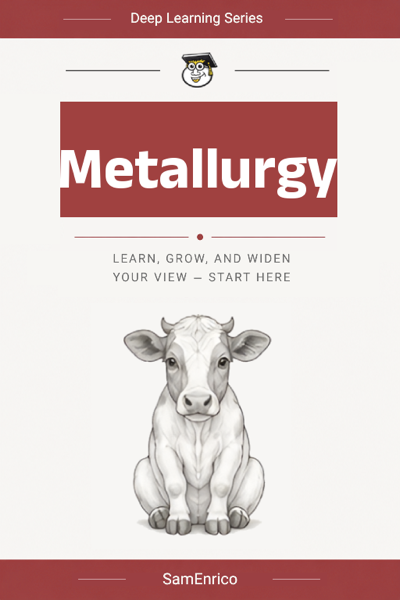
Non-FictionInformativeEducational
Metallurgy eBook
A Coursebook on Metallurgy
by Slack Elmer
A Coursebook on Metallurgy
Formats
Free sample
Chapter 1: The Alchemy of Strength--–- The old iron bridge groaned under its own weight, a deep metallic sigh that echoed across the frozen river gorge. For ninety-seven years, it had carried locomotives, then trucks, then the daily commuters who never once looked down at the riveted lattice of steel beneath their tires. On this particular Tuesday afternoon in January, with the temperature at minus fourteen degrees Fahrenheit, a metallurgist named Elena Vasquez stood on the ice below, aiming a portable ultrasonic thickness gauge at one of the main load-bearing beams. The device beeped. The number on the screen was wrong.
She measured again. Still wrong. Then she measured a different beam, then another, then walked the entire length of the underside, her breath crystallizing in the beam of her headlamp. Every reading told the same story: the steel had grown thinner. Not by rust—the bridge was painted meticulously every seven years—but by something far more insidious.
The iron atoms themselves had been moving, slowly, patiently, for nearly a century, creeping away from the highest-stress regions like sand flowing out from under a heavy stone. The bridge was eating itself from the inside out.Elena did not call the county engineer that night. She called the state emergency management office. By morning, the bridge was closed. By spring, it was demolished.
The replacement cost fifty-two million dollars. The old bridge had cost forty-seven thousand dollars to build in 1927, adjusted for inflation. The difference—fifty-two million dollars—was not the price of concrete and steel. It was the price of ignorance. Ninety-seven years earlier, the men who built that bridge understood strength, understood load calculations, understood how to rivet and brace and paint.
But they did not understand that a metal is not a static thing. It is a living, breathing population of atoms in constant, restless motion. They did not understand that the same atomic dance that gives steel its strength also gives it a slow, inevitable death sentence.This book is about that dance.If you have ever wondered why a paperclip bends a few times and then snaps, why a titanium hip replacement can outlast the patient who receives it, why some stainless steel kitchen knives rust in the dishwasher while others do not, or how a lump of reddish rock dug from the ground becomes the engine block of a passenger jet, you have already asked the questions that metallurgy answers. This book is for the curious, the makers, the fixers, the engineers, the investors, and anyone who has ever held a piece of metal and wondered what it would take to break it—and why it didn't.The first thing you need to understand is that metallurgy is not a single science. It is a conversation between four fundamental questions, and every chapter of this book returns to these questions again and again.
They form what materials scientists call the tetrahedron, though you can think of it as a four-legged stool: Processing, Structure, Properties, Performance.Take that paperclip. The metal started as a coil of steel wire—that's the processing. The wire was drawn through a series of ever-smaller holes, cold-working the metal, shoving dislocations into its crystal lattice—that's the structure at the atomic scale, though you cannot see it with your naked eye. Because of that structure, the wire became stiffer and stronger, but also more brittle—those are the properties. And when you bend it back and forth, the paperclip eventually snaps at a predictable number of cycles—that's the performance.
Change any one of the four legs, and the whole stool wobbles differently.Most people think of metal as a uniform, inert gray substance. In reality, a piece of steel is a chaotic, polyglot metropolis of billions of tiny crystals called grains, each one a few millionths of a meter across, each one packed with imperfections—missing atoms, misplaced atoms, extra atoms wedged into spaces they do not belong. These imperfections are not flaws. They are the entire reason metal is useful. Without them, a perfect crystal of iron would be as brittle as a diamond, shattering under the slightest impact.
With them, iron can be rolled into sheets, drawn into wire, forged into swords, stamped into car bodies. The entire history of human civilization, from the Bronze Age to the space age, is the history of learning to control these imperfections.Consider the difference between a cast-iron frying pan and a high-speed steel drill bit. Both are made mostly of iron. Both contain carbon. But the frying pan's carbon content is around three and a half percent, and it cooled slowly in a sand mold, allowing the carbon to form flakes of graphite throughout the iron.
Those flakes make the pan excellent at holding heat evenly, but they also make it brittle—drop it on a concrete floor, and it will crack. The drill bit contains less than one percent carbon, and it was quenched—cooled so fast that the carbon atoms had no time to migrate and form graphite. Instead, they became trapped inside the iron crystal lattice, distorting it into a tetragonal shape called martensite, harder than glass. The same two elements, arranged differently, produce materials with properties as different as butter and ceramic.This is the core paradox of metallurgy: the more you understand about how metals work, the more you realize how little the average person—and even the average engineer—knows about them. We live in a world built almost entirely of metal and its derivatives.
The average American car contains over two thousand pounds of steel, aluminum, copper, and trace metals like neodymium and dysprosium. The average commercial jetliner contains more than a hundred thousand individual metal components, each one selected for a specific combination of strength, weight, corrosion resistance, fatigue life, and cost. The global steel industry alone produces nearly two billion tons of metal every year—enough to build a Golden Gate Bridge every hour. And yet, most engineering curricula require only a single semester of materials science. Most mechanical engineers graduate without ever looking at a metal fracture surface under a microscope.
Most product designers specify alloys by number alone, without understanding what those numbers mean.That bridge across the frozen river? It was designed by engineers who understood static loads. They calculated the weight of the trains, the force of the wind, the expansion and contraction of the steel with temperature changes. They did not calculate, because the science did not yet exist, the slow, time-dependent deformation called creep, driven by the diffusion of iron atoms along grain boundaries under decades of constant stress. They did not know that the same atomic motion that allowed blacksmiths to forge swords also allows bridges to sag and turbine blades to stretch and pressure vessels to bulge.
By the time Elena Vasquez put her ultrasonic gauge against that beam, the creep strain had reached nearly two percent—not enough to see with the naked eye, but more than enough to reduce the safety margin to zero.This book is organized as a journey. Part One introduces the foundations: what metals are made of, how their atoms arrange themselves, and how thermodynamics and kinetics determine…
This is the end of the free sample. Get the eBook to keep going. Buy now
About this book
Details
- Author
- Slack Elmer
- Publisher
- SamEnrico
- Language
- English
- Genre
- Non-Fiction, Informative, Educational
- Released
- 2026-06-02
- Pages (approx.)
- 155
- Available as
- eBook, Audiobook

Read better in the ZLOADR app
Your eBooks on your phone or tablet. Sign in with your SamEnrico account and start reading.
More by Slack Elmer
 Pecha Kucha Presentation MethodSlack Elmer$11.99
 Body Language ConspiracySlack Elmer$11.99
 Outsourcing Data EntrySlack Elmer$11.99
 Fecal Calprotectin TrackingSlack Elmer$11.99
 Jan Pieterszoon Sweelinck: The Golden Voice of AmsterdamSlack Elmer$11.99
 How to Become a Corrugated-fastener DriverSlack Elmer$11.99
 Charity and Cause Pricing Without FearSlack Elmer$12.99
 How to Produce a Case SealerSlack Elmer$11.99
You may also like
 Hong Kong Handover 1997Dunn Johnnie$11.99
 Zumba For Postnatal Recovery CourseNeal Christian$11.99
 Zumba for BeginnersLadner Nikia$11.99
 YouTube Comment Mining GuideHumes Pandora$12.99
 Worry Box MeditationCarlin Rudy$11.99
 Workplace Stress MeditationNguyen Lynn$11.99
 Workplace Stress and Sleep RepairHawley Ivory$11.99
 Workplace Perfectionism CureDelaney Jeffry$11.99
 Workplace Injustice Anger GuideWallen Isabelle$11.99
 Work Addiction and Burnout LinkGreenwood Ester$11.99
 Women in Yoga and WellnessBeattie Galina$11.99
 Women in Stand Up ComedyChun Evangeline$11.99