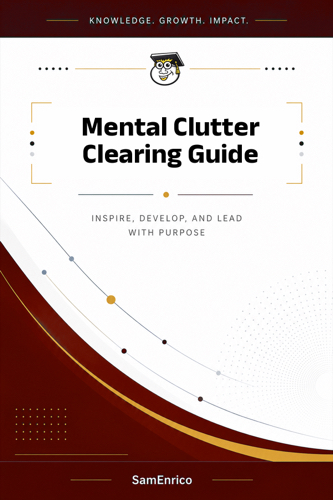
Mental Clutter Clearing Guide
Empties brain of lingering distracting thoughts.
Empties brain of lingering distracting thoughts.
Formats
About this book
Free sample
Chapter 1: The Archaeology of Noise–- Every morning, before you have brushed your teeth or checked your phone, your brain is already at work. Not on your behalf—not yet—but on its own ancient schedule. Deep within the folds of your cerebral cortex, a network of regions called the default mode network (DMN) has been humming along since before you opened your eyes, stitching together fragments of yesterday’s conversations, tomorrow’s deadlines, last year’s embarrassments, and a vague sense that you forgot something important. This is not a bug. It is not a sign of weakness or poor discipline.
It is the result of three hundred million years of evolutionary refinement, and it is the single greatest obstacle to mental clarity you will ever face—not because your brain is broken, but because it is working exactly as it was designed to work in a world that no longer exists.To clear mental clutter, you must first understand what you are fighting. And what you are fighting is not just “having a lot on your mind.” It is a specific neurological machinery built to keep you alive on the savanna, now running on overdrive in an era of emails, group chats, news alerts, and unfinished arguments that live rent-free in your head for decades.The Discovery of the Brain’s Idle Engine In the early 1990s, a neuroscientist named Marcus Raichle at Washington University School of Medicine made an accidental discovery that would change how we understand the wandering mind. He and his team were using positron emission tomography (PET) scans to measure brain activity while participants performed specific tasks—reading words, looking at pictures, solving problems. They expected to see certain regions “light up” during these tasks. They did.
But they also noticed something strange: when participants were asked to simply rest and do nothing, a different set of regions became consistently active. Not just active—highly active. More active, in fact, than during many of the tasks themselves.This was counterintuitive. For decades, neuroscientists had assumed that the brain at rest was essentially idling, like a car…
This is the end of the free sample. Get the eBook to keep going. Buy now
Contents
- Chapter 1
- Chapter 2
- Chapter 3
- Chapter 4
- Chapter 5
- Chapter 6
- Chapter 7
- Chapter 8
- Chapter 9
- Chapter 10
- Chapter 11
- Chapter 12
Details
- Author
- Myers Allison
- Publisher
- SamEnrico
- Language
- English
- Genre
- Non-Fiction, Self-Help, Cognitive Load
- Released
- 2026-06-10
- Pages (approx.)
- 123
- Available as
- eBook, Audiobook

Read better in the ZLOADR app
Your eBooks on your phone or tablet. Sign in with your SamEnrico account and start reading.
More by Myers Allison
 Due App RepetitionMyers Allison$11.99
 CrossFit Mental ToughnessMyers Allison$11.99
 Post Traumatic Growth After Child LossMyers Allison$11.99
 Parent Death Time Capsule GuideMyers Allison$11.99Parent Death Time Capsule GuideMyers Allison$11.99
 The Fake Adoption SchemeMyers Allison$11.99
 The Exercise Assisted QuitMyers Allison$11.99
 EQ for Anger Management GuideMyers Allison$11.99
 College Exam StrategyMyers Allison$11.99
 The Barrios That Roar: How Colombian Soccer Fans Saved a Nation’s SoulMyers Allison$11.99
 The Beat That Broke Barriers: How a Teen DJ Revolutionized Global MusicMyers Allison$11.99
 The Last Broadcast: The Fall of Kabul Through a Reporter's LensMyers Allison$11.99