
Non-FictionHealth & WellnessTemperatureChills
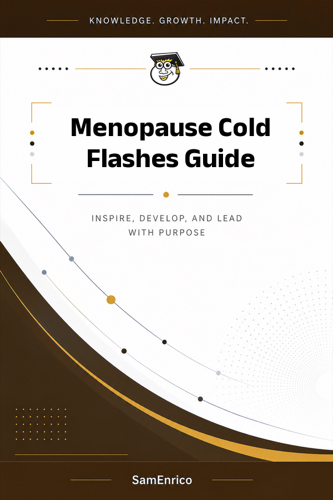
Menopause Cold Flashes Guide eBook
Address sudden cold sensations and chills that alt
Address sudden cold sensations and chills that alternate with hot flashes.
Formats
Free sample
Chapter 1: The Frozen Flush...--–- The first time it happened, Margaret was standing in front of an open freezer aisle at Costco, reaching for a bag of frozen berries. One moment she was fine. The next, her skin erupted in goosebumps so violent she nearly dropped her shopping basket. Her teeth chattered. Her fingers turned white at the tips.
She pulled her cardigan tighter, confused because the store was sixty-eight degrees and she had been comfortable seconds earlier. A woman pushing a cart stopped and asked if she was okay. Margaret nodded, embarrassed, and hurried to the checkout. By the time she reached her car, the chill had vanished as suddenly as it arrived. She sat in the driver's seat, windows up, heater off, perfectly warm, and wondered if she was losing her mind.Margaret is not losing her mind.
She is experiencing a cold flash – one of the most underreported, misunderstood, and unnecessarily isolating symptoms of the menopause transition. And she is far from alone.If you are reading this book, chances are something similar has happened to you. Perhaps you have woken up at two in the morning drenched in sweat, only to start shivering uncontrollably five minutes later. Perhaps you have been sitting in a meeting, perfectly comfortable, when a wave of cold washed over you for no apparent reason. Perhaps you have noticed that your body seems to have forgotten how to pick a temperature – swinging from hot to cold and back again like a broken pendulum.
Perhaps you have searched online for "sudden chills menopause" and found plenty of information about hot flashes, but almost nothing about the cold that follows. Perhaps you have even wondered if something else is wrong – a thyroid problem, a circulation issue, or just anxiety.Let me be clear about what this chapter will do. It will name your experience. It will validate what you have been feeling. It will show you that cold flashes are not rare, not imaginary, and not a sign of some hidden disease.
And it will introduce you to three distinct patterns of cold flashes – because understanding your specific pattern is the single most important step toward managing this symptom effectively.Most menopause books dedicate pages and pages to hot flashes. They describe the rush of heat, the redness, the sweating. They offer tips on cooling down. They normalize the experience. But cold flashes – the sudden chills, the goosebumps, the shivering, the cold intolerance that makes you reach for a sweater in July – these are usually mentioned in a single paragraph, if they are mentioned at all.
One best-selling menopause guide devotes exactly two sentences to cold sensations. Another mentions chills only in the context of night sweats. A third dismisses them as "less common" and moves on.This silence creates a quiet crisis. Women who experience cold flashes assume they are anomalies. They do not bring it up with their doctors because they are not sure it is a menopause symptom at all.
Their doctors, who were trained in the same silence, often shrug and order thyroid tests that come back normal. The woman leaves the office with no explanation, no treatment plan, and a growing sense that her body is doing something weird that no one else understands.The truth is that cold flashes are not less common than hot flashes. They are less reported. There is a difference. When researchers have asked specifically about cold sensations, the numbers tell a different story.
In one study of perimenopausal women, nearly forty percent reported experiencing chills or cold intolerance as part of their vasomotor symptoms. Another study found that among women who reported hot flashes, more than half also experienced a cold phase afterward. The reason cold flashes seem rare is that no one asks about them. The research tools used in most menopause studies ask specifically about "hot flashes" and "night sweats." They do not ask about chills, shivering, or cold intolerance. You cannot measure what you do not ask.So let us name what is happening to you.
A cold flash is a sudden, transient episode of cold sensation, often accompanied by visible shivering, goosebumps, and a subjective feeling of being chilled to the bone. It may last anywhere from thirty seconds to several minutes. It may occur on its own, or it may follow a hot flash. It may be limited to your extremities, or it may spread across your entire body. It may be mild enough to ignore, or severe enough to interrupt your sleep, your work, and your sense of normalcy.The physiology of a cold flash is the mirror image of a hot flash.
During a hot flash, blood vessels near the skin widen – a process called vasodilation – allowing heat to escape from your core to your skin. You feel hot. You may sweat as your body tries to cool itself further. During a cold flash, the opposite happens. Blood vessels constrict – vasoconstriction – reducing blood flow to the skin and trapping heat in your core.
Your skin temperature drops. Your body activates the piloerector muscles, the tiny muscles attached to each hair follicle, causing goosebumps. If the cold sensation is intense enough, your body initiates shivering thermogenesis – rapid, involuntary muscle contractions that generate heat. You feel cold. You may shake.
You may pull on a sweater even though the room temperature has not changed.This is not in your head. This is not anxiety. This is your vascular and neuromuscular systems responding to a signal from your brain – a signal that has been scrambled by changing hormone levels.But here is where most resources get it wrong. They assume that cold flashes are simply the tail end of a hot flash – the rebound after the heat. For many women, that is true.
For many others, it is not. And this distinction matters enormously because the strategies that work for one pattern can be useless or even harmful for another.Based on clinical data and patient reports, cold flashes fall into three distinct patterns. Understanding your pattern is the foundation of everything that follows in this book.Pattern one is the hot-first pattern. This is the most common pattern, affecting perhaps sixty to seventy percent of women who experience cold flashes. In this pattern, a classic hot flash occurs first – the rush of heat, the sweating, the redness.
The hot flash lasts anywhere from one to five minutes and then begins to subside. But instead of returning to normal temperature, the body over-corrects. As the heat-dissipation mechanisms shut down, the body's temperature regulation system swings too far in the opposite direction. Vasoconstriction kicks in. The skin, still damp with sweat, begins to cool rapidly through evaporation.
The result is a cold phase that typically begins five to fifteen minutes after the hot flash started and lasts another five to ten minutes. Women with this pattern often describe it as "the freeze after the flush." They wake up in the middle of the night drenched in sweat, throw off the covers, and then ten minutes later are shivering and reaching for blankets. They step out of a hot shower feeling fine, but by the time they have dried off…
This is the end of the free sample. Get the eBook to keep going. Buy now
About this book
Details
- Author
- Sommer Merlin
- Publisher
- SamEnrico
- Language
- English
- Genre
- Non-Fiction, Health & Wellness, Temperature, Chills
- Released
- 2026-06-07
- Pages (approx.)
- 155
- Available as
- eBook, Audiobook

Read better in the ZLOADR app
Your eBooks on your phone or tablet. Sign in with your SamEnrico account and start reading.
More by Sommer Merlin
 Alcohol and Anger TriggersSommer Merlin$11.99
 Workaholism And Eating DisordersSommer Merlin$11.99
 Chet Atkins Guitar Gentleman GuideSommer Merlin$11.99
 Brainwriting Team Technique GuideSommer Merlin$11.99
 The Troll King's Last Lesson: A Wizened Sage of the Northern WastesSommer Merlin$11.99
 The Clockwork Cartographer: Franklin's Lost Expedition and the Birth of Mechanical ExplorationSommer Merlin$11.99
 How to Start a Pawnshops (principally Dealing In Second-hand Goods) (retail) Business (Beginners GuiSommer Merlin$11.99
 Associate Support AnalystSommer Merlin$11.99
 Post Win Execution HandbookSommer Merlin$12.99
 Energy Efficiency PricingSommer Merlin$12.99
 Understanding FructosuriaSommer Merlin$17.99
You may also like
 Hong Kong Handover 1997Dunn Johnnie$11.99
 Zumba For Postnatal Recovery CourseNeal Christian$11.99
 Zumba for BeginnersLadner Nikia$11.99
 YouTube Comment Mining GuideHumes Pandora$12.99
 Worry Box MeditationCarlin Rudy$11.99
 Workplace Stress MeditationNguyen Lynn$11.99
 Workplace Stress and Sleep RepairHawley Ivory$11.99
 Workplace Perfectionism CureDelaney Jeffry$11.99
 Workplace Injustice Anger GuideWallen Isabelle$11.99
 Work Addiction and Burnout LinkGreenwood Ester$11.99
 Women in Yoga and WellnessBeattie Galina$11.99
 Women in Stand Up ComedyChun Evangeline$11.99