
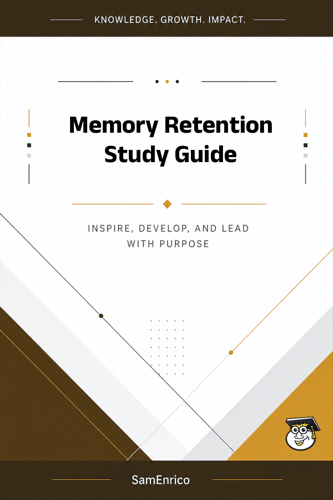
Memory Retention Study Guide eBook
Use spaced repetition, active recall, and memory p
by Reiter Bonny
Use spaced repetition, active recall, and memory palaces to reduce study time.
Formats
Free sample
Chapter 1: The Forgetting Trap--–- Sarah had spent fourteen hours that week re-reading her organic chemistry textbook. She had highlighted nearly every paragraph in three different colors. She had reviewed her highlighted sections twice. She felt prepared. She felt confident.
She felt like she had finally mastered the 150 reactions that would appear on Monday's exam.Then came the practice test.Sarah stared at the first question: "Draw the mechanism of the aldol condensation between acetaldehyde and benzaldehyde." Her mind went blank. She remembered reading about aldol reactions. She remembered the yellow highlighter on page 347. She even remembered thinking, "This is important" as she underlined a particular sentence. But the mechanism itself?
The curved arrows? The intermediate? Nothing.She flipped to the next question. Then the next. By the tenth question, Sarah was no longer staring at the page.
She was staring at the ceiling, fighting the growing knot in her stomach. She had studied harder for this exam than any other in her life. She had sacrificed sleep, social time, and sanity. And she was failing.Sarah is not real. But her experience is.
It is repeated millions of times every semester in every country on earth. Students re-read. They highlight. They summarize. They feel productive.
And then, within 48 hours, they forget 80 percent of what they "learned." This is not a character flaw. It is not a lack of intelligence. It is not laziness or stupidity. It is the Ebbinghaus Forgetting Curve, discovered by German psychologist Hermann Ebbinghaus in 1885, and it is one of the most replicated findings in the history of cognitive science.This chapter is the first step in breaking that curve forever.The Discovery That Changed Everything Hermann Ebbinghaus was a pioneer of memory research. Unlike the philosophers who came before him, Ebbinghaus did not speculate about memory.
He measured it. He invented 2,300 nonsense syllables—meaningless combinations like "ZOF," "WUK," and "QAX"—and tested his own ability to remember them over time. What he discovered was both simple and devastating.Immediately after learning a list of nonsense syllables, Ebbinghaus remembered nearly everything. But after just 20 minutes, he had forgotten 42 percent. After one hour, 56 percent.
After one day, 67 percent. After one week, 77 percent. After one month, 79 percent. The curve was steep, exponential, and unforgiving. No matter what he tried—repeating the syllables, writing them down, grouping them into patterns—the curve remained.This is the Forgetting Curve.
And it applies to everything you learn, not just nonsense syllables.When you read a textbook chapter, attend a lecture, or watch an educational video, your brain begins forgetting almost immediately. Within one hour, you will have lost more than half of what you just learned. Within 24 hours, you will have lost nearly two-thirds. Within a week, you will have lost three-quarters. This is not a flaw in your brain.
It is a feature—one we will use strategically in later chapters. But first, we must understand why it happens.Why Your Brain Is Designed to Forget Your brain contains approximately 86 billion neurons. Each neuron can form thousands of connections with other neurons, creating a theoretical storage capacity of 2.5 petabytes—roughly three million hours of television shows. You have more than enough space to remember everything you have ever experienced. So why do you forget?The answer lies in energy efficiency.Your brain consumes 20 percent of your body's calories despite representing only 2 percent of your body weight.
Every memory, every neural connection, every synapse requires energy to maintain. If your brain remembered everything—the color of every car you passed on your morning walk, the pattern of every cloud you saw last Tuesday, the exact wording of every advertisement you have ever ignored—it would quickly exhaust its metabolic budget.So your brain evolved a pruning mechanism. Information that you do not use, do not retrieve, and do not need is gradually discarded. The neural pathways that represent that information weaken, then thin, then disappear. This is forgetting.
And it is not a bug. It is a critical feature that allows your brain to prioritize what matters.The problem is that your brain has a very different definition of "what matters" than you do.Your brain cares about survival, safety, and social belonging. It does not care about organic chemistry mechanisms, historical dates, or foreign language vocabulary—unless you convince it otherwise. Re-reading and highlighting do not convince your brain. They feel easy, familiar, and low-effort.
Your brain interprets this ease as a signal: "This information is already known. No need to strengthen the connection."This is the fluency illusion, and it is the single greatest enemy of effective studying.The Fluency Illusion: Why Feeling Smart Makes You Stupid Psychologists have known for decades that the subjective experience of "knowing" is a poor predictor of actual memory. In one classic study, researchers gave students a list of words to study. Half of the students studied the list once. The other half studied it four times.
Then both groups predicted how many words they would remember on a test.The students who studied four times were much more confident. They had seen the words repeatedly. The words felt familiar. The students who studied only once were less confident; they knew they had not seen the words very often.The results? Both groups remembered exactly the same number of words.Repeated exposure creates a feeling of familiarity.
Familiarity feels like knowledge. But it is not. Knowledge requires retrieval—the active, effortful act of pulling information from your memory without looking. Familiarity requires only recognition, which is passive and shallow.This is why Sarah failed her practice test. She had seen the aldol condensation mechanism multiple times.
She recognized it when she saw it in the textbook. But when she needed to retrieve it from scratch—to produce it without cues—she could not. Her brain had strengthened the pathway for recognition but not the pathway for production.The same thing happens when you re-read a chapter. Each time you see the same words on the same page, in the same order, with the same headings and diagrams, you feel more confident. But your confidence is an illusion.
You are not learning. You are merely becoming familiar with the physical layout of the information, not its content.The Myth of Learning Styles Before we go further, we must clear away one of the most persistent myths in education: learning styles.You have heard this before. "I'm a visual learner." "I need to hear it to understand it." "I learn best by doing." These statements feel true. They have become part of our cultural vocabulary. But they are not supported by evidence.In 2009, a team of cognitive psychologists led by Harold Pashler reviewed decades of research on learning styles.
They found no convincing evidence that matching instruction to a student's preferred style improves learning outcomes. None. Subsequent reviews have reached the same conclusion. The idea of learning styles is intuitively appealing but scientifically bankrupt.Why does this matter for memory retention? Because the learning styles myth encourages you to seek comfortable, familiar modes of study.
Visual learners reach for diagrams. Auditory learners reach for recordings. Kinesthetic learners reach for hands-on activities. But comfort is the…
This is the end of the free sample. Get the eBook to keep going. Buy now
About this book
Details
- Author
- Reiter Bonny
- Publisher
- SamEnrico
- Language
- English
- Genre
- Non-Fiction, Self-Help, Learning Strategies
- Released
- 2026-06-07
- Pages (approx.)
- 139
- Available as
- eBook, Audiobook

Read better in the ZLOADR app
Your eBooks on your phone or tablet. Sign in with your SamEnrico account and start reading.
More by Reiter Bonny
 In Law Stress Management GuideReiter Bonny$11.99
 Combined Loci Peg SystemReiter Bonny$11.99
 Loving Kindness For TeensReiter Bonny$11.99
 Meditation for Illness AnxietyReiter Bonny$11.99
 Unionization Talent FlowsReiter Bonny$11.99
 Surge Pricing EvidenceReiter Bonny$11.99
 Parent Caregiver MistakesReiter Bonny$11.99
 Mesa Verde Cliff DwellingsReiter Bonny$11.99
 The Great Bitcoin Heist: How Iceland’s Cold War Became a Crypto Gold RushReiter Bonny$11.99
 Love in the Casbah: A Soldier and a Rebel in the Algerian WarReiter Bonny$11.99
 The Spinners: Could It Be I’m Falling in Love, YesReiter Bonny$11.99
 Growing DrosanthemumReiter Bonny$11.99
You may also like
 Interleaved Studying PracticeLarue Lera$11.99
 Chunking Study MaterialThomson Lucina$11.99
 Interleaving Practice for Problem SolvingMcgrath Rueben$11.99
 Chunking Abstract ConceptsMarx Lane$11.99
 Interleaving Study MethodKroll Ermelinda$11.99
 Pattern Recognition for LearningBenitez Horacio$11.99
 Loci Palace Construction HandbookStover Tenisha$11.99
 The Sleep Dependent Learning GuideHammonds Warner$11.99