
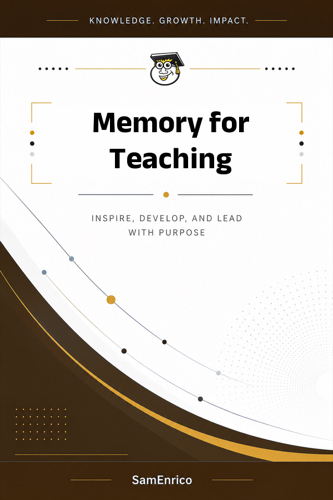
Free sample
Chapter 1: The Bouncer at the Door--–- Every teacher knows the feeling. You stand at the front of the room, having just delivered what you genuinely believe was a brilliant explanation. You used the good analogy, the one that worked last year. You paused for effect. You made eye contact with the student in the back who is usually on their phone.
You ask a simple question—something basic, something you literally just said ninety seconds ago. A hand goes up. The student asks, “Wait, can you say that again? I wasn’t listening.”You feel it in your chest. That mixture of frustration, exhaustion, and a tiny, quiet voice that whispers, Maybe I’m just not a good teacher.Here is what you need to know: you are not a bad teacher.
You are fighting a biological fact that no amount of charisma, preparation, or colorful slides can bypass. Before any student can remember what you taught, before any fact can move from your mouth to their long-term memory, they have to pass through a single, ruthless gatekeeper. That gatekeeper is attention. And attention is not something you can demand, beg, or bribe into existence for an entire hour. Attention is a limited, selective, exhaustible resource.
If your lesson does not get past the bouncer at the door, nothing else matters. Not your perfectly aligned learning objectives. Not your standards-based grading rubric. Not the beautiful worksheet you stayed up late creating. Nothing.This chapter is about that bouncer.
You are going to learn exactly how attention works, why your students lose it, and—most importantly—how to design your lessons so that attention shows up, stays for a while, and actually lets the information through the door.The Three Lies Teachers Tell Themselves About Attention Before we get into the science, we need to clear out some junk. Most teachers operate under three unconscious beliefs about attention. These beliefs are wrong, and they are making you miserable.Lie Number One: “If the content is interesting enough, they will pay attention.”This sounds nice. It is also false. You can show a video of a volcano erupting in slow motion while a dramatic orchestra plays, and three students will still be staring at a crack in the ceiling.
Why? Because interest is subjective. What fascinates you (the intricate geological processes that lead to a pyroclastic flow) might bore a fourteen-year-old…
This is the end of the free sample. Get the Audiobook to keep going. Buy now
About this book
Details
- Author
- Saylor Patrick
- Publisher
- SamEnrico
- Language
- English
- Genre
- Non-Fiction, Self-Help
- Released
- 2026-06-07
- Pages (approx.)
- 128
- Available as
- eBook, Audiobook

Listen in the VoxFlicks app
Audiobooks and audio dramas wherever you go. Sign in with your SamEnrico account and press play.
More by Saylor Patrick
 Retail Space Lease NegotiationSaylor Patrick$11.99
 Stop Interrupting Yourself CourseSaylor Patrick$11.99
 Desert Oasis EscapeSaylor Patrick$11.99
 Miscarriage Prolonged GriefSaylor Patrick$11.99
 Energy Efficient Depreciation BonusSaylor Patrick$11.99
 Loving Kindness for a One Night StandSaylor Patrick$11.99
 Vietnam Dustoff MedicSaylor Patrick$11.99
 Exam Prep Time BlockingSaylor Patrick$11.99
 Whispers of the Black Stone: The Lost Rites of the DruidsSaylor Patrick$11.99
 The Last Transmission: The Titanic’s Wireless Operators and Their Final BroadcastsSaylor Patrick$11.99
 The Iron Makers of the Sahel: Forging the Future of AfricaSaylor Patrick$11.99
 Understanding Allergic Autoimmune ThyroiditisSaylor Patrick$17.99
You may also like
 Workplace Stress MeditationNguyen Lynn$11.99
 Volcano Monitoring ScientistCox Alexis$11.99
 The Tech Professional NetAguiar Nevada$11.99
 The Morning Metta RitualCanales Anya$11.99
 The Chunking Memory TechniqueClanton Hyacinth$11.99
 The Beginner Mistake FixAmmons Cassondra$11.99
 Surrendering to What IsGrimm Reatha$11.99
 Self Hypnosis for Fear of FireBillups Eli$11.99
 Road Rage for Professional DriversBrackett Janise$11.99
 Psychiatric Ward Nurse StressDunning Wyatt$11.99
 Observation vs Evaluation NVCTimmons Alda$11.99
 Networking for Nonprofit ProfessionalsPoole Jesse$11.99