
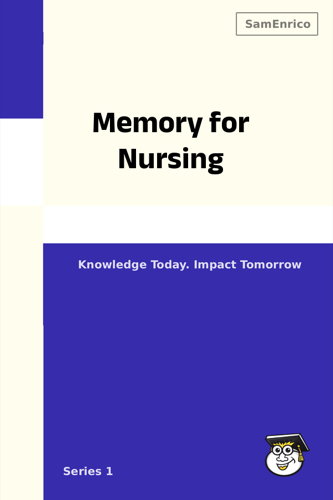
Memory for Nursing eBook
undefined
undefined
Formats
Free sample
Chapter 1: The Forgetting Crisis--–- The call came in at 3:47 AM on a Tuesday, and Emily, a newly graduated nurse just three weeks off orientation, felt her stomach drop before she even read the triage note. "Room 4, 68-year-old male, weakness, possible electrolyte imbalance." She grabbed her stethoscope, took a breath, and walked in. Mr. Henderson was awake, alert, and complaining of "just feeling off." His potassium level from the morning draw was 6.1 m Eq/L—flagged critical. Emily knew that number was high.
She had memorized the normal range of 3.5 to 5.0 for her exam just six months ago. But standing in that room at 3:47 AM, with a patient who looked fine, she froze. Should she call the provider? Get an EKG? Give calcium gluconate?
Or was this a lab error? She rechecked the value, rechecked the patient, and hesitated. Forty-seven minutes later, Mr. Henderson's telemetry monitor showed peaked T waves, then a wide QRS, then ventricular tachycardia. The code team arrived.
He survived, but Emily spent the rest of her shift in the break room, crying, replaying the moment she knew the fact but could not retrieve the action.This is not a story about a bad nurse. This is a story about a broken study system. Emily knew the normal potassium range. She had written it on flashcards, highlighted it in her textbook, and repeated it aloud three times before her NCLEX. But knowing and retrieving are not the same thing.
Nursing school teaches recognition—multiple-choice questions where the answer is in front of you. Clinical practice demands retrieval—pulling the right information from memory under pressure, without cues, while a patient's life hangs in the balance. The gap between those two skills is where errors happen. It is where confidence dies. And it is the problem this book exists to solve.Every year, approximately 150,000 nursing students graduate in the United States alone.
The vast majority of them have studied for hundreds of hours. They have read thousands of pages. They have memorized drug suffixes, lab values, and disease processes. And yet, on the NCLEX and in clinical practice, they fail not because they never learned the material, but because they cannot access it when it matters. This chapter will explain exactly why that happens—and preview the solution that the rest of this book will deliver.
You do not have a memory problem. You have a retrieval problem. And retrieval can be trained.The Science of Forgetting: Why You Lose 50% in 24 Hours In 1885, German psychologist Hermann Ebbinghaus published a discovery that has been replicated hundreds of times since: the Forgetting Curve. Ebbinghaus memorized lists of nonsense syllables (like "WID" and "ZOF") and then tested himself at increasing intervals. What he found was both simple and devastating.
Within one hour of learning new information, subjects forgot an average of 50% of what they had learned. Within 24 hours, that number climbed to 70%. Within one week, without reinforcement, retention dropped below 10%.Here is what that means for a nursing student. You attend a two-hour lecture on heart failure on Monday morning. You take careful notes.
You underline key points. By Tuesday morning—just 24 hours later—you have already forgotten 70% of what you learned. The four stages of heart failure? Gone. The difference between left-sided and right-sided symptoms?
Faded. The mechanism of action of furosemide? Vague at best. You are not lazy. You are not unintelligent.
You are simply human, operating under the same biological constraints that Ebbinghaus documented more than a century ago.But here is the critical insight that most nursing students never learn: the Forgetting Curve is not destiny. Ebbinghaus also discovered that the curve could be flattened dramatically by a single intervention—active recall. When subjects were forced to retrieve information from memory (by testing themselves) rather than simply rereading it, the rate of forgetting dropped by more than 60%. One self-test immediately after learning, followed by another self-test at 24 hours, and another at 48 hours, transformed a 70% loss into a 30% loss or less.The problem is that most nursing students do not practice active recall. They practice passive review.
They reread chapters. They highlight textbooks. They rewrite their notes. These strategies feel productive—your hands are moving, your eyes are tracking words, you are spending time with the material—but they are among the least effective study methods ever measured. In a landmark 2008 study published in the journal Psychological Science, researchers found that students who reread a passage three times performed worse on a subsequent test than students who read it once and then tested themselves once.
Rereading creates an illusion of competence. Your brain sees the words on the page and confuses familiarity ("I've seen this before") with mastery ("I can retrieve this on demand").Cognitive Load: Why Nursing School Breaks Your Working Memory The Forgetting Curve is only half the problem. The other half is something called Cognitive Load Theory, developed by educational psychologist John Sweller in the 1980s. Cognitive load refers to the total amount of mental effort being used in your working memory at any given moment. Working memory—the part of your brain that holds and manipulates information in real time—is severely limited.
The most widely cited estimate, from psychologist George Miller's 1956 paper "The Magical Number Seven, Plus or Minus Two," suggests that working memory can hold approximately seven discrete pieces of information at once. More recent research has revised that number downward to four or five.Now consider what nursing school asks you to hold in working memory simultaneously. For a single patient with heart failure, you might need to recall: the normal range for brain natriuretic peptide (BNP), the difference between systolic and diastolic dysfunction, the four stages of heart failure as classified by the American College of Cardiology, the mechanism of action of three different diuretics, the electrolyte imbalances caused by those diuretics (especially potassium), the signs of digoxin toxicity if the patient is also on that medication, the dietary sodium restriction target (less than 2,000 mg per day), the fluid restriction if the patient is hyponatremic, the daily weight parameters (more than 2-3 pounds in 24 hours is concerning), the lung sounds associated with pulmonary edema, the positioning interventions for orthopnea, and the discharge teaching points about when to call the provider. That is not seven pieces of information. That is closer to seventy.The traditional nursing study method—rereading, highlighting, and linear notetaking—does nothing to reduce cognitive load.
In fact, it makes the problem worse. When you reread a chapter on heart failure, you are re-exposing yourself to all seventy pieces of information at once, without any structure to help your brain organize them. Your working memory becomes overwhelmed. You feel exhausted after an hour of studying, even though you have not actually encoded anything for long-term retention. This is the "brain freeze" that Emily experienced in Room 4—not a lack of knowledge, but a catastrophic overload of working memory at the exact moment she needed to retrieve a single piece of critical information.The Illusion of Recognition: Why Multiple Choice Lies to You There is another, more insidious reason that nursing students fail to retrieve information in clinical settings: the NCLEX and nursing school exams are fundamentally different from real…
This is the end of the free sample. Get the eBook to keep going. Buy now
About this book
Details
- Author
- Corrigan Taneka
- Publisher
- SamEnrico
- Language
- English
- Genre
- Non-Fiction, Self-Help
- Released
- 2026-06-08
- Pages (approx.)
- 148
- Available as
- eBook, Audiobook

Read better in the ZLOADR app
Your eBooks on your phone or tablet. Sign in with your SamEnrico account and start reading.
More by Corrigan Taneka
 Distraction Proofing Your BrainCorrigan Taneka$11.99
 1031 Exchange Improvement ExchangesCorrigan Taneka$11.99
 Ex Spouse Death Complicated GriefCorrigan Taneka$11.99
 Treehouse Sanctuary GuideCorrigan Taneka$11.99
 Navy Corpsman Iwo JimaCorrigan Taneka$11.99
 Morning Routine For CreativesCorrigan Taneka$11.99
 Industrial Warehouse Investment StrategyCorrigan Taneka$11.99
 Job Search Time BlocksCorrigan Taneka$11.99
 Night Wolves: The Soviet Saboteurs of Operation GreifCorrigan Taneka$11.99
 The Troll King's Last Stand: A Forgotten Saga of CamelotCorrigan Taneka$11.99
 The Ghost of Station X: The Secret Codebreakers of Bletchley ParkCorrigan Taneka$11.99
 The Complete Guide to Half Assed Weight LossCorrigan Taneka$11.99
You may also like
 Hong Kong Handover 1997Dunn Johnnie$11.99
 Zumba For Postnatal Recovery CourseNeal Christian$11.99
 Zumba for BeginnersLadner Nikia$11.99
 YouTube Comment Mining GuideHumes Pandora$12.99
 Worry Box MeditationCarlin Rudy$11.99
 Workplace Stress MeditationNguyen Lynn$11.99
 Workplace Stress and Sleep RepairHawley Ivory$11.99
 Workplace Perfectionism CureDelaney Jeffry$11.99
 Workplace Injustice Anger GuideWallen Isabelle$11.99
 Work Addiction and Burnout LinkGreenwood Ester$11.99
 Women in Yoga and WellnessBeattie Galina$11.99
 Women in Stand Up ComedyChun Evangeline$11.99