
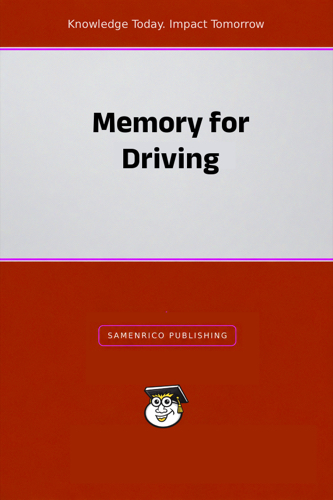
Free sample
Chapter 1: The Forgotten Commute...--The average driver will spend 38 actual days of their life sitting at red lights. They will circle the same block searching for parking for the equivalent of a full week. They will grip the steering wheel for over 40,000 miles—enough to circle the Earth one and a half times—without any conscious memory of most of those miles. Ask a commuter on a Friday afternoon what they saw on their drive to work that morning, and they will struggle to recall a single mailbox, pedestrian, or pothole. The road has become a ghost.This is not a failure of character.
It is not laziness, carelessness, or a lack of concern for safety. It is, quite simply, the way the human brain was designed to work. And that design flaw—or feature, depending on how you use it—is the single greatest predictor of whether you will end the year in a crash or arrive home without remembering how you got there.Every dangerous situation on the road begins as a failure of memory. Not the kind of memory that helps you recite poetry or remember a birthday, but the kind that keeps you alive when a child chases a ball into the street. The driver who runs a red light did not forget the law.
They forgot to look. The driver who sideswipes a motorcyclist did not forget that motorcycles exist. Their brain deleted the motorcyclist from the visual field because, statistically, that space was usually empty. The driver who rear-ends the car in front of them did not forget to brake. Their working memory was so consumed by a phone call that there was no remaining capacity to calculate following distance.This book is built on a simple, radical premise: driving is not a test of reflexes.
It is a test of memory. And like any memory system, it can be trained, optimized, and hardened against failure. But first, you must understand what you are working with.The Two Memory Systems You Use Every Time You Drive Before we can fix the problem, we must name the parts. The human brain does not have one memory system. It has dozens, each with its own rules, strengths, and catastrophic weaknesses.
For driving, two systems matter above all others.Procedural memory is the brain’s autopilot. It governs actions you have performed so many times that they no longer…
This is the end of the free sample. Get the Audiobook to keep going. Buy now
About this book
Details
- Author
- Sweet Dann
- Publisher
- SamEnrico
- Language
- English
- Genre
- Non-Fiction, Self-Help
- Released
- 2026-06-06
- Pages (approx.)
- 145
- Available as
- eBook, Audiobook

Listen in the VoxFlicks app
Audiobooks and audio dramas wherever you go. Sign in with your SamEnrico account and press play.
More by Sweet Dann
 Commercial Lease Abstraction GuideSweet Dann$11.99
 Meeting Interruption BusterSweet Dann$11.99
 Mass Shooting Grief GuideSweet Dann$11.99
 Gulf War Combat MedicSweet Dann$11.99
 Loving Kindness for a Stray AnimalSweet Dann$11.99
 Depreciation of Restaurant EquipmentSweet Dann$11.99
 Sunrise Yoga VisualizationSweet Dann$11.99
 Social Media Time BoxingSweet Dann$11.99
 The Night the Music Died: How a Single Decision Toppled a GovernmentSweet Dann$11.99
 The Ghost Fleet of Operation K: The Doomed Convoy That Changed the Pacific WarSweet Dann$11.99
 Shadows of the Silk Road: The Lost War Correspondents of the 19th CenturySweet Dann$11.99
 Understanding Alopecia AreataSweet Dann$17.99
You may also like
 Workplace Stress MeditationNguyen Lynn$11.99
 Volcano Monitoring ScientistCox Alexis$11.99
 The Tech Professional NetAguiar Nevada$11.99
 The Morning Metta RitualCanales Anya$11.99
 The Chunking Memory TechniqueClanton Hyacinth$11.99
 The Beginner Mistake FixAmmons Cassondra$11.99
 Surrendering to What IsGrimm Reatha$11.99
 Self Hypnosis for Fear of FireBillups Eli$11.99
 Road Rage for Professional DriversBrackett Janise$11.99
 Psychiatric Ward Nurse StressDunning Wyatt$11.99
 Observation vs Evaluation NVCTimmons Alda$11.99
 Networking for Nonprofit ProfessionalsPoole Jesse$11.99