
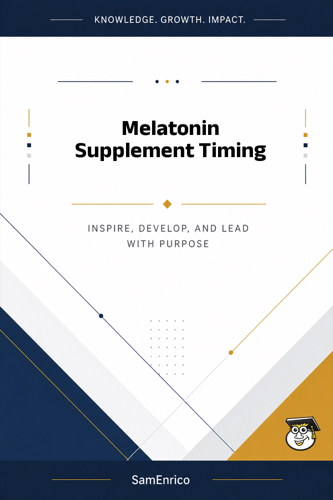
Non-FictionHealth & WellnessSupplement Timing
Melatonin Supplement Timing eBook
Take 0.5 to 1 mg two hours before desired sleep on
Take 0.5 to 1 mg two hours before desired sleep onset.
Formats
Free sample
Chapter 1: The 10mg Lie--–- The first time I swallowed a 10mg melatonin gummy, I thought I had found the answer to my prayers. It was 11:47 PM on a Tuesday. I was exhausted—the kind of bone-tired that comes from three nights of staring at the ceiling while your brain runs marathons it was never trained for. The gummy tasted like artificial berry and left a faint chemical coating on my tongue. I climbed into bed, pulled the covers to my chin, and waited for the sweet release of unconsciousness.Twenty minutes passed.
Then forty. Then an hour.At 1:30 AM, I was still awake, now vaguely nauseous and experiencing the unsettling sensation that the ceiling fan was moving slightly faster than physics should allow. When I finally fell asleep around 3 AM, I was rewarded with the most vivid nightmare of my adult life—a detailed, technicolor horror film involving being chased through an endless IKEA by furniture that had somehow developed teeth. I woke up at 6:30 AM feeling like I had been hit by a truck. My head throbbed.
My mouth tasted like copper. And I had to give a presentation to fifteen people in three hours.That was the morning I almost swore off melatonin forever.But here is the thing that kept nagging at me, even through the brain fog and the lingering image of a homicidal sofa: melatonin was supposed to work. The research seemed solid. Friends swore by it. My own mother—a woman who once slept through a fire alarm—took 5mg every night and claimed it changed her life.
So why was I feeling worse? Was I broken? Was my brain somehow resistant to the very hormone that nature designed to usher in the night?The answer, I would eventually discover, had nothing to do with my brain being broken. It had everything to do with a lie—a quiet, profitable, almost invisible lie that the supplement industry has been selling us for decades.The Lie Is Simple: More Is More Walk into any CVS, Walgreens, or Whole Foods in America. Find the sleep aisle.
You will see gummy bears, quick-dissolve tablets, liquid drops, and capsules that look like they belong in a spaceship’s medical bay. And on almost every single bottle, the numbers will shout at you: 5mg. 10mg. Even 12mg. The message is unmistakable.
If you cannot sleep, you need a bigger dose. You need more firepower. You need to nuke the problem from orbit.It makes intuitive sense, does it not? If 1mg is good, 5mg must be better. If 5mg is better, 10mg is best.
This is how every other medication in the world works. You have a headache? Two aspirin work better than one. You have a bacterial infection? A higher dose of antibiotics kills more bacteria.
You cannot sleep? Surely, more melatonin will knock you out faster and keep you under longer.That logic is wrong. Dangerously, expensively, and counterintuitively wrong.What Melatonin Actually Is (Not What You Think)To understand why the supplement industry has it backwards, you must first understand what melatonin actually is. And here is where most people—including the version of me chewing that 10mg gummy—get tripped up.Melatonin is not a sedative. Repeat that sentence out loud if you need to: Melatonin is not a sedative.A sedative—like Ambien, Valium, Xanax, or even a stiff glass of whiskey—works by depressing your central nervous system.
It slows down brain activity, reduces neural firing, and essentially forces your body into a state of reduced consciousness. Sedatives are sledgehammers. They break down the door of your awareness and drag you into sleep, sometimes against your will.Melatonin does nothing of the sort.Melatonin is a hormone. Specifically, it is the hormone your pineal gland—a tiny, pine-cone-shaped structure buried deep in the center of your brain—releases when your eyes signal that darkness has arrived. Melatonin is the messenger that says, "Hey, night is here.
Start winding down." It is not the sleep itself. It is the invitation to sleep.Think of it this way. Imagine you are hosting a dinner party. A sedative is someone grabbing you by the shoulders, shoving you into a chair, and forcing food into your mouth. Melatonin is the polite text message you send to your guests two hours before dinner, saying, "Just a reminder—we start at 7 PM.
See you soon."One is coercion. The other is coordination.This distinction matters more than almost anything else in this book, so let me repeat it in a different way, using a metaphor that will stick. Your circadian rhythm—the internal 24-hour clock that governs when you feel alert and when you feel sleepy—is like a train running on tracks. Melatonin is not the engine. It is not the fuel.
It is not even the conductor. Melatonin is a signal that tells the train, "The station is coming up. Begin slowing down."If you pour too much melatonin into your system, you are not making the train slow down faster. You are confusing the signal. You are sending ten text messages instead of one.
You are shouting at the conductor while simultaneously flickering the station lights. The train does not stop better. It stops weirder. And sometimes, it does not stop at all.The Clinical Data That Changed Everything In 2001, a researcher named Dr. Irina Zhdanova at MIT published a study that should have rewritten the melatonin playbook overnight.
She and her team gave volunteers either a placebo or one of several doses of melatonin—ranging from 0.3mg all the way up to 10mg—and measured how quickly they fell asleep and how well they stayed asleep.The results were stunning. The 0.3mg dose worked beautifully, improving sleep onset and quality with almost no side effects. The higher doses? They worked too—but they also produced next-day grogginess, vivid dreams, and in some cases, the same kind of sleep disruption they were meant to treat.More importantly, the study revealed something counterintuitive about the dose-response curve. With most drugs, higher doses produce stronger effects in a straight line.
More drug equals more response. But with melatonin, the curve looks like an upside-down U. Low doses work. Medium doses work about the same. High doses work—but they also cause problems.
And very high doses (anything above 10mg for most people) can actually make sleep worse.This is called a biphasic or inverted-U dose response. It is rare in pharmacology. It is also the reason the supplement industry has been able to sell you the wrong product for thirty years, because a biphasic response is counterintuitive. It does not feel right. It does not match your lived experience with aspirin, coffee, or alcohol.
So when you see a 10mg gummy, you assume it must be better than a 1mg pill. Why would they sell it if it were not?They sell it because it makes money. Period.The Blood Level Problem Let me get slightly technical for a moment, because this next piece of information is the key that unlocks everything else in this book.Your body, when left to its own devices in a dark room, produces melatonin…
This is the end of the free sample. Get the eBook to keep going. Buy now
About this book
Details
- Author
- Beatty Blanch
- Publisher
- SamEnrico
- Language
- English
- Genre
- Non-Fiction, Health & Wellness, Supplement Timing
- Released
- 2026-06-06
- Pages (approx.)
- 137
- Available as
- eBook, Audiobook

Read better in the ZLOADR app
Your eBooks on your phone or tablet. Sign in with your SamEnrico account and start reading.
More by Beatty Blanch
 The Senior Fashion GuideBeatty Blanch$11.99
 Tech M&A Precedent TransactionsBeatty Blanch$11.99
 Mindfulness For EQ GuideBeatty Blanch$11.99
 LBO Legal Documentation GuideBeatty Blanch$11.99
 Empathy for New ParentsBeatty Blanch$11.99
 Self Hypnosis for Menopause SleepBeatty Blanch$11.99
 Famous Forensic DentistsBeatty Blanch$11.99
 The Vanishing Masterpieces: Iraq's Lost Treasures and the Woman Who Stole ThemBeatty Blanch$11.99
 Pantomime and Power: The Forgotten Art of Ancient Roman MimeBeatty Blanch$11.99
 How to Produce Dates (Fruit)Beatty Blanch$11.99
 A Collector's Handbook to the Volkswagen Beetle 1302Beatty Blanch$11.99
 Rabbits: PET Rabbit CareBeatty Blanch$11.99
You may also like
 Hong Kong Handover 1997Dunn Johnnie$11.99
 Zumba For Postnatal Recovery CourseNeal Christian$11.99
 Zumba for BeginnersLadner Nikia$11.99
 YouTube Comment Mining GuideHumes Pandora$12.99
 Worry Box MeditationCarlin Rudy$11.99
 Workplace Stress MeditationNguyen Lynn$11.99
 Workplace Stress and Sleep RepairHawley Ivory$11.99
 Workplace Perfectionism CureDelaney Jeffry$11.99
 Workplace Injustice Anger GuideWallen Isabelle$11.99
 Work Addiction and Burnout LinkGreenwood Ester$11.99
 Women in Yoga and WellnessBeattie Galina$11.99
 Women in Stand Up ComedyChun Evangeline$11.99