
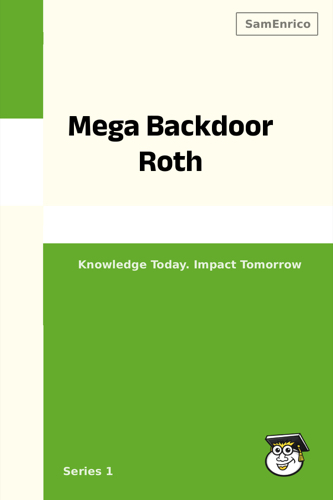
Non-FictionBusiness BriefRoth IRA
Mega Backdoor Roth eBook
Teaches after tax contributions for tax free growt
Teaches after tax contributions for tax free growth.
Formats
Free sample
Chapter 1: The Hidden Vault...--You have been told a lie about your 401(k). It is not a lie told with malicious intent. Your human resources department did not wake up one morning determined to hide money from you. Your financial advisor did not deliberately steer you wrong to protect some secret commission. The lie is simply one of omission—a quiet, persistent assumption that has been repeated so many times that everyone believes it is the truth.The lie sounds like this: You cannot save more than $23,500 per year in your 401(k).If you are over fifty, the number grows slightly to $30,500.
But the message is the same: there is a wall, a ceiling, a hard stop on how much you can shelter from the tax man each year. You have likely accepted this as fact because everyone around you—your colleagues, your benefits coordinator, even your certified public accountant—has nodded along. They have all agreed that once you hit that limit, your only remaining option is to save in a taxable brokerage account, where every dividend, every capital gain, and every sale chips away at your wealth.They are all wrong.The IRS does not actually limit your total annual 401(k) contributions to $23,500. That number applies only to a specific type of contribution. The IRS provides three distinct buckets inside your 401(k) plan.
You know two of them well. The third has been sitting there all along, hidden in plain sight, waiting for someone to open the door.This chapter is called The Hidden Vault because that is precisely what the third bucket represents. It is a vault that most plan providers do not advertise, most human resources departments do not understand, and most high earners never discover until it is too late. Inside that vault lies the ability to contribute tens of thousands of additional dollars each year—dollars that can eventually be moved into a Roth account where they will grow completely tax‑free for the rest of your life.Before we open that vault, however, we need to understand exactly how your 401(k) is structured. We need to dismantle the myth that $23,500 is your maximum.
And we need to learn the language of the three buckets, because once you speak this language, you will never look at your retirement plan the same way again.The Three‑Bucket System That Your Plan Document Hides Every 401(k) plan that follows IRS rules contains three distinct contribution types. Think of them as three buckets sitting side by side. They share the same account number and the same investment options, but the IRS treats each bucket differently for tax purposes. The buckets are not created equal. Two of them have severe annual limits.
The third has almost no limit at all.Bucket One: The Pre‑Tax Bucket This is the bucket you almost certainly use today. When you contribute money to the Pre‑Tax bucket, you receive an immediate tax deduction. Your taxable income for the year goes down by the amount you contributed. The money then grows inside the account, and you pay no taxes on dividends, interest, or capital gains while it remains invested. The catch—and there is always a catch—is that every dollar you withdraw in retirement is taxed as ordinary income.The Pre‑Tax bucket is the most popular because it offers immediate gratification.
You see the tax savings on your next paycheck. Your refund grows. Your accountant smiles. But you are effectively making a deal with the government: I will give you less money today, and you will take more money from me tomorrow. For high earners, tomorrow often arrives with a higher tax bill than expected.Bucket Two: The Roth Bucket This bucket works in reverse.
You receive no tax deduction when you contribute. Your paycheck shrinks by the full amount. But once the money is inside the Roth bucket, it never touches the tax system again. It grows tax‑free. You withdraw it tax‑free.
Your heirs inherit it tax‑free. The Roth bucket is the closest thing the American tax code offers to a legal tax loophole for the middle class and wealthy alike.The problem with the Roth bucket is that it shares the same annual contribution limit as the Pre‑Tax bucket. In 2026, you can contribute a combined total of $23,500 across both buckets. If you put $10,000 into the Pre‑Tax bucket, you can only put $13,500 into the Roth bucket. The limit applies to the sum of both.
This is why most high earners feel trapped. They would love to pour money into the Roth bucket, but they hit the wall at $23,500.Bucket Three: The After‑Tax Bucket Here is the bucket your plan provider never mentions. The After‑Tax bucket is not the same as the Roth bucket, despite the confusing similarity in names. When you contribute to the After‑Tax bucket, you receive no tax deduction—just like the Roth bucket. However, unlike the Roth bucket, the growth inside the After‑Tax bucket is taxable.
If you put $10,000 into the After‑Tax bucket and it grows to $100,000, you will pay capital gains tax on the $90,000 of growth when you withdraw it.At first glance, this seems useless. Why would anyone contribute to a bucket that offers no deduction and still taxes the growth? The answer lies in the contribution limit—or rather, the lack of one.The IRS imposes no separate annual limit on After‑Tax contributions. The only limit that applies to the After‑Tax bucket is the total plan limit found in Section 415(c) of the Internal Revenue Code. That limit is far, far larger than $23,500.The $72,000 Doorway Section 415(c) caps the total amount that can flow into your 401(k) from all sources combined: your Pre‑Tax contributions, your Roth contributions, your After‑Tax contributions, and your employer's matching contributions.
In 2026, that total limit is $72,000. If you are fifty or older, the limit rises to $80,000.Do you see the opportunity now?You have been looking at a small door labeled $23,500. Behind that door lies a massive room with a $72,000 ceiling. The only way to enter that room is to use the After‑Tax bucket, because the Pre‑Tax and Roth buckets hit their combined limit at $23,500 and then refuse to accept another dollar.Here is how the math works for a typical high earner. Suppose you earn $300,000 per year.
Your employer provides a 4% matching contribution, which amounts to $12,000. You decide to max out your Pre‑Tax or Roth contributions at $23,500. Your employer adds $12,000. The total so far is $35,500. The 415(c) limit is $72,000.
That leaves $36,500 of unused space.That $36,500 is your invitation to the After‑Tax bucket. You can contribute that much—or even more, depending on your match—into the After‑Tax bucket. No other IRS limit stops you. The only remaining question is: Why would you want to contribute to a bucket that taxes growth?The answer is that you do not stay in the After‑Tax bucket. You use it as a hallway, not a destination.The Alchemy of the Mega Backdoor The term "Mega Backdoor Roth" describes a two‑step process.
Step one: you contribute money to the After‑Tax bucket. Step two: you convert that money into a Roth bucket. The…
This is the end of the free sample. Get the eBook to keep going. Buy now
About this book
Details
- Author
- Mcwilliams Aline
- Publisher
- SamEnrico
- Language
- English
- Genre
- Non-Fiction, Business Brief, Roth IRA
- Released
- 2026-06-07
- Pages (approx.)
- 137
- Available as
- eBook, Audiobook

Read better in the ZLOADR app
Your eBooks on your phone or tablet. Sign in with your SamEnrico account and start reading.
More by Mcwilliams Aline
 Dining Out Behavior StudyMcwilliams Aline$11.99
 Self Doubt In Learning GuideMcwilliams Aline$11.99
 Team Task Allocation GuideMcwilliams Aline$11.99
 Managing Notification Overload CourseMcwilliams Aline$11.99
 Anger and Breakup ThreatsMcwilliams Aline$11.99
 Ma Anand Sheela BiographyMcwilliams Aline$11.99
 The Siege of Montluc: France's Bloody Prison Revolt of 1848Mcwilliams Aline$11.99
 DIM Supplement GuideMcwilliams Aline$11.99
 The Black Market of Life: Australia's Organ Harvesting Scandal (1960s-1970s)Mcwilliams Aline$11.99
 How to Start a Endodontic Dentistry Business (Beginners Guide)Mcwilliams Aline$11.99
 How to Produce Furniture AccessoriesMcwilliams Aline$11.99
 How to Produce Skillets and Frying PansMcwilliams Aline$11.99
You may also like
 Hong Kong Handover 1997Dunn Johnnie$11.99
 Zumba For Postnatal Recovery CourseNeal Christian$11.99
 Zumba for BeginnersLadner Nikia$11.99
 YouTube Comment Mining GuideHumes Pandora$12.99
 Worry Box MeditationCarlin Rudy$11.99
 Workplace Stress MeditationNguyen Lynn$11.99
 Workplace Stress and Sleep RepairHawley Ivory$11.99
 Workplace Perfectionism CureDelaney Jeffry$11.99
 Workplace Injustice Anger GuideWallen Isabelle$11.99
 Work Addiction and Burnout LinkGreenwood Ester$11.99
 Women in Yoga and WellnessBeattie Galina$11.99
 Women in Stand Up ComedyChun Evangeline$11.99