
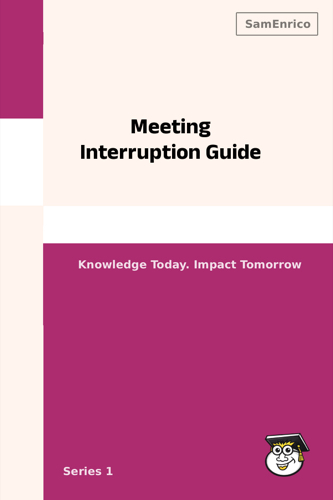
Meeting Interruption Guide eBook
Reduces unscheduled drop ins and long calls.
Reduces unscheduled drop ins and long calls.
Formats
Free sample
Chapter 1: The 11:45 AM Funeral--– The first time Sarah cried in her car, she told herself it was just exhaustion. The second time, she blamed the traffic. The third time, parked outside her own house at 11:47 AM on a Tuesday, she finally admitted the truth: she had just completed her third consecutive week without a single uninterrupted hour of meaningful work.Her calendar was a lie. It showed focus blocks, project time, and strategic thinking sessions—all color-coded, all meticulously planned. But those blocks were fiction.
What actually happened was a slow, invisible death by a thousand cuts. A Slack ping at 9:14 AM. A colleague tapping her shoulder at 9:37. A "quick question" that became a 28-minute call at 10:15. Another drop-in at 10:52.
A fire drill at 11:20. By 11:45, when she looked back at her morning, she had accomplished exactly nothing of value. She had been busy. She had been responsive. She had been available.
But she had not been effective.Sarah is not real. But you know her. You might be her.This chapter is not about fixing your calendar yet. It is not about scripts, systems, or strategies. Those come later.
This chapter is about something more urgent: the funeral for the work you thought you would do today, and the quiet realization that the problem is not your laziness, your willpower, or your time management. The problem is the availability trap—the modern belief that being responsive equals being effective, that an open door is a virtue, and that saying "not now" is a failure of professionalism.Let me show you what this trap actually costs. Not in feelings. In dollars, hours, and careers.The Minute-by-Minute Autopsy of a Wasted Morning Let us reconstruct a typical knowledge worker's morning. Not an outlier.
Not a day with back-to-back disasters. A normal Tuesday.9:00 AM – You sit down with a clear priority. You know exactly what you need to accomplish. Your calendar shows a two-hour focus block. You open your primary work document.9:07 AM – A Slack message arrives.
It is not urgent. It could wait. But the notification appears. You glance at it. Your brain registers the question.
You decide to ignore it and return to your work.9:14 AM – Another Slack message. This one is from your boss. "Got a sec?" Your heart rate increases slightly. You do not have a sec. But you respond: "Sure, what's up?" The thread begins.
Seven minutes later, you have answered three questions and lost your train of thought completely.9:23 AM – You try to resume your focus block. But your brain is no longer in the document. It is in the Slack thread. It is anticipating the next question. This is called attention residue—the phenomenon where your mind stays partially stuck on the previous task even after you have switched contexts.9:37 AM – A colleague appears at your desk (or in your DM window).
"Hey, quick question." You know it will not be quick. But you say "sure" because saying "not now" feels rude. The question takes eleven minutes to answer. Then there is follow-up. Then there is a story about their weekend.
Then there is a tangent. The total interruption: seventeen minutes.9:54 AM – You return to your work. But now you have lost the thread entirely. You spend six minutes trying to remember where you were. You read the last three paragraphs you wrote.
You delete two of them.10:15 AM – A scheduled call begins. It was supposed to be fifteen minutes. It is now 10:42 AM and still going. Someone is "just circling back" on something from last week. Someone else has "one more thing." You check the clock.
Forty-seven minutes have passed. You have contributed maybe four sentences.10:52 AM – Another drop-in. This time it is a junior team member who needs "thirty seconds of your expertise." You give them the answer in two minutes. They thank you profusely. You feel helpful.
You also feel your focus slip away again.11:20 AM – An email chain erupts. Someone misunderstood a deadline. Now everyone is cc'ing everyone. Your phone buzzes. Your computer chimes.
Two people tag you in the thread. You spend twelve minutes clarifying, calming, and correcting.11:32 AM – You look at your original task. You have written approximately three sentences. None of them are good.11:45 AM – You give up. You close the document.
You open your email inbox and begin the grim work of administrative triage. The focus block is dead. The morning is dead. You tell yourself you will try again after lunch.But after lunch, there are more pings. More drop-ins.
More "quick questions."And tomorrow, you will do it all again.The 23-Minute Lie: What Research Says About Recovery Here is the most dangerous myth in modern knowledge work: that interruptions are just small, manageable annoyances. A minute here. Three minutes there. What is the harm?The harm is that an interruption is not just the time it takes. The harm is the recovery time that follows.In 2014, researchers at the University of California, Irvine conducted a study that should be tattooed on the forearm of every office worker.
They followed employees in a real workplace and measured how long it took them to return to a focused state after an interruption. The answer was not seconds. It was not five minutes. It was an average of twenty-three minutes and fifteen seconds.Let me say that again. You lose twenty-three minutes of productivity for every interruption that lasts less than sixty seconds.Here is why.
Human attention is not a light switch that flips on and off instantly. Attention is a deep, slow river that takes time to build momentum. When you are in a state of deep focus—what psychologist Mihaly Csikszentmihalyi called "flow"—your brain has suppressed irrelevant stimuli, activated task-relevant networks, and entered a high-performance mode. Interruptions do not gently tap you on the shoulder. They detonate a bomb in that river, and the water takes nearly half an hour to settle.Most people do not believe this.
They think they are good at multitasking. They think they can switch contexts quickly. They are wrong. More than one hundred studies over four decades have shown the same thing: the human brain cannot process two cognitive tasks simultaneously. What we call "multitasking" is actually rapid task-switching, and each switch carries a cognitive penalty.
The more you switch, the more you lose.Let us do the math on a typical day.Assume you experience five interruptions. Not a heavy day. A light day. Five "quick questions," five Slack pings that demand a response, five moments where someone needs "just a minute."Five interruptions × 23 minutes recovery time = 115 minutes lost. Nearly two hours.
Every day. Over a forty-hour work week, that is ten hours of lost productivity. Over a fifty-week year, that is five hundred hours. Five hundred hours is the equivalent of twelve and a half full-time work weeks.Now multiply that by your team. Your department.
Your company.One of the most revealing case studies in the literature comes from a mid-sized technology company that agreed to track every unscheduled interruption for one month. They were not a chaotic startup. They were a professional organization with competent, well-intentioned people. The results were staggering.Their team of twenty knowledge…
This is the end of the free sample. Get the eBook to keep going. Buy now
About this book
Details
- Author
- Corrigan Zandra
- Publisher
- SamEnrico
- Language
- English
- Genre
- Non-Fiction, Self-Help, Meeting Management
- Released
- 2026-06-06
- Pages (approx.)
- 151
- Available as
- eBook, Audiobook

Read better in the ZLOADR app
Your eBooks on your phone or tablet. Sign in with your SamEnrico account and start reading.
More by Corrigan Zandra
 Library Quiet Room VisualizationCorrigan Zandra$11.99
 Bryan Stevenson Justice MercyCorrigan Zandra$11.99
 The Green Card GrindCorrigan Zandra$11.99
 Reading Wind Down MeditationCorrigan Zandra$11.99
 Long COVID Emotional BluntingCorrigan Zandra$11.99
 U 2 Dragon Lady PilotCorrigan Zandra$11.99
 Fear of Failure for AthletesCorrigan Zandra$11.99
 Shadows of the Silk Road: The Vanished CaravanCorrigan Zandra$11.99
 The Velvet and the Steel: The Renaissance Costume Makers Who Dressed HistoryCorrigan Zandra$11.99
 How to Become a Pulp-and-paper TesterCorrigan Zandra$11.99
 How to Produce Ladders and ScaffoldingCorrigan Zandra$11.99
 A Collector's Handbook to the Lotus 2Corrigan Zandra$11.99
You may also like
 Meeting Scheduling OptimizationShorter Lahoma$11.99
 Distraction Proof Meeting CultureGreenfield Jon$11.99
 Virtual Meeting Facilitation GuidePennington Gigi$11.99
 Meeting Fatigue Reduction GuideMorrissey Diann$11.99
 Meeting Interruption ControlMccray Phyliss$11.99
 Meeting Interruption Buster CourseGregory Pat$11.99
 Meeting Distraction Management GuideKerns Ladawn$11.99
 Meeting Block SchedulingAvalos Alesha$11.99
 Meeting Block CompressionLindquist Rupert$11.99
 Meeting Creativity Rescue GuideSwift Reva$11.99
 Meeting Sanity GuideLaws Felisha$11.99
 Meeting Reduction StrategyKeys Shirly$11.99