
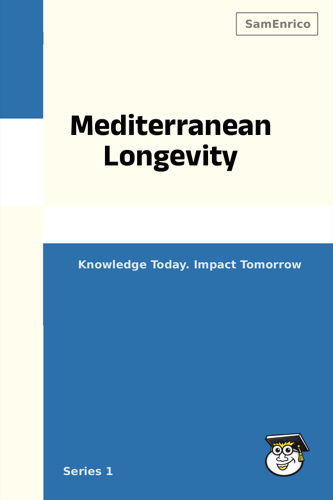
Non-FictionHealth & WellnessAging
Mediterranean Longevity eBook
Explains Blue Zones and reduced chronic disease ri
by Earl Coy
Explains Blue Zones and reduced chronic disease risk.
Formats
Free sample
Chapter 1: The Geography of Forever--–- On a small, rocky Greek island where the average age of death hovers near 90, where dementia is so rare that the local word for Alzheimer’s was borrowed from a neighboring island, and where men in their nineties still tend olive groves under the Mediterranean sun, I learned my first and most important lesson about longevity: it is not written in your genes.The lesson came not from a laboratory or a medical journal, but from a 94-year-old named Yiorgos. He was standing on a hillside in Ikaria, barefoot, leaning on a wooden staff, watching his goats pick their way through thyme and oregano. His hands were gnarled but strong. His eyes were clear. When I asked him the secret to a long life, he laughed—a deep, gravelly sound—and said, “The secret is that there is no secret.
We just live. And we don’t stop living until we die.”That was the moment I understood that everything I thought I knew about aging was backward.For years, we have been told that longevity runs in families, that your fate is sealed by the DNA you inherit from your parents. If your grandfather died of a heart attack at sixty, the story goes, you are destined for the same. If your mother had Alzheimer’s, you are walking toward the same cliff. This is the genetic fatalism that pervades modern medicine—a quiet, corrosive belief that biology is destiny.It is also, as the world’s longest-lived communities demonstrate, almost entirely wrong.The Five Places Where Time Moves Slower Between 2004 and 2010, National Geographic Fellow Dan Buettner assembled a team of demographers, epidemiologists, and anthropologists to do something that had never been done systematically: identify the world’s hotspots of human longevity, then figure out what they had in common.
The team combed through census data, birth certificates, and mortality records, searching for regions with unusually high concentrations of centenarians—people who had reached their hundredth birthday—and, just as important, people who had reached old age without the chronic diseases that define Western aging.They found five places that met their criteria.The first was Ikaria, Greece , an island in the eastern Aegean Sea, a few dozen miles off the coast of Turkey. Ikaria is mountainous, remote, and historically poor. For centuries, pirates and conquerors left it largely alone because there was nothing worth stealing. That isolation preserved something invaluable: a traditional way of eating and living that had not been touched by the industrial revolution. Today, one in three Ikarians lives into their nineties.
Rates of dementia are so low that researchers struggled to find enough cases to study. Middle-aged men have roughly one-quarter the rate of heart disease of their American counterparts.The second Blue Zone was Sardinia, Italy , specifically the mountainous central region of Barbagia. Sardinia is the only place in the world where men live as long as women—a statistical anomaly that demographers call “the Sardinian exception.” The island’s shepherds walk five to ten miles a day across steep terrain, eat a diet rich in whole grains, goat’s milk, and pecorino cheese, and drink a modest amount of red wine made from grapes grown in volcanic soil.The third was Okinawa, Japan , a subtropical archipelago south of mainland Japan. Okinawa has the highest concentration of centenarians on earth, and its elderly women are particularly remarkable—they are energetic, socially engaged, and rarely suffer from breast or prostate cancer. The traditional Okinawan diet is plant-based, centered on sweet potatoes, bitter melon, tofu, and turmeric.
The elderly practice a form of caloric moderation called Hara Hachi Bu—eating until eighty percent full.The fourth was Nicoya, Costa Rica , a peninsula on the country’s Pacific coast. Nicoyan men in their sixties have the lowest mortality rate in the world. The water in Nicoya is exceptionally hard, rich in calcium and magnesium, which may explain the region’s low rates of heart disease and hip fractures. But the more powerful factor may be plan de vida—a sense of purpose that extends well into old age.The fifth and final Blue Zone was Loma Linda, California , a community of Seventh-day Adventists who live, on average, a full decade longer than other Californians. Adventists are religiously prohibited from smoking and drinking alcohol.
Many are vegetarian or vegan. They observe a twenty-four-hour Sabbath each week, which functions as a regular, structured period of rest, social connection, and spiritual reflection.These five places are separated by oceans, continents, and cultures. Ikaria and Sardinia are Mediterranean islands; Okinawa is a Japanese archipelago; Nicoya is a Central American peninsula; Loma Linda is a Southern California suburb. They speak different languages, worship different gods, and eat different foods. And yet, when researchers looked beneath the surface, they found a common blueprint—a set of shared patterns that transcend culture and geography.The Four Common Threads The first common thread is geography that requires movement.
Every Blue Zone is located in hilly or mountainous terrain. There are no flat cities where you can drive everywhere. The natural environment forces residents to walk, climb stairs, and carry things. In Sardinia, shepherds walk eight to ten miles a day. In Ikaria, the road up from the harbor is steep enough that even young visitors get winded.
In Okinawa, traditional houses are built on slopes, and gardens are terraced. The movement is not exercise—it is simply life.The second thread is climate that permits year-round outdoor living. All five Blue Zones are in temperate or subtropical zones where winters are mild enough that people can spend time outside every day. They garden, walk to neighbors’ houses, eat meals outdoors, and work in fields or vineyards. The social and physical life of the community happens outside, not inside a climate-controlled gym.The third thread is historical isolation that preserved traditional diets.
Each Blue Zone was, until relatively recently, remote and economically marginalized. Industrial food—refined oils, sugar, white flour, processed meats—never arrived in significant quantities. Instead, people ate what they grew, raised, or caught. Their diets were high in fiber, low in sugar, and rich in polyphenols from locally grown herbs and produce.The fourth thread is cultural identity that resists Westernization. In every Blue Zone, there is a strong sense of local identity that acts as a buffer against the homogenizing forces of globalization.
Ikarians are fiercely proud of being Ikarian. Sardinians identify with their village, not just with Italy. Okinawans have moai—small, committed social groups that meet daily for support. These cultural anchors preserve the behaviors that keep people healthy.The Myth of Genetic Destiny I want you to pause here, because this next point is the single most important idea in this entire book. It is the foundation upon which everything else rests.For decades, we have been told that longevity is primarily genetic.
This belief is so deeply embedded in our culture that it feels like common sense. Of course, we think, people from long-lived families have good genes. Of course, if your parents lived into their nineties, you will too. Of course, if your father died of a heart attack at…
This is the end of the free sample. Get the eBook to keep going. Buy now
About this book
Details
- Author
- Earl Coy
- Publisher
- SamEnrico
- Language
- English
- Genre
- Non-Fiction, Health & Wellness, Aging
- Released
- 2026-06-06
- Pages (approx.)
- 131
- Available as
- eBook, Audiobook

Read better in the ZLOADR app
Your eBooks on your phone or tablet. Sign in with your SamEnrico account and start reading.
More by Earl Coy
 Senior Home Safety ConfidenceEarl Coy$11.99
 Design Thinking for Account ManagementEarl Coy$11.99
 Adaptive ThermogenesisEarl Coy$11.99
 The Step Ten Daily ReviewEarl Coy$11.99
 Cross Functional TeamsEarl Coy$11.99
 Shift Work Weight Gain GuideEarl Coy$11.99
 Handling Nicotine Withdrawal SymptomsEarl Coy$11.99
 The Battle of Ipsus: The End of Alexander's DreamEarl Coy$11.99
 The Shanghai Opium Vault Heist: A 19th-Century Crime Unraveled by DNAEarl Coy$11.99
 How to Produce TouchpadsEarl Coy$11.99
 How to Become a Powerhouse HelperEarl Coy$11.99
 Portfolio Career Building GuideEarl Coy$12.99
You may also like
 Hong Kong Handover 1997Dunn Johnnie$11.99
 Zumba For Postnatal Recovery CourseNeal Christian$11.99
 Zumba for BeginnersLadner Nikia$11.99
 YouTube Comment Mining GuideHumes Pandora$12.99
 Worry Box MeditationCarlin Rudy$11.99
 Workplace Stress MeditationNguyen Lynn$11.99
 Workplace Stress and Sleep RepairHawley Ivory$11.99
 Workplace Perfectionism CureDelaney Jeffry$11.99
 Workplace Injustice Anger GuideWallen Isabelle$11.99
 Work Addiction and Burnout LinkGreenwood Ester$11.99
 Women in Yoga and WellnessBeattie Galina$11.99
 Women in Stand Up ComedyChun Evangeline$11.99