
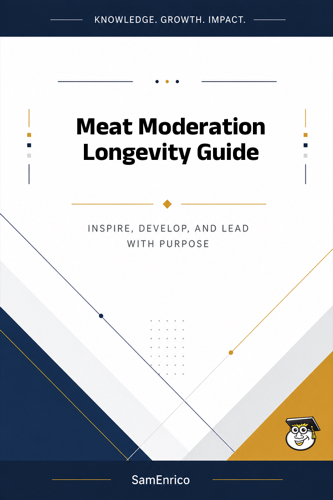
Non-FictionHealth & WellnessRed Meat
Meat Moderation Longevity Guide eBook
Eat pork or meat only five times monthly as specia
by Mojica Odis
Eat pork or meat only five times monthly as special occasions.
Formats
Free sample
Chapter 1: The $400 Billion Lie--The first time Jennifer cried over a hamburger, she was sitting in her car outside a Mc Donald’s, alone, at 9:47 on a Tuesday night. She had not wanted the burger. She had not planned for the burger. She had spent the entire day eating well—a spinach smoothie for breakfast, a lentil salad for lunch, a piece of salmon for dinner. She had felt proud, in control, like someone who had finally figured things out.
Then she drove past the golden arches, and something inside her snapped. Her hands turned the wheel before her brain could object. She ordered a double cheeseburger, large fries, and a chocolate shake. She ate everything in less than eight minutes. And then she sat in the silence of her car, grease on her fingers, shame in her throat, wondering what was wrong with her.Nothing was wrong with Jennifer.
Everything was wrong with the system she was swimming in. And until she understood that system, she would keep blaming herself for failing to beat it.This chapter is not about meat. Not yet. This chapter is about the four hundred billion dollars spent every year to ensure that you eat meat not once in a while, not as a special occasion, but every single day, often multiple times per day. This chapter is about the engineering, the advertising, the lobbying, and the psychology designed to make you believe that a hamburger is not a treat but a right, that bacon is not a condiment but a breakfast staple, that chicken is not a protein source but a default setting.
And this chapter is about the first step toward freedom: recognizing that your cravings are not a moral failure. They are a predictable response to a food system that has been weaponized against your willpower.The Invention of Daily Meat For 99 percent of human history, meat was a luxury. Our hunter-gatherer ancestors did not eat steak for breakfast, chicken for lunch, and pork for dinner. They celebrated a successful hunt with a feast, then went days or weeks without animal flesh, surviving on tubers, berries, nuts, seeds, and whatever plants the landscape provided. The word “meat” itself comes from the Old English mete, which simply meant “food.” It was not a category.
It was not a daily requirement. It was one thing among many.The industrialization of meat is a remarkably recent phenomenon. In 1900, the average American ate about 120 pounds of meat per year—roughly two and a half pounds per week, or about the amount a single person might consume in two or three meals. By 2024, that number had doubled to 240 pounds per year, or nearly five pounds per week, distributed across breakfast, lunch, dinner, and snacks. The difference is not because Americans suddenly evolved a greater biological need for protein.
The difference is because a handful of corporations discovered that meat could be produced cheaply, marketed aggressively, and sold daily if they could just convince you that you needed it.The transformation happened in three waves. The first wave was technological: refrigerated railcars, industrial slaughterhouses, and factory farming made meat cheap enough for the middle class. The second wave was political: agricultural subsidies, meat-friendly dietary guidelines, and trade policies that favored animal agriculture over plant farming. The third wave was psychological: the deliberate engineering of meat products to hit what food scientists call the “bliss point,” the precise combination of fat, salt, sugar, and texture that triggers a dopamine response in the human brain nearly identical to the response produced by mild opioids.You are not addicted to meat. You are addicted to the bliss point.
And the food industry knows your brain better than you do.The Bliss Point: How Bacon Hijacks Your Dopamine Let us examine a single slice of bacon. It contains approximately eleven grams of fat, one hundred ninety milligrams of sodium, and a complex array of glutamate compounds that trigger umami receptors. That combination—fat, salt, umami—is not accidental. It is the result of decades of food science research aimed at finding the precise ratio that maximizes palatability without triggering the body’s natural satiety signals.Dr. Michael Moss, in his Pulitzer Prize-winning book Salt Sugar Fat, describes walking through the research facilities of major food corporations and watching scientists measure the “craveability” of products using MRI machines and taste panels.
The goal is not to make food nutritious. The goal is to make food compelling—to ensure that the first bite triggers a desire for the second, and the second for the third, and the third for the entire package. Bacon is a masterpiece of this engineering. It is salty enough to excite the tongue, fatty enough to coat the mouth, and crisp enough to provide the textural contrast that the brain interprets as freshness. It is also, not incidentally, nearly impossible to eat in small quantities.A 2018 study published in the journal Cell Metabolism followed participants who eliminated hyper-palatable foods—the bliss-point engineered products—for fourteen days.
The researchers measured not just what the participants ate but how they felt. The results were striking: after just seventy-two hours, participants reported a measurable decrease in craving intensity. By day seven, their dopamine receptors had become more sensitive, meaning they derived more pleasure from smaller amounts of food. By day fourteen, many participants reported that previously irresistible foods (bacon, cheese puffs, chocolate bars) now tasted “too salty,” “too greasy,” or “artificial.”The takeaway is profound and liberating: your cravings are not a sign of weakness. They are a sign that your brain has been trained, through repeated exposure to bliss-point foods, to expect a dopamine hit every time you see, smell, or think about meat.
And like any trained response, it can be untrained. But you cannot untrain it by blaming yourself. You can only untrain it by understanding the mechanism and systematically reducing your exposure.The Seven Thousand Ads Per Year Now let us move from engineering to advertising. The average American sees approximately seven thousand meat-related advertisements every year. That is nearly twenty per day.
They arrive in the form of television commercials during primetime shows, billboards along highways, sponsored social media posts from influencers, coupons in the mail, signage at grocery store checkouts, and the most insidious form of all: product placement in movies and television shows where characters eat burgers, wings, and ribs as part of everyday life.These advertisements are not neutral. They are designed to normalize daily meat consumption by associating it with positive emotions: family barbecues, celebratory feasts, romantic dates, manly independence, feminine indulgence. Consider the language of fast-food marketing: “You deserve a break today.” “Have it your way.” “I’m lovin’ it.” The message is always the same: meat is not a special occasion. Meat is a reward for simply existing. You worked hard?
Eat meat. You feel sad? Eat meat. You feel happy? Eat meat to celebrate.
There is no emotion, no circumstance, no time of day that the advertisements cannot frame as an invitation to consume animal flesh.The most successful advertising campaign in meat industry history was not created by a meat company at all. It was created by the federal government. In…
This is the end of the free sample. Get the eBook to keep going. Buy now
About this book
Details
- Author
- Mojica Odis
- Publisher
- SamEnrico
- Language
- English
- Genre
- Non-Fiction, Health & Wellness, Red Meat
- Released
- 2026-06-06
- Pages (approx.)
- 130
- Available as
- eBook, Audiobook

Read better in the ZLOADR app
Your eBooks on your phone or tablet. Sign in with your SamEnrico account and start reading.
More by Mojica Odis
 Global Talent Competition ForecastMojica Odis$11.99
 Immigrant Childhood Self EsteemMojica Odis$11.99
 The Workaholism Laptop Free Evening GuideMojica Odis$11.99
 Gambling Addiction Relapse PlanMojica Odis$11.99
 Fenrir's Howl: The Wolf Who Swallowed the MoonMojica Odis$11.99
 Conventional Loan UnderwriterMojica Odis$11.99
 Real Estate Tokenization GuideMojica Odis$12.99
 One Page Customer Journey HandbookMojica Odis$12.99
 Understanding Léri–weill DyschondrosteosisMojica Odis$17.99
 How to Start a Chair Seating Made of Cane or Wicker Business (Beginners Guide)Mojica Odis$11.99
You may also like
 Hong Kong Handover 1997Dunn Johnnie$11.99
 Zumba For Postnatal Recovery CourseNeal Christian$11.99
 Zumba for BeginnersLadner Nikia$11.99
 YouTube Comment Mining GuideHumes Pandora$12.99
 Worry Box MeditationCarlin Rudy$11.99
 Workplace Stress MeditationNguyen Lynn$11.99
 Workplace Stress and Sleep RepairHawley Ivory$11.99
 Workplace Perfectionism CureDelaney Jeffry$11.99
 Workplace Injustice Anger GuideWallen Isabelle$11.99
 Work Addiction and Burnout LinkGreenwood Ester$11.99
 Women in Yoga and WellnessBeattie Galina$11.99
 Women in Stand Up ComedyChun Evangeline$11.99