
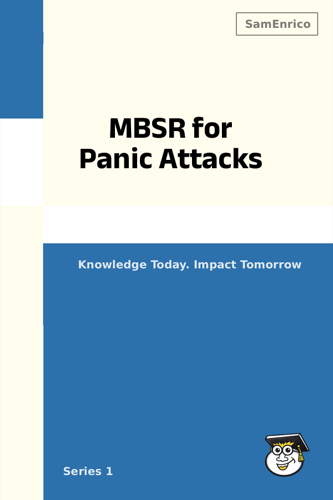
MBSR for Panic Attacks eBook
Uses mindfulness during acute anxiety episodes.
Uses mindfulness during acute anxiety episodes.
Formats
Free sample
Chapter 1: The Grocery Store Incident--–- I was twenty-three years old, standing in line at a grocery store, buying milk and eggs, when I became absolutely certain I was going to die.My heart started racing. Not the normal "I'm in a hurry" racing. This was different. This was my heart pounding so hard that I could see my shirt moving with each beat. The room started spinning.
The fluorescent lights seemed too bright. The person behind me said something—I have no idea what—and their voice sounded distant, like they were speaking from the end of a long tunnel.I grabbed the shopping cart to steady myself. My hands were sweating. My chest felt tight. I could not get enough air.
Every breath felt like trying to suck air through a narrow straw. I was absolutely, one hundred percent convinced that I was having a heart attack. That I was dying. That this was it.I left the cart where it was—abandoned in the middle of the aisle—and walked as calmly as I could manage toward the exit. I say "walked," but it was more of a controlled stumble.
I pushed through the automatic doors, made it to my car, and sat there for what felt like hours but was probably forty-five minutes.I did not call an ambulance. I did not go to the emergency room. I just sat there, gripping the steering wheel, waiting to die.I did not die.Eventually, my heart rate returned to normal. The sweating stopped. I could breathe again.
I drove home, shaken and confused, and spent the rest of the night googling my symptoms. Heart attack? No, I was twenty-three and healthy. Panic attack? I had heard the term, but I had no idea it could feel like that.I had no idea that my own body could terrorize me so completely.That was my first panic attack.
It was not my last.The Lies We Tell Ourselves in the Middle of Panic If you are reading this book, chances are you have had a moment like mine. Maybe it was in a grocery store. Maybe it was on an airplane, in a meeting, driving on the highway, or lying in bed at three in the morning. Maybe you have been to the emergency room, convinced you were dying, only to be told that nothing was physically wrong.Here is what you probably believed in that moment:I am having a heart attack.I am going to faint.I am going to stop breathing.I am losing my mind.I am going crazy.I am about to lose control completely.Everyone can see me falling apart.Something terrible is about to happen.I am going to die.Here is what was actually true:Your heart was racing. That is uncomfortable but not dangerous.You felt dizzy.
That is unpleasant but not life-threatening.Your breathing was rapid and shallow. That is your body's natural response to perceived threat.You were not dying. You were having a panic attack.I need you to read that last line again. Slowly.You were not dying. You were having a panic attack.This is the first and most important truth of this entire book.
Panic attacks feel like life-threatening emergencies. They feel like you are losing your mind. They feel like you are about to die. But they are not any of those things. They are panic attacks.
They are uncomfortable. They are terrifying. They are not dangerous.The difference between discomfort and danger is the difference between being trapped in a panic attack and riding one out. And learning that difference is the first step toward freedom.What Panic Actually Is (And Isn't)Let me define my terms clearly. When I say "panic attack," I mean a discrete episode of intense fear or discomfort that comes on suddenly, peaks within minutes, and involves at least four of the following physical and cognitive symptoms:Racing heart, pounding heart, or palpitations.
Sweating. Trembling or shaking. Shortness of breath or a feeling of being smothered. A choking sensation. Chest pain or chest tightness.
Nausea or abdominal distress. Dizziness, unsteadiness, lightheadedness, or feeling faint. Chills or heat sensations. Numbness or tingling sensations. Feelings of unreality or being detached from yourself.
Fear of losing control or going crazy. Fear of dying.If you have experienced these sensations, you know how terrifying they are. They are not imaginary. They are not "all in your head" in the sense that you are making them up. They are real physiological events.
Your heart actually is racing. You actually are having trouble breathing. You actually are sweating and trembling.The problem is not the sensations themselves. The problem is what your brain does with them.Here is the critical distinction that changes everything: Fear is a response to a real, present-moment threat. A car swerving toward you on the highway.
A person following you down a dark street. A fire alarm ringing in a building. In these situations, your body's fight-or-flight response is appropriate and potentially life-saving.Panic is a response to a perceived threat that is out of sync with actual danger. Your heart races because you drank too much coffee, and your brain decides you are having a heart attack. You feel dizzy because you stood up too quickly, and your brain decides you are about to faint.
You feel short of breath because you are anxious about a presentation, and your brain decides you are suffocating.The alarm is sounding, but there is no fire.Your nervous system has learned to sound the alarm too loudly, too often, and at the wrong times. It is not broken. It is overprotective. It is like a smoke detector that goes off every time you toast a bagel. Annoying?
Yes. Frightening? Sometimes. But not a sign that the house is burning down.The Three Dimensions of Panic To work with panic effectively, you need to understand that it has three distinct dimensions. Each dimension requires a slightly different mindfulness approach.
Throughout this book, we will address each dimension in turn. But first, you need to know what they are.The Physical Dimension This is the most obvious dimension of panic. Racing heart. Shortness of breath. Dizziness.
Sweating. Trembling. Choking sensations. Chest tightness. Nausea.
These sensations are produced by your sympathetic nervous system—the "fight-or-flight" branch of your autonomic nervous system. When your amygdala (your brain's alarm system) detects a threat, it floods your body with stress hormones like adrenaline and cortisol. Your heart rate increases to pump blood to your muscles. Your breathing quickens to take in more oxygen. You sweat to cool your body down.
You tremble as your muscles tense for action.All of these responses are designed to help you survive a physical threat. They make perfect sense if you are being chased by a predator. They make no sense at all if you are sitting in a meeting or standing in line at a grocery store.The Emotional Dimension The physical sensations of panic are uncomfortable. But what makes them truly terrifying is the emotional layer on top of them. Terror.
Dread. The overwhelming feeling that something terrible is about to happen. The sense that you are losing your mind. The…
This is the end of the free sample. Get the eBook to keep going. Buy now
About this book
Details
- Author
- Shull Maritza
- Publisher
- SamEnrico
- Language
- English
- Genre
- Non-Fiction, Self-Help, Panic
- Released
- 2026-06-05
- Pages (approx.)
- 113
- Available as
- eBook, Audiobook

Read better in the ZLOADR app
Your eBooks on your phone or tablet. Sign in with your SamEnrico account and start reading.
More by Shull Maritza
 Networking for the Product ManagerShull Maritza$11.99
 Gut Brain Axis and Western DietShull Maritza$11.99
 Forgiveness Art Therapy GuideShull Maritza$11.99
 Operation Gladio: The Shadow War You Weren’t Supposed to KnowShull Maritza$11.99
 Gibbsite MiningShull Maritza$11.99
 How to Start a Bolt End Business (Beginners Guide)Shull Maritza$11.99
 Mercury Bank Non Resident GuideShull Maritza$12.99
 How to Produce Bath Oil and BeadsShull Maritza$11.99
You may also like
 Hong Kong Handover 1997Dunn Johnnie$11.99
 Zumba For Postnatal Recovery CourseNeal Christian$11.99
 Zumba for BeginnersLadner Nikia$11.99
 YouTube Comment Mining GuideHumes Pandora$12.99
 Worry Box MeditationCarlin Rudy$11.99
 Workplace Stress MeditationNguyen Lynn$11.99
 Workplace Stress and Sleep RepairHawley Ivory$11.99
 Workplace Perfectionism CureDelaney Jeffry$11.99
 Workplace Injustice Anger GuideWallen Isabelle$11.99
 Work Addiction and Burnout LinkGreenwood Ester$11.99
 Women in Yoga and WellnessBeattie Galina$11.99
 Women in Stand Up ComedyChun Evangeline$11.99