
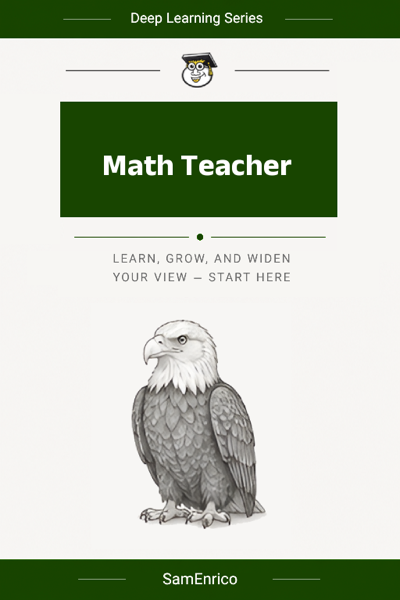
Non-FictionInformativeEducational
Math Teacher eBook
A Coursebook on Math Teacher
A Coursebook on Math Teacher
Formats
Free sample
Chapter 1: The Algorithm Trap--–- The first time I watched a student fake a math education, he was in the third row, second seat from the window. His name was Marcus, and he had developed a remarkably sophisticated system. He would wait for the teacher to work through an example on the board, copy every step into his notebook with painstaking precision, and then, when given a similar problem, he would look at his notes, look at the new numbers, and simply give up. Not because he was lazy. Not because he didn't care.
But because no one had ever shown him that the numbers meant anything at all.Marcus had learned the single most dangerous lesson that school can teach: that mathematics is a performance, not a sense-making activity. He had mastered the art of looking like he was learning while actually learning nothing. And the system had rewarded him for it—C's on quizzes, gentle nods from teachers, the quiet invisibility of the student who never causes trouble.This chapter is for Marcus. And for the thousands of students like him who sit in math classrooms every day, copying steps, memorizing tricks, and never once being invited to actually think. This chapter is also for you, the teacher who refuses to let that continue.The Transmission Delusion Let me name the enemy clearly.
It is not teachers. It is not students. It is not parents or administrators or standardized tests. The enemy is a set of assumptions about what it means to teach and learn mathematics that has become so deeply embedded in our collective consciousness that we no longer see it as an assumption at all. We see it as simply what math class is.This set of assumptions is called the transmission model of teaching.Here is how it works.
The teacher possesses mathematical knowledge. The student does not. The teacher's job is to transmit that knowledge into the student's brain, like pouring water from one container into another. The student's job is to receive that knowledge, store it, and produce it on demand when asked. Mathematics, in this model, is a collection of procedures, formulas, and algorithms to be memorized and applied.If you went to school in the United States at any point in the last century, you recognize this model.
It looks like this: teacher stands at the board, demonstrates a procedure (say, long division), works through three examples, then assigns thirty similar problems for practice. The next day, repeat with a different procedure. The week ends with a test asking students to perform the procedures without error.The transmission model has a seductive logic. It appears efficient. It appears straightforward.
It appears to produce measurable results—students can, in fact, perform the procedures on the test, at least some of them, some of the time.But here is the problem: the transmission model is a lie. Not a small lie, not a well-intentioned simplification, but a fundamental misunderstanding of how human beings learn mathematics. Research from cognitive science, mathematics education, and neuroscience has converged on an uncomfortable truth: you cannot transmit mathematical understanding. It cannot be poured from one brain to another. Understanding must be built, constructed, and actively assembled by the learner themselves.This is not a matter of opinion.
It is not a pedagogical fad that will be replaced by something else next year. It is a finding as robust as any in educational research. Jean Piaget described it decades ago. Lev Vygotsky extended it. Every major mathematics education organization in the world—the National Council of Teachers of Mathematics, the International Commission on Mathematical Instruction, the American Mathematical Society—has endorsed instructional practices consistent with this view.And yet, walk into most math classrooms in America, and you will still see the transmission model playing out, day after day, year after year.
Why?Because the transmission model is easier to implement. It requires no real understanding of mathematics, only the ability to follow a script. It requires no knowledge of how students think, only the ability to grade answers as right or wrong. It requires no creativity, no flexibility, no genuine engagement with the discipline. It is the path of least resistance in a system that already asks too much of teachers.But easier is not better.
And the transmission model is not just ineffective—it is actively harmful.The Harm We Do Let me be specific about the damage caused by the transmission model. I want you to recognize these outcomes, because you have seen them. Every math teacher has.First, it produces learned helplessness. When students are taught that mathematics consists of procedures to be memorized and applied, they naturally conclude that they cannot succeed unless someone shows them the procedure first. Ask a student raised in the transmission model to solve a problem they have never seen before, and they will say, "We haven't learned that yet." Not because it requires knowledge they don't have, but because it requires thinking they haven't been trained to do.I have watched eighth-grade students stare at a problem that read, "A number times five plus three equals eighteen.
What is the number?" These students had solved equations of the form 5x + 3 = 18 for months. But when the equation was presented in words, without the familiar symbols, they froze. They had not learned to solve equations. They had learned to execute a procedure when given specific visual input. Change the input, and the procedure disappeared.Second, it erases mathematical reasoning.
In the transmission model, the question "Why does this work?" is irrelevant. What matters is whether you can execute the procedure correctly. Students learn to stop asking why, and eventually they forget that asking why is even possible. Mathematics becomes a collection of arbitrary rules imposed by an arbitrary authority—the teacher, the textbook, the answer key.I once asked a high school student why the product of two negatives is positive. She said, "Because a negative times a negative equals a positive." I asked, "Yes, but why?" She looked at me with genuine confusion and said, "That's just the rule." She had been taught mathematics for eleven years and had never been asked—or allowed—to wonder why a rule made sense.
The rule was the explanation. There was nothing underneath.Third, it creates math anxiety. When you are constantly evaluated on your ability to remember and apply procedures under time pressure, and when you have no conceptual understanding to fall back on when your memory fails, mathematics becomes a source of fear. The stakes feel impossibly high. One wrong step, one forgotten algorithm, and the whole problem collapses.This is not how mathematics actually works.
Real mathematicians make mistakes constantly and recover through reasoning. A mathematician who forgets the quadratic formula can derive it in thirty seconds from the principle of completing the square. A student in the transmission model who forgets the quadratic formula has nothing. The anxiety is not a personality flaw; it is a rational response to being taught a subject in a way that makes you perpetually one forgotten step away from failure.Fourth, it sorts and labels students. The transmission model produces wide variation in…
This is the end of the free sample. Get the eBook to keep going. Buy now
About this book
Details
- Author
- Cheatham Elizabet
- Publisher
- SamEnrico
- Language
- English
- Genre
- Non-Fiction, Informative, Educational
- Released
- 2026-06-02
- Pages (approx.)
- 143
- Available as
- eBook, Audiobook

Read better in the ZLOADR app
Your eBooks on your phone or tablet. Sign in with your SamEnrico account and start reading.
More by Cheatham Elizabet
 Postmortem Dahlia Photography EthicsCheatham Elizabet$11.99
 Power Posing HandbookCheatham Elizabet$11.99
 Dreams After C SectionCheatham Elizabet$11.99
 William Forsythe ImprovCheatham Elizabet$11.99
 The Iron Genius of Benin: Oba Ewuare's Engineering MarvelsCheatham Elizabet$11.99
 How to Produce BedskirtsCheatham Elizabet$11.99
 Instagram Parenting EnvyCheatham Elizabet$12.99
 How to Start a Nitrogen Resin Type Paint Business (Beginners Guide)Cheatham Elizabet$11.99
You may also like
 Hong Kong Handover 1997Dunn Johnnie$11.99
 Zumba For Postnatal Recovery CourseNeal Christian$11.99
 Zumba for BeginnersLadner Nikia$11.99
 YouTube Comment Mining GuideHumes Pandora$12.99
 Worry Box MeditationCarlin Rudy$11.99
 Workplace Stress MeditationNguyen Lynn$11.99
 Workplace Stress and Sleep RepairHawley Ivory$11.99
 Workplace Perfectionism CureDelaney Jeffry$11.99
 Workplace Injustice Anger GuideWallen Isabelle$11.99
 Work Addiction and Burnout LinkGreenwood Ester$11.99
 Women in Yoga and WellnessBeattie Galina$11.99
 Women in Stand Up ComedyChun Evangeline$11.99