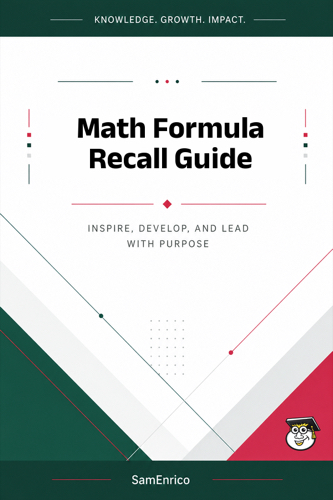
Math Formula Recall Guide
Understand derivations to reconstruct formulas rat
Understand derivations to reconstruct formulas rather than rote memorize.
Formats
About this book
Free sample
The Math Formula Recall Guide: Master Derivations, Not Memorization Revised & Corrected Edition Unifying Framework (Prologue): The Five Seeds of Formula Reconstruction Before Chapter 1, a short prologue introduces the Five Seed Concepts that generate every formula in the book:Distance – How far apart things are (number line, Pythagorean theorem)Change – How quantities vary (slope, derivative, rate)Accumulation – How small pieces sum to a whole (area, integral, sum)Symmetry – Circles, rotation, and repeating patterns (trigonometry, periodicity)Inversion – Undoing an operation (inverse functions, logarithms, integration)Each chapter explicitly connects back to one or more seeds. A visual map at the start of the book shows how all 12 chapters branch from these five roots.Revised Chapter Summaries (Minimum 250 Words Each)Chapter 1: The Myth of the "Memory Gene" – Why Rote Learning Fails Core Concept: This opening chapter dismantles the belief that some people are naturally "bad at memorizing formulas" while others are gifted. Drawing on cognitive science, it explains that rote memorization creates fragile neural pathways—highly susceptible to stress, time pressure, and interference. During exams, when cortisol rises, these isolated memory traces often collapse, leaving students staring at blank pages.The Key Shift: The chapter introduces the distinction between recognition (seeing a formula and knowing you've seen it before) and derivation (rebuilding a formula step-by-step from basic principles). Using the quadratic formula as the lead example, the chapter shows how memorizing x=−b±b2−4ac2ax = \frac{-b \pm \sqrt{b^2 - 4ac}}{2a}x=2a−b±b2−4ac without context is brittle, but deriving it via completing the square makes it unforgettable.
The reader works through completing the square in real time, experiencing the derivation as a narrative rather than a final product.Clarifying Memorization vs. Retention: The chapter makes a crucial distinction that resolves a common contradiction: memorization without understanding is fragile, but retention through derivation is antifragile. The reader will still need to remember a small set of foundational definitions (e.g., the limit definition of a derivative, the Pythagorean theorem). These are not "formulas to memorize" but "seeds to plant." The chapter closes by introducing First Principles Thinking and Chunking, arguing that…
This is the end of the free sample. Get the eBook to keep going. Buy now
Contents
- Chapter 1
- Chapter 2
- Chapter 3
- Chapter 4
- Chapter 5
- Chapter 6
- Chapter 7
- Chapter 8
- Chapter 9
- Chapter 10
- Chapter 11
- Chapter 12
Details
- Author
- Peltier Mireya
- Publisher
- SamEnrico
- Language
- English
- Genre
- Non-Fiction, Self-Help, Math Study
- Released
- 2026-06-09
- Pages (approx.)
- 158
- Available as
- eBook, Audiobook

Read better in the ZLOADR app
Your eBooks on your phone or tablet. Sign in with your SamEnrico account and start reading.
More by Peltier Mireya
 Rotavirus Vaccine Diarrhea DefeatPeltier Mireya$11.99
 Age Restricted Rental Market CoursePeltier Mireya$11.99
 Internal Comms Measurement GuidePeltier Mireya$12.99
 Remote Retreats Planning GuidePeltier Mireya$11.99
 Digital Planner Etsy Sales Funnel CoursePeltier Mireya$11.99
 The Unseen Hand: Jackie Kennedy’s Secret White House ResurrectionPeltier Mireya$11.99
 Neon Mirage: The AI That Dreamed in CodePeltier Mireya$11.99
 Manager Fish and Fish HabitatPeltier Mireya$11.99
 Postpartum Mental Health BoardPeltier Mireya$12.99Internal Comms Measurement GuidePeltier Mireya$12.99
 Understanding ChondroblastomaPeltier Mireya$17.99
 Ultimate Handbook Guide to Port Elizabeth : (South Africa) Travel GuidePeltier Mireya$11.99