
Non-FictionSelf-HelpDecentralized Media
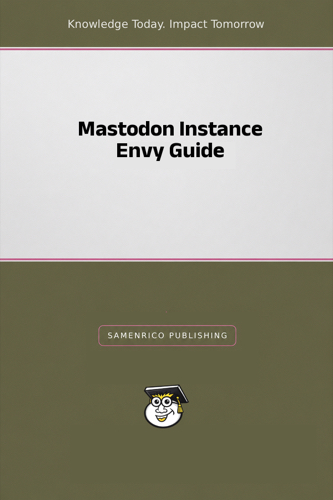
Mastodon Instance Envy Guide eBook
Stop comparing your server's culture and popularit
Stop comparing your server's culture and popularity to other fediverse communities.
Formats
Free sample
Chapter 1: Reverse Engineering Envy--–- The first time I felt Instance Envy, I was sitting on my couch at 11:47 PM, phone in hand, watching a Local Timeline that was not my own. I had joined a small Mastodon server dedicated to creative writing—thirty-seven members, a handful of active posters, a quiet rhythm of morning check-ins and evening replies. It was, by any reasonable measure, lovely. The admin posted weekly writing prompts. Two members were serializing a collaborative science fiction story.
There was no drama, no spam, no algorithm shoving rage bait into my peripheral vision.And yet.I found myself scrolling the Local Timeline of a different server—one I had no intention of joining—because a friend had linked to a post there. This server had thousands of members. Its timeline moved like a river in flood: jokes, hot takes, art shares, political arguments, memes, announcements, all cascading past at a velocity that made my quiet little writing server feel, in that moment, like a library where everyone had been asked to whisper. Why wasn't my server like that? Why didn't we have inside jokes that spawned across three hundred replies?
Why wasn't anyone liking my posts within thirty seconds of my hitting send?I closed the app. Opened it again. Closed it. Opened it. The pit in my stomach was unmistakable—the same hollow ache I used to feel on Twitter when a mutual gained five thousand followers overnight while I gained seven.
I had escaped the comparison engine, I thought. I had joined the fediverse precisely to get away from the dopamine slot machine of likes, retweets, and engagement metrics. And yet here I was, at nearly midnight, coveting another server's velocity like a gambler watching someone else hit the jackpot.This is Instance Envy. And if you are reading this book, you have felt it too.The good news is that Instance Envy is not a sign that you are weak, shallow, or "doing social media wrong." It is a sign that you are human, operating within a cognitive architecture that evolved to notice discrepancies in status and resources, and that you have been trained by two decades of corporate social media to measure your worth in metrics that were never designed for your wellbeing. The bad news is that if you do not learn to recognize, deconstruct, and redirect that envy, it will follow you from server to server, platform to platform, for as long as you seek connection online.This chapter is not about "fixing" your envy by pretending it does not exist.
It is about reverse engineering it—taking the feeling apart, piece by piece, until you understand exactly what you are actually craving and whether the object of your envy can actually deliver it. We will borrow a methodology from software engineering and apply it to your own psychology. We will distinguish between comparative metrics that poison your perception and diagnostic metrics that clarify your needs. And we will build a tool—the Jealousy Log—that you can use every time the pit in your stomach appears.By the end of this chapter, you will not be free of envy. That is not the goal.
The goal is to become literate in your own longing, to read your envy like a map rather than a wound. Let us begin.The Architecture of Envy: Why We Compare Before we can reverse engineer anything, we must understand what we are dismantling. Envy is not a simple emotion. It is a compound—a mixture of social comparison, perceived scarcity, and a specific kind of longing that psychologist Sara Protasi calls "emulative envy" (the desire to have what another has) versus "invidious envy" (the desire for the other to lose what they have). In the context of the fediverse, most Instance Envy is emulative: you do not want the popular server to fail; you want your own server to feel as alive as theirs seems to be.But why do we compare at all?The answer lies deep in our evolutionary past.
Human beings are a tribal species. For the vast majority of our existence, survival depended on accurate social comparison: Am I pulling my weight in the group? Is the group treating me fairly? Who has access to food, shelter, or mating opportunities that I do not? The brain regions that process social status—the ventromedial prefrontal cortex and the anterior cingulate cortex—are some of the oldest and most sensitive in our neural architecture.
We do not choose to compare. We are built to compare, the same way we are built to breathe.The problem is not comparison itself. The problem is the metrics we have been taught to compare.Corporate social media did not invent social comparison, but it weaponized it with breathtaking precision. When Facebook introduced the Like button in 2009, it seemed innocuous—a simple way to acknowledge a friend's update. But the Like button was not designed for connection; it was designed for measurement.
Suddenly, every post had a visible score. Every user could see, in real time, whether their content was outperforming or underperforming relative to their peers. The Like button was followed by the retweet count, the share count, the view count, the follower count, and eventually the "ratio"—a brutal metric comparing replies to likes that turned every post into a battlefield.By the time you joined Mastodon, you had been trained for approximately fifteen years to equate three specific things:Noisy = Alive. A timeline that moves fast must be more vibrant than a timeline that moves slow.Viral = Valid. A post that gets many replies or boosts must be more worthwhile than a post that gets few.Large = Successful.
A server with ten thousand users must be better than a server with fifty.These equations are false. They were false on Twitter, false on Facebook, and false on Instagram. But they are especially false on the fediverse, where the underlying architecture is designed for connection rather than extraction. However, knowing that the equations are false is not enough to stop feeling their pull. You cannot logic your way out of a neural pathway that has been reinforced for a decade and a half.
You have to dismantle it.That is what reverse engineering means.Critical Reverse Engineering: Taking Your Envy Apart In software engineering, "reverse engineering" is the process of taking a finished product—a program, a device, a piece of code—and disassembling it to understand how it works. You do not ask whether the product is good or bad. You ask: What are its components? How do they interact? What assumptions does it make?We are going to do the same thing with your envy.The next time you feel a pang of Instance Envy—scrolling a timeline that makes your own feel inadequate—I want you to pause.
Do not close the app. Do not switch to another distraction. Stay with the feeling for sixty seconds. Then ask yourself the following five questions, which together form the Envy Autopsy framework.Question 1: What specific metric triggered this feeling?Was it the number of users on the server? The speed of the Local Timeline?
The density of replies on a particular post? The number of inside jokes you did not understand? The apparent intimacy…
This is the end of the free sample. Get the eBook to keep going. Buy now
About this book
Details
- Author
- Hartwell Bronwyn
- Publisher
- SamEnrico
- Language
- English
- Genre
- Non-Fiction, Self-Help, Decentralized Media
- Released
- 2026-06-07
- Pages (approx.)
- 137
- Available as
- eBook, Audiobook

Read better in the ZLOADR app
Your eBooks on your phone or tablet. Sign in with your SamEnrico account and start reading.
More by Hartwell Bronwyn
 Sundowning Alzheimers MeditationHartwell Bronwyn$11.99
 News Overload InsomniaHartwell Bronwyn$11.99
 TM for Executive LeadershipHartwell Bronwyn$11.99
 Stress Induced Control FixHartwell Bronwyn$11.99
 South Africa Remote Tax GuideHartwell Bronwyn$11.99
 Spielberg AmblinHartwell Bronwyn$11.99
 Weight Loss Apnea GuideHartwell Bronwyn$11.99
 Pomodoro For ReadingHartwell Bronwyn$11.99
 The Great Moon Hoax: How One Newspaper Fooled the WorldHartwell Bronwyn$11.99
 The Ancient Games of Meroë: Africa's Forgotten Football RivalryHartwell Bronwyn$11.99
 The Habsburg Cosmos: Spain's Celestial EmpireHartwell Bronwyn$11.99
 The Mineral Guide to Ferrierite (Subgroup of Zeolite Minerals)Hartwell Bronwyn$11.99
You may also like
 Hong Kong Handover 1997Dunn Johnnie$11.99
 Zumba For Postnatal Recovery CourseNeal Christian$11.99
 Zumba for BeginnersLadner Nikia$11.99
 YouTube Comment Mining GuideHumes Pandora$12.99
 Worry Box MeditationCarlin Rudy$11.99
 Workplace Stress MeditationNguyen Lynn$11.99
 Workplace Stress and Sleep RepairHawley Ivory$11.99
 Workplace Perfectionism CureDelaney Jeffry$11.99
 Workplace Injustice Anger GuideWallen Isabelle$11.99
 Work Addiction and Burnout LinkGreenwood Ester$11.99
 Women in Yoga and WellnessBeattie Galina$11.99
 Women in Stand Up ComedyChun Evangeline$11.99