
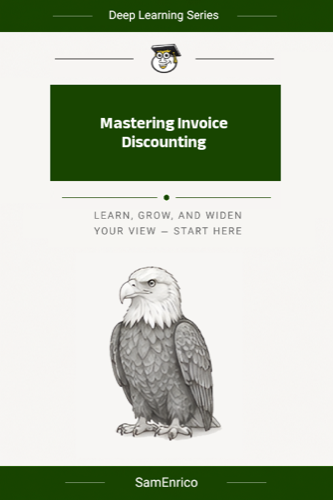
Non-FictionInformativeEducational
Mastering Invoice Discounting eBook
This publication, published by SamEnrico, covers M
by Bock Tory
This publication, published by SamEnrico, covers Mastering Invoice Discounting
Formats
Free sample
Chapter 1: The 47-Day Kill Zone...--–- The voicemail came in at 4:47 PM on a Friday. "Mr. Delgado, this is Jennifer from First Metro Bank. We've reviewed your facility and regret to inform you that your borrowing base has been frozen effective immediately. Please call our workout department by 9 AM Monday to discuss next steps."Paul Delgado, founder of Delgado Manufacturing, had just signed a $2.4 million contract with a national retailer.
His order book was the fullest it had been in three years. His factory floor was running two shifts. And in sixty seconds, that voicemail had turned a profitable, growing business into a potential corpse.The reason? A single invoice. A 147,000invoicetoacustomerwhohadtaken94daystopayinsteadoftheusual45.Thatinvoicehadagedpastthe90−dayeligibilitylimitin Paul′sdiscountingfacility.Thefunder′salgorithmspotteditat4:15PM.By4:47,thephonerang.By Mondaymorning,Paulwoulddiscoverthatheowedthebank147,000 invoice to a customer who had taken 94 days to pay instead of the usual 45.
That invoice had aged past the 90-day eligibility limit in Paul's discounting facility. The funder's algorithm spotted it at 4:15 PM. By 4:47, the phone rang. By Monday morning, Paul would discover that he owed the bank 147,000invoicetoacustomerwhohadtaken94daystopayinsteadoftheusual45.Thatinvoicehadagedpastthe90−dayeligibilitylimitin Paul′sdiscountingfacility.Thefunder′salgorithmspotteditat4:15PM.By4:47,thephonerang.By Mondaymorning,Paulwoulddiscoverthatheowedthebank680,000 in margin calls—money he did not have.Paul's story is not unusual. It is the single most common failure mode in small and medium-sized manufacturing, wholesale, and distribution.
Great businesses do not die because they are unprofitable. They die because they run out of air. And the clock that measures that breath is called the cash conversion cycle.The Silent Killer of Profitable Businesses Let us begin with a paradox that will define every page of this book. Most business owners believe that profitability equals survival. They are wrong.
Profit is an accounting concept—a lagging indicator recorded on paper months after the fact. Cash is a biological necessity. A company can be profitable for ten consecutive years and still go bankrupt in ten days if its cash flow seizes up.Consider the numbers from Paul Delgado's business in the month before that voicemail. His income statement showed a healthy 12% net profit margin. His balance sheet showed 2.1millioninaccountsreceivable—moneylegallyowedtohimbycreditworthycustomers.Hisbankaccount,however,showed2.1 million in accounts receivable—money legally owed to him by creditworthy customers.
His bank account, however, showed 2.1millioninaccountsreceivable—moneylegallyowedtohimbycreditworthycustomers.Hisbankaccount,however,showed43,000. That was not enough to meet the next payroll of $187,000, due in six days.This gap between "money earned" and "money in hand" is the cash conversion cycle (CCC). It measures the number of days between the moment a business pays its suppliers for raw materials and the moment it collects cash from its customers for finished goods. For Paul's manufacturing business, that cycle was 90 days: he paid for steel and components on day zero, spent 30 days producing, shipped on day 45, and waited another 45 days for the customer to pay.During those 90 days, Paul had to fund everything—wages, rent, utilities, marketing, debt service—without the cash from that sale. He was, in effect, lending his customers money for three months at zero percent interest.
And he was not alone. According to data from the US Census Bureau's Annual Business Survey, the median small manufacturer operates on just 27 days of cash reserves. A 90-day cash conversion cycle with only 27 days of reserves is not a business plan. It is a death sentence with a delayed fuse.The Invoice Discounting Solution—And Its Limits Invoice discounting is the financial technology designed to cut that fuse. In its simplest form, it works like this: a funder advances a percentage of the face value of a company's unpaid invoices—typically 70% to 90%—within 24 to 48 hours of the invoice being issued.
When the customer eventually pays, the funds go into a controlled trust account. The funder takes its advance plus fees and interest, and the surplus returns to the borrowing company.This is not a loan in the traditional sense. There is no fixed repayment schedule. The borrowing rises and falls automatically with the company's sales volume. When business booms and invoices pile up, borrowing capacity expands.
When sales slow and invoices are collected, the facility contracts. For a growing company like Paul's, this sounds like the perfect solution.Yet Paul's facility froze not because his business was failing, but because a single invoice aged past 90 days. The funder's eligibility criteria—the invisible fine print we will dissect in Chapter 2—treated that invoice as "toxic" and triggered a margin call on the entire borrowing base. The 90-day limit was not arbitrary. It reflected a statistical reality: invoices aged beyond 90 days are four times more likely to end in dispute or default than invoices aged under 60 days.
But for Paul, that statistical reality became a personal catastrophe.This is the central tension of invoice discounting. It is an extraordinarily powerful tool for unlocking trapped cash, but it comes with rigid rules, hidden costs, and operational traps that can destroy a business faster than the cash flow problem it was meant to solve. Mastering invoice discounting means understanding not just how to use it, but how to survive it.The Recourse vs. Non-Recourse Spectrum Before we go any further, we must establish the most important distinction in this entire field. Every invoice discounting facility falls somewhere on a spectrum between two extremes: recourse and non-recourse.Recourse facilities are the default for most small and medium-sized businesses.
Under a recourse arrangement, the borrower retains the credit risk. If a customer fails to pay an invoice—whether due to insolvency, dispute, or simple refusal—the borrower must buy back that invoice from the funder at its full face value. This is often called a "buy-back obligation," and it typically triggers 90 to 120 days after the invoice's due date.Recourse facilities have lower fees because the funder is not insuring against customer default. They also require less due diligence on the borrower's customer base. The trade-off is that the borrower's balance sheet remains fully exposed to bad debt risk.
In Paul's case, his facility was recourse. The frozen borrowing base was not the funder's problem; it was his.Non-recourse facilities flip this arrangement. The funder assumes the credit risk. If a customer defaults, the funder absorbs the loss—provided the invoice was valid, undisputed, and properly assigned. Non-recourse facilities charge significantly higher fees, often 3% to 5% more annually than recourse facilities.
They also require extensive credit underwriting on the borrower's customers, which can take weeks and cost thousands in due diligence fees.Between these two poles lies a gray area that most funders do not advertise. Some facilities offer "limited recourse" or "guaranteed recourse," where the funder covers only specific risks (e.g., customer insolvency but not customer disputes). Others use a "first loss" structure, where the borrower absorbs the first X% of bad debt losses, and the funder covers the remainder. The key takeaway for now is simple: know exactly which risk you are retaining before you sign.The Time Value of Money—Why Waiting Costs More Than You Think Let us ground this discussion in a fundamental principle of finance: a dollar today is worth more than a dollar tomorrow. This is not merely an aphorism about spending habits.
It is a mathematical reality with precise economic consequences.The time value of money has three components. First, opportunity cost. The…
This is the end of the free sample. Get the eBook to keep going. Buy now
About this book
Details
- Author
- Bock Tory
- Publisher
- SamEnrico
- Language
- English
- Genre
- Non-Fiction, Informative, Educational
- Released
- 2026-05-11
- Pages (approx.)
- 159
- Available as
- eBook, Audiobook

Read better in the ZLOADR app
Your eBooks on your phone or tablet. Sign in with your SamEnrico account and start reading.
More by Bock Tory
 Research Proposal Significance Section GuideBock Tory$12.99
 Senior Move Management GuideBock Tory$11.99
 Trigger Rehearsal VisualizationBock Tory$11.99
 Hair Salon Chemical ExposureBock Tory$11.99
 Self Hypnosis Script WritingBock Tory$11.99
 Wearable Tech InvestmentBock Tory$11.99
 Pet Loss For Vet TechsBock Tory$11.99
 Topical Estrogen Skin Aging WorkbookBock Tory$11.99
 DeSantis FloridaBock Tory$11.99
 Anger In PolyamoryBock Tory$11.99
 The Calculators of the Nile: Alexandria's Forgotten GeniusesBock Tory$11.99
 The Lost River Pioneers: Taming the Congo’s Prehistoric WatersBock Tory$11.99
You may also like
 Hong Kong Handover 1997Dunn Johnnie$11.99
 Zumba For Postnatal Recovery CourseNeal Christian$11.99
 Zumba for BeginnersLadner Nikia$11.99
 YouTube Comment Mining GuideHumes Pandora$12.99
 Worry Box MeditationCarlin Rudy$11.99
 Workplace Stress MeditationNguyen Lynn$11.99
 Workplace Stress and Sleep RepairHawley Ivory$11.99
 Workplace Perfectionism CureDelaney Jeffry$11.99
 Workplace Injustice Anger GuideWallen Isabelle$11.99
 Work Addiction and Burnout LinkGreenwood Ester$11.99
 Women in Yoga and WellnessBeattie Galina$11.99
 Women in Stand Up ComedyChun Evangeline$11.99