
Non-FictionStudent's ShortcutThesis StrategyResearch Writing
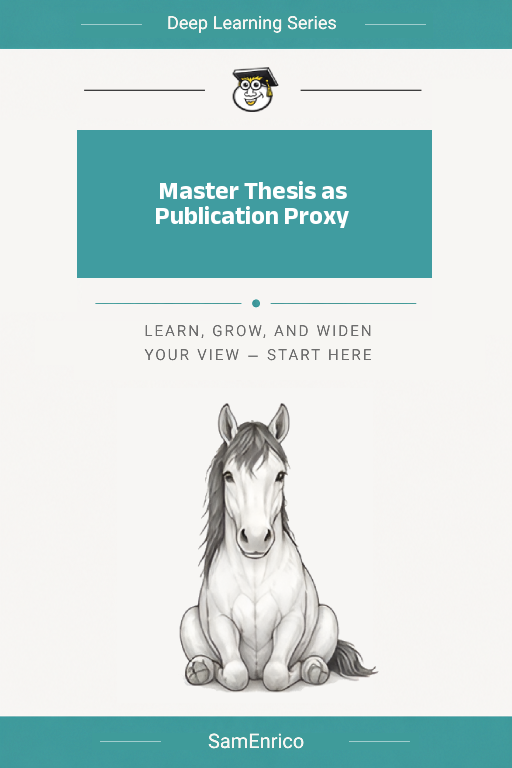
Master Thesis as Publication Proxy eBook
Submit your master's thesis abstract and findings
Submit your master's thesis abstract and findings as a writing sample to demonstrate research capability.
Formats
Free sample
Chapter 1: The Five-Minute Jury--Imagine a stranger holding your entire academic future in their hands. They are not your advisor. They are not your thesis committee. They are a person who has never met you, has no obligation to like you, and has exactly ninety seconds to decide whether you are worth a second glance. This person might be a Ph D admissions committee member reviewing five hundred applications for twelve spots.
They might be a research director at a think tank who needs to hire one junior analyst from a pool of two hundred. They might be a hiring manager at a biotech firm who has been told to find someone who can handle longitudinal data and write clearly.Here is what that stranger will do. They will open your application package. They will see your resume or CV first. Then they will see a document labeled “Master’s Thesis Abstract.” They will read it.
If it confuses them, bores them, or fails to answer three questions—What problem did you tackle? How did you tackle it? What did you find?—they will close the file and move to the next candidate. You will never know you were rejected. The entire trial will take less time than brewing a cup of coffee.This chapter is about that stranger.
It is about the five minutes—often fewer—that separate your thesis from a dead PDF on a university server and your thesis as the document that opens doors. Most master’s students write their thesis to satisfy their advisor. That is a catastrophic strategic error. Your advisor will read your thesis because they are paid to do so. Everyone else will read it only if you force them to by making the first page irresistible.
This chapter introduces the concept of the Proxy Value—the measure of how well your thesis stands in for your research capability when you are not in the room. By the end of this chapter, you will understand who your real audience is, why they have less patience than you imagine, and how to write for the reader who holds the keys.The Grave Mistake Most Students Make Walk into any graduate writing center and ask to see examples of master’s theses. You will find documents that are technically correct and professionally dead. They begin with sentences like: “In the following pages, this thesis will explore the historical context of…” or “Before proceeding to the methodology, it is necessary to first consider…” or “The literature review will be divided into three sections.” These are the linguistic equivalent of a long, slow bow before a performance. By the time the reader reaches the actual argument, they have already checked their email.Why do students write this way?
Because they are writing for the wrong audience. They imagine their advisor sitting in a comfortable chair, reading every word with care, underlining passages, writing thoughtful comments in the margins. That image is largely fantasy. Advisors are overworked, underpaid, and reading multiple theses simultaneously. But even if your advisor does read every word, your advisor is not hiring you.
Your advisor is not admitting you to a Ph D program. Your advisor is not funding your next project.The real audience is what this book calls the Five-Minute Jury. This jury is composed of busy, skeptical, slightly exhausted professionals who have seen hundreds of theses before yours. They have developed a screening heuristic: read the abstract, glance at the findings, decide. If the abstract is unclear, they assume the research is unclear.
If the methods are vague, they assume you cannot execute. If the finding is buried on page twenty-three, they assume you have no finding at all. They are not being cruel. They are being efficient. And you must write for their efficiency.Defense Versus Demonstration To understand the Five-Minute Jury, you must first understand the difference between a defense and a demonstration.
A defense is a ritual designed to prove that you did not cheat, that you followed the rules, that you read enough books, that you can survive a committee’s questioning. Defenses are backward-looking. They ask: Did you do the work? Did you cite the right sources? Did you follow the format?
These are necessary questions for graduation, but they are entirely irrelevant to the Five-Minute Jury.A demonstration, by contrast, is forward-looking. It asks: Can you do the work again? Can you think independently? Can you communicate clearly under pressure? Can you be trusted with data, with methods, with the responsibility of producing new knowledge?
The Five-Minute Jury does not care about your IRB approval form or your page margins. They care about whether you can walk into their organization and contribute on day one.Consider two hypothetical thesis abstracts. The first reads: “This thesis examines the relationship between social media use and adolescent mental health. A mixed-methods approach was employed. Data were collected from 150 participants.
Results indicate a correlation between screen time and anxiety scores. Implications for future research are discussed.” This is a defense. It checks boxes. It says nothing specific. It could have been written by anyone about any study.The second reads: “While prior research has established a link between social media and adolescent anxiety, little is known about whether the timing of use—morning versus evening—moderates this effect.
Using ecological momentary assessment data from 150 adolescents (ages 14–17) collected over fourteen days, this study finds that evening screen time (after 8 p.m.) predicts a 22 percent increase in next-day anxiety scores, while morning use shows no significant effect. This finding suggests that clinical interventions should target bedtime device habits rather than total screen time reduction.” This is a demonstration. It names a specific gap. It names a specific method. It reports a specific finding.
It draws a concrete implication. The Five-Minute Jury reads this and thinks: This person can think. This person can execute. This person can write. I want to talk to them.The difference is not in the study design.
The difference is in the framing. The first student wrote to defend. The second student wrote to demonstrate. This book is for the second student.Introducing the Proxy Value Equation How do you measure whether your thesis is a good proxy for your research capability? This chapter introduces the Proxy Value Equation, a conceptual tool that will guide every decision in this book:Proxy Value = (Clarity of Gap + Methodological Transparency + Specificity of Finding) / Jargon Density Let us break this down.
The numerator has three components. Clarity of Gap means that within the first two sentences of your abstract, a reader who is not a specialist in your narrow subfield can understand what is unknown. Not vaguely unknown. Specifically unknown. “Little is known about how social media timing affects anxiety” is a clear gap.
“More research is needed” is not a gap—it is a placeholder.Methodological Transparency means that you name your tools, your sample, your analytic approach, and your validation strategy. “Mixed-methods approach” is not transparent. “Fifteen semi-structured interviews analyzed using reflexive thematic analysis (Braun & Clarke, 2021) plus a survey of 150 participants analyzed using multiple regression in R” is transparent. The Five-Minute Jury wants to know what you…
This is the end of the free sample. Get the eBook to keep going. Buy now
About this book
Details
- Author
- Hooks Trinidad
- Publisher
- SamEnrico
- Language
- English
- Genre
- Non-Fiction, Student's Shortcut, Thesis Strategy, Research Writing
- Released
- 2026-05-29
- Pages (approx.)
- 153
- Available as
- eBook, Audiobook

Read better in the ZLOADR app
Your eBooks on your phone or tablet. Sign in with your SamEnrico account and start reading.
More by Hooks Trinidad
 Arsenio Hall WhoopHooks Trinidad$11.99
 TikTok Shop InfluencerHooks Trinidad$11.99
 Sitali Cooling Breath TechniqueHooks Trinidad$11.99
 The Stress Body Connection HandbookHooks Trinidad$11.99
 CPR for Pets GuideHooks Trinidad$11.99
 Persuasive Email Sequences GuideHooks Trinidad$11.99
 The Elderly Care CaptiveHooks Trinidad$11.99
 The Bioluminescent SeaHooks Trinidad$11.99
 Franchise Builder Master CollectionHooks Trinidad$11.99
 The Last Stand of the Biscuit King: How a Billionaire’s Bet Against a Small Town Changed the Food IndustryHooks Trinidad$11.99
 The Secret Life of the Queen's Guard: Behind the Velvet RopeHooks Trinidad$11.99
 Starlight Pioneers: The Black Scientists Who Charted the CosmosHooks Trinidad$11.99
You may also like
 Hong Kong Handover 1997Dunn Johnnie$11.99
 Zumba For Postnatal Recovery CourseNeal Christian$11.99
 Zumba for BeginnersLadner Nikia$11.99
 YouTube Comment Mining GuideHumes Pandora$12.99
 Worry Box MeditationCarlin Rudy$11.99
 Workplace Stress MeditationNguyen Lynn$11.99
 Workplace Stress and Sleep RepairHawley Ivory$11.99
 Workplace Perfectionism CureDelaney Jeffry$11.99
 Workplace Injustice Anger GuideWallen Isabelle$11.99
 Work Addiction and Burnout LinkGreenwood Ester$11.99
 Women in Yoga and WellnessBeattie Galina$11.99
 Women in Stand Up ComedyChun Evangeline$11.99