
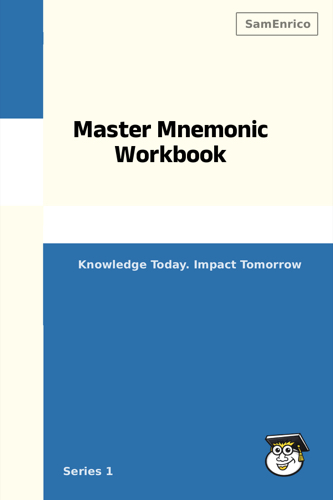
Non-FictionSelf-HelpComprehensive Mnemonics
Master Mnemonic Workbook eBook
Combines loci and peg systems for ultimate memory.
Combines loci and peg systems for ultimate memory.
Formats
Free sample
Chapter 1: The Tip-of-the-Tongue Trap--–- You are at a networking event. The room hums with forced laughter and the clink of wine glasses. A woman approaches you, hand extended, smile wide. "Great to see you again!" she says. Her face is unmistakably familiar—the curve of her jaw, the way she tilts her head.
Your brain scrambles. You know you know her. You have exchanged words with this person, perhaps even shared a meal. But her name? Gone.
Evaporated. You smile back, shake her hand, and mutter, "You too! Great to see you!" Then you spend the next three minutes nodding along while your internal monologue screams: WHO IS THIS? She mentions a project you worked on together. A flicker of context—ah, the Henderson account.
But the name remains a ghost. She walks away. You never speak to her again. You just lost a potential client, a future friend, or worse—her name was on the tip of your tongue.This is not a memory problem. This is a retrieval problem.
And this chapter will fix it in fifteen minutes.The Anatomy of a Memory Failure Let us name the enemy. The "tip-of-the-tongue" state—psychologists call it presque vu, French for "almost seen"—is not a sign of a failing brain. It is a sign of a poorly organized brain. Your hippocampus, that seahorse-shaped structure deep in your temporal lobe, has stored the information. The neural pathway exists.
But the index to that information is missing or corrupted. Think of a vast library where every book is present, but the card catalog has been replaced with sticky notes written in disappearing ink. The knowledge is there. The retrieval system is not.Consider three common failure patterns:Pattern A: The Grocery Ghost. You walk into the supermarket with a mental list of seven items.
By the time you reach the dairy aisle, you have forgotten the third item. You stand there, staring at yogurt, knowing you needed something from this section, but the thought has slipped through a crack in your attention span.Pattern B: The Name Void. You meet someone at a party. They say, "Hi, I'm Sarah." You say, "Nice to meet you, Sarah." Thirty seconds later, you introduce them to your friend, and your brain offers only: "This is... um..." Sarah is now a nameless face, and everyone feels awkward.Pattern C: The Presentation Freeze.
You have prepared a speech. You know the opening. You know the closing. But at slide four, standing before thirty people, your mind goes blank. The bullet points you rehearsed ten times have rearranged themselves into abstract nouns.
You ad-lib poorly, skip a critical statistic, and sit down feeling defeated.These three failures—sequential, associative, and structural—are not random. They correspond to the two ancient memory systems this entire workbook is built upon. And you have been using one of them your whole life without knowing it.The Two Brains Inside Your Head You do not have one memory system. You have two. And they fight for control every time you try to remember something.System One: The Spatial Navigator.
This is the oldest part of your memory architecture, honed over millions of years of evolution. Your ancestors did not need to remember phone numbers or quarterly earnings. But they desperately needed to remember where the water hole was, which cave had the bear, and which berry bush was poisonous. The brain rewards spatial memory with a flood of dopamine. That is why you can return to a childhood home after twenty years and still walk to the kitchen without thinking.
That is why you can navigate a hotel room in the dark after one night. Space is sacred to the brain.System Two: The Pattern Coder. This is a newer, more fragile system. It handles numbers, names, lists, and sequences. It is what you use when you dial a phone number or recite a password.
But this system has a fatal flaw: it does not anchor to anything physical. Numbers float. Names evaporate. Lists decay within seconds unless actively rehearsed. The pattern coder is like writing in sand while the spatial navigator is carving into stone.Here is the secret that every memory champion knows: you cannot make the pattern coder stronger.
But you can trick your brain into treating patterns as if they were spaces. You can wrap a list around a location. You can turn a number into a monster that lives inside your childhood bedroom. You can convert Sarah into a cartoon character sitting on the nose of her own face.This is not a metaphor. This is neuroanatomy.The Diagnostic Quiz: Which Brain Do You Trust?Before we build your hybrid system, you need to know where your natural strengths lie.
This is not about labeling yourself. It is about identifying which tool you already reach for, so you can deliberately train the other.Answer each question quickly. Do not overthink. Your first instinct is the correct one.Question 1: You need to remember a list of ten errands. Do you:A) Mentally walk through your house, assigning each errand to a room B) Repeat the list out loud three times, focusing on the rhythm of the words C) Write them down and take a photo with your phone Question 2: Someone gives you a seven-digit phone number.
You:A) Visualize the numbers as objects placed along your driveway B) Chunk them into two groups (e.g., 555-1234) and repeat the sound C) Immediately type it into your contacts Question 3: You are introduced to three people at a party. Later, you remember:A) Where each person was standing and what they were holding B) The rhythm of their names (two syllables, one syllable, three syllables)C) Neither, and you feel embarrassed Question 4: You need to memorize a short speech. You:A) Walk around your living room while rehearsing, associating each paragraph with a piece of furniture B) Write the speech out three times, focusing on the first letter of each sentence C) Record yourself and listen on repeat during your commute Question 5: You lose your phone and need to recall your own number. You:A) Picture the keypad and "see" your fingers pressing the digits B) Hear the rhythm of the numbers in your head C) Call your spouse and ask them to text it to you Scoring: If you answered A to three or more questions, you are a Visual-Spatial learner. Your brain already uses the Method of Loci naturally.
If you answered B to three or more questions, you are a Verbal-Numeric learner. Your brain prefers peg systems and phonetic patterns. If you answered C to three or more questions, you have been outsourcing your memory to technology—and this workbook will be a revelation.Neither profile is better. Both are incomplete. The visual-spatial learner can remember where everything is but cannot recall the 14th item on a list without walking the entire journey.
The verbal-numeric learner can recite numbers forward and backward but loses them entirely if the sequence is interrupted. The hybrid system—which you will begin building in this chapter—gives you both abilities simultaneously.The Borg Scale of Memory (Why One Plus One Equals Eleven)When…
This is the end of the free sample. Get the eBook to keep going. Buy now
About this book
Details
- Author
- Jenson Tanesha
- Publisher
- SamEnrico
- Language
- English
- Genre
- Non-Fiction, Self-Help, Comprehensive Mnemonics
- Released
- 2026-06-10
- Pages (approx.)
- 160
- Available as
- eBook, Audiobook

Read better in the ZLOADR app
Your eBooks on your phone or tablet. Sign in with your SamEnrico account and start reading.
More by Jenson Tanesha
 Uber Comfort and Premier GuideJenson Tanesha$11.99
 Anger Restructuring Relapse PlanJenson Tanesha$11.99
 The Mastery Rescript ProtocolJenson Tanesha$11.99
 The Binaural Beats InductionJenson Tanesha$11.99
 Public Speaking for WomenJenson Tanesha$11.99
 Prenatal Vitamins GuideJenson Tanesha$11.99
 Grit Angela Duckworth GuideJenson Tanesha$11.99
 The Pools of Dreams: How Football Pools Swept the World (1920s-1950s)Jenson Tanesha$11.99
 The Golden Pens of Timbuktu: Africa's Renaissance ScholarsJenson Tanesha$11.99
 How to Produce Apparel ProjectsJenson Tanesha$11.99
 How to Start a Bean Growing Business (Beginners Guide)Jenson Tanesha$11.99
 Growing Carpinus (Hornbeam)Jenson Tanesha$11.99
You may also like
 Hong Kong Handover 1997Dunn Johnnie$11.99
 Zumba For Postnatal Recovery CourseNeal Christian$11.99
 Zumba for BeginnersLadner Nikia$11.99
 YouTube Comment Mining GuideHumes Pandora$12.99
 Worry Box MeditationCarlin Rudy$11.99
 Workplace Stress MeditationNguyen Lynn$11.99
 Workplace Stress and Sleep RepairHawley Ivory$11.99
 Workplace Perfectionism CureDelaney Jeffry$11.99
 Workplace Injustice Anger GuideWallen Isabelle$11.99
 Work Addiction and Burnout LinkGreenwood Ester$11.99
 Women in Yoga and WellnessBeattie Galina$11.99
 Women in Stand Up ComedyChun Evangeline$11.99