
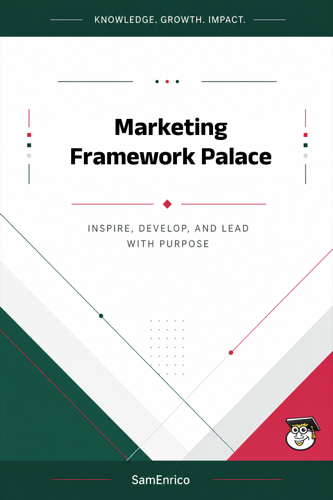
Marketing Framework Palace eBook
Store the four Ps, consumer behavior models, and c
Store the four Ps, consumer behavior models, and campaign structures.
Formats
Free sample
Chapter 1: The Leaning Palace...–- Every marketer has felt it. You launch a campaign—smart targeting, beautiful creative, reasonable budget—and the results are… mediocre. You tweak the price. Slightly better. You shift the media spend.
A small bump. But nothing scales. Nothing sustains. You are pushing against a structure that is already broken.This is not a tactical problem. It is an architectural one.Welcome to the Marketing Framework Palace.
You are about to learn why most marketing fails not because of the last ad you ran, but because of the walls you built five years ago.The Hidden Failure That No One Talks About In twenty years of diagnosing marketing departments across four continents, one pattern repeats with depressing predictability. A company hires a brilliant new Chief Marketing Officer. She audits the team, refreshes the creative, renegotiates agency contracts, and launches a bold new campaign. For ninety days, metrics climb. Then they plateau.
Then they decline. The CMO is fired. The next one repeats the cycle.The problem is never the campaign. The problem is the Palace.Here is what those CMOs discover too late: their organization’s marketing “structure” is not a structure at all. It is a pile of tactics masquerading as a strategy.
They have a Product team that never speaks to Pricing. A Place team that does not know what Promotion is promising. A Promotion team that has never met the People delivering customer service. And above all of it, no Strategy roof to hold the walls together.This book calls that pile of disconnected tactics a Leaning Palace.A Leaning Palace is any marketing organization where the seven load-bearing walls—Product, Price, Place, Promotion, People, Process, and Physical Evidence—are not balanced. One wall pushes too hard.
Another is cracked. A third was never built at all. The roof (Strategy) leaks. The floor (Profit) is sinking. And every campaign you run is just another piece of furniture added to a collapsing building.The good news?
You can straighten the walls. You can repair the foundation. You can build a Palace that does not leak profit.But first, you must unlearn almost everything the top ten marketing bestsellers taught you.Why the Original 4 Ps Failed You (And You Didn’t Even Know It)In 1960, E. Jerome Mc Carthy published Essentials of Marketing and introduced the world to the 4 Ps: Product, Price, Place, Promotion. It was a brilliant simplification for a manufacturing-driven economy where goods moved through physical stores and customers had few choices.
For thirty years, the 4 Ps worked.Then the internet happened. Then social media. Then e-commerce. Then DTC. Then subscription models.
Then AI.The 4 Ps did not evolve. They fossilized.Here is the problem with teaching the 4 Ps as isolated categories. A young marketer learns that “Product” means features and quality. “Price” means the number on the tag. “Place” means distribution channels.
“Promotion” means advertising. They then go into the world and build functional silos exactly like their textbooks: a Product Manager, a Pricing Analyst, a Distribution Lead, and a Brand Manager. None of them share a budget. None of them share goals. None of them speak the same language.This is not marketing.
This is medieval feudalism.The 4 Ps model treats marketing as four separate activities that happen to involve the same customer. In reality, marketing is one integrated system where changing one variable instantly changes the others. Lower your price without changing your Product? You just signaled lower quality. Shift your Place from retail to DTC without adjusting Promotion?
You just lost all your retail co-op advertising dollars. Add a new feature to your Product without retraining your People? You just guaranteed a customer service disaster.The 4 Ps are not wrong. They are incomplete. And worse, they are taught as silos when they should be taught as a system.Introducing the 9-Element Palace: A Complete Architecture This book replaces the 4 Ps with a nine-element architectural model.
Every element is a load-bearing wall. Every element must be balanced against the others. And every element has a permanent place in your marketing structure—not just during campaigns, but every day.Here is the Palace, from top to bottom.The Roof: Strategy Strategy is not a document you write once a year. Strategy is the roof that protects every other element. It answers three questions: Who are we serving?
What unique value do we provide? Why should anyone care? Without a roof, rain pours in. Campaigns get built on shifting ground. Priorities change every quarter.
The Palace rots from above.The Seven Walls: The Updated 7 Ps These are the load-bearing pillars that turn strategy into action.Product: Not just the tangible good or service, but the entire layered promise—core need, actual features, augmented experience (warranty, support, community).Price: Not a number, but a value signal. Price tells the market who you are, who you are not, and who belongs in your Palace.Place: Not just retail shelves, but the entire digital and physical supply chain that gets your offer into the customer’s hands. Direct-to-consumer, omnichannel, wholesale, marketplaces—all of it.Promotion: Not just advertising, but the orchestration of messages across Paid, Earned, Shared, and Owned media. Promotion is how you invite people into the Palace.People: Every human who touches your customer—and every human who touches your employees. This includes customer service, sales, HR, leadership, and even your customers themselves when they act as advocates.Process: The systems, workflows, and automation that make the customer journey frictionless.
From checkout to returns to onboarding to support tickets—process is the invisible plumbing.Physical Evidence: The tangible cues that signal quality and trust. Packaging, store design, website UX, unboxing experience, even the font on your email signature.The Floor: Profit Profit is not the goal of marketing. Profit is the floor beneath the entire Palace. If the floor cracks—if you lose money on every transaction—the Palace collapses. Every wall must eventually contribute to a floor that holds.
Some walls (Product, Price) contribute directly. Others (People, Process) contribute indirectly through retention and efficiency. But all of them must eventually support the floor.That is the complete architecture. Nine elements. One integrated system.The Balance Principle: Why Leaning Walls Destroy Growth Here is the single most important concept in this book.No wall stands alone.When one wall leans, it pulls the others with it.
When you fix one wall without checking the others, you create a new lean somewhere else. The only sustainable way to grow is to balance all nine elements simultaneously.Consider a real example. A direct-to-consumer mattress company had a brilliant Product (high-quality foam at half the retail price) and a brilliant Promotion (hilarious You Tube ads that went viral). Their Place was pure DTC. Their Price was aggressively low.But their Process wall was cracked.
Returns required printing a label, boxing the mattress, and scheduling a pickup—a twelve-step process. Their People wall was understaffed. Customer service took three days to respond. Their Physical Evidence wall was ugly. The mattress arrived in a flimsy box with no branding.The company grew fast for eighteen months.
Then reviews turned negative. Then returns spiked. Then acquisition costs doubled because angry customers posted unboxing videos. The Palace leaned…
This is the end of the free sample. Get the eBook to keep going. Buy now
About this book
Details
- Author
- Grogan Jarrod
- Publisher
- SamEnrico
- Language
- English
- Genre
- Non-Fiction, Self-Help, Marketing
- Released
- 2026-06-06
- Pages (approx.)
- 152
- Available as
- eBook, Audiobook

Read better in the ZLOADR app
Your eBooks on your phone or tablet. Sign in with your SamEnrico account and start reading.
More by Grogan Jarrod
 Contract Abstraction Prompt LibraryGrogan Jarrod$11.99
 Nubian ConquestsGrogan Jarrod$11.99
 Jealousy Regulation SkillsGrogan Jarrod$11.99
 Trauma Surgeon Coping GuideGrogan Jarrod$11.99
 The Waco Flash PaperGrogan Jarrod$11.99
 The Post Meditation BreathGrogan Jarrod$11.99
 Deep Diver's Gas Mix PrimerGrogan Jarrod$11.99
 Self Talk For Emotional RegulationGrogan Jarrod$11.99
 The Siege of Belgrade: The Cannons That Roared Against the CrescentGrogan Jarrod$11.99
 The Secret Life of the Queen: Inside the Royal Family's Most Exclusive ClubGrogan Jarrod$11.99
 The Great Bitcoin Heist: How a Billion Dollars Vanished into Thin AirGrogan Jarrod$11.99
 Technical Prompt Validation TechniquesGrogan Jarrod$11.99
You may also like
 Hong Kong Handover 1997Dunn Johnnie$11.99
 Zumba For Postnatal Recovery CourseNeal Christian$11.99
 Zumba for BeginnersLadner Nikia$11.99
 YouTube Comment Mining GuideHumes Pandora$12.99
 Worry Box MeditationCarlin Rudy$11.99
 Workplace Stress MeditationNguyen Lynn$11.99
 Workplace Stress and Sleep RepairHawley Ivory$11.99
 Workplace Perfectionism CureDelaney Jeffry$11.99
 Workplace Injustice Anger GuideWallen Isabelle$11.99
 Work Addiction and Burnout LinkGreenwood Ester$11.99
 Women in Yoga and WellnessBeattie Galina$11.99
 Women in Stand Up ComedyChun Evangeline$11.99