
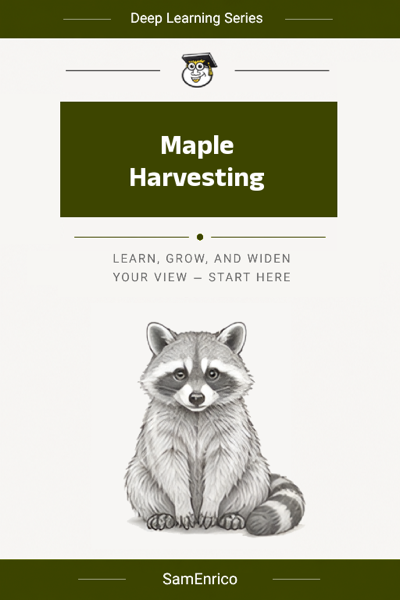
Non-FictionInformativeEducational
Maple Harvesting eBook
A Coursebook on Maple Harvesting
A Coursebook on Maple Harvesting
Formats
Free sample
Chapter 1: The Sweetest Secret--The first time I held a glass of fresh maple sap, I almost laughed. It looked exactly like water—clear, thin, unremarkable. I had driven three hours through a Vermont blizzard, walked a quarter mile through knee-deep snow, and there it was: a plastic bucket hanging off a metal spile, catching what appeared to be rainwater. I dipped my finger. The liquid was cold, barely sweet, and utterly forgettable.
Forty gallons of this, the old-timer next to me said without looking up from his drill, makes one gallon of syrup. I did the math silently. Forty to one. That meant boiling away thirty-nine gallons of water just to taste what I had driven all this way to find.I had no idea, standing there in that silent sugar bush with snow falling onto my shoulders, that I was about to stumble into a craft older than the pyramids, more precise than any kitchen recipe, and more addictive than caffeine. Maple harvesting—sugaring, as the old-timers call it—is not a hobby.
It is not even really an industry, despite the hundred and fifty million dollars it moves across North America every year. It is a conversation between a human being and a tree, mediated by temperature, patience, and a willingness to wake up at three in the morning to stoke a fire.This book exists because almost everything I learned about maple harvesting came the hard way: through frozen fingers, scorched syrup, and one spectacular incident involving a garage evaporator, a pressure relief valve I forgot to install, and a kitchen ceiling that still bears the faint brown stain of my ambition. I wrote this coursebook so that you—whether you own fifty acres of sugar maples or a single tree in your suburban backyard—do not have to make the same mistakes. The following twelve chapters will walk you through every stage of the harvest, from the first drill bite to the last bottled quart. But before we talk about taps and temperatures, before we discuss vacuum pumps or the precise angle of a spile, we need to talk about what you are actually walking into.You are about to join a tradition that stretches back ten thousand years.
The Indigenous peoples of northeastern North America were making maple sugar long before anyone in Egypt thought about stacking stones into pyramids. They called it sinzibuckwud, an Algonquian word that means simply "drawn from trees." They discovered it, according to the legend passed down through generations, when a chief named Woksis threw his tomahawk into a maple tree one winter evening and pulled it out the next morning. His wife, collecting water from the base of the tree, noticed that the liquid tasted strange—sweet, almost like the berries they gathered in summer. She boiled it overnight, reducing it into a thick, grain sugar that kept for months without spoiling.Whether that story is literally true or beautifully metaphorical hardly matters. What matters is what it tells us about the craft you are about to learn: that maple harvesting is not about speed or efficiency.
It is about noticing what the tree offers and having the patience to wait for more. The Indigenous method—gashing trunks with stone axes, collecting sap in birch bark containers, boiling it by dropping hot rocks into clay vessels—would strike a modern sugar maker as impossibly slow. A single gallon of syrup might take forty-eight hours of continuous labor. But that slowness was the point. Maple sugar was not a commodity; it was a ceremony.
It marked the end of winter, the first reliable food after months of stored corn and dried meat. Children would race to tap holes, drinking sap straight from the tree. Elders would tell stories while the boiling stones hissed in the clay pots.European settlers, arriving in the seventeenth century, recognized immediately that maple sugar was a gift. They had brought sugar cane with them from the Caribbean, but cane sugar required slavery, shipping, and a climate that killed most Englishmen within a year. Maple sugar required only a walk into the woods.
The settlers adapted the Indigenous methods, replacing stone axes with iron hatchets, birch bark containers with hollowed-out logs, clay pots with cast iron kettles. By the 1700s, maple sugar was the primary sweetener for much of New England and eastern Canada. Families would spend two weeks in March living in crude sugar shacks, boiling sap around the clock, emerging with hundred-pound blocks of hardened sugar that would last the rest of the year.The technology has changed since then. You will learn about reverse osmosis machines that strip 75 percent of the water from sap before it ever touches a flame. You will learn about vacuum pumps that double your yield and tubing networks that stretch for miles through the forest canopy.
But the heart of the craft has not changed. You still wait for the freeze-thaw cycle: nights cold enough to freeze the tree solid, days warm enough to thaw it into flowing. You still drill a hole, insert a spile, and wait for the drip to begin. You still stand in front of a boiling pan, watching steam rise into the winter air, feeling the change in density as the sap transforms from watery nothingness into amber gold.My first season, I made exactly three gallons of syrup from twelve taps. I boiled for three days straight.
I burned two batches to acrid black sludge. I nearly set my garage on fire when the evaporator arch developed a crack and shot sparks into a pile of dry kindling. My wife, who had been supportive up to that point, stood in the doorway with her arms crossed and asked, exactly once, whether we could just buy syrup from the store. I did not have a good answer. Store syrup is fine.
It is consistent, cheap, and available in December when you run out during pancake breakfast. But store syrup does not remember the sound of sap dripping into a bucket at four in the morning. Store syrup does not carry the memory of your daughter tasting her first warm spoonful straight from the finishing pan and saying, "Daddy, this tastes like the woods."That is the secret that no bottle can capture. Maple syrup is not just a sweetener. It is a place and a time, crystallized into liquid form.
It is the late-winter sun on your face while you check your buckets. It is the smell of woodsmoke and steam clinging to your jacket for days afterward. It is the quiet satisfaction of taking something that starts as clear as tap water and coaxing it, through nothing but heat and attention, into something precious.So before we get into the details—before you learn about Brix density and vacuum leaks and the precise way to hammer a spile without splitting the wood—take a moment to understand what you are really signing up for. Maple harvesting is not efficient. It is not going to make you rich.
A backyard operation with twenty taps might produce five gallons of syrup in a good season, which you could buy at the grocery store for…
This is the end of the free sample. Get the eBook to keep going. Buy now
About this book
Details
- Author
- Tolliver Alana
- Publisher
- SamEnrico
- Language
- English
- Genre
- Non-Fiction, Informative, Educational
- Released
- 2026-05-11
- Pages (approx.)
- 142
- Available as
- eBook, Audiobook

Read better in the ZLOADR app
Your eBooks on your phone or tablet. Sign in with your SamEnrico account and start reading.
More by Tolliver Alana
 Humorous Presentation TechniquesTolliver Alana$11.99
 Nonverbal Apology GuideTolliver Alana$11.99
 Vertigo And Exercise SafetyTolliver Alana$11.99
 Delegation Psychology GuideTolliver Alana$11.99
 The DNA Thief: How a Rogue Scientist Stole the FutureTolliver Alana$11.99
 How to Produce Carpentry and Woodworking Project PlansTolliver Alana$11.99
 Negotiation Without Fear on PriceTolliver Alana$12.99
 How to Start a Luncheon Voucher Company Business (Beginners Guide)Tolliver Alana$11.99
You may also like
 Hong Kong Handover 1997Dunn Johnnie$11.99
 Zumba For Postnatal Recovery CourseNeal Christian$11.99
 Zumba for BeginnersLadner Nikia$11.99
 YouTube Comment Mining GuideHumes Pandora$12.99
 Worry Box MeditationCarlin Rudy$11.99
 Workplace Stress MeditationNguyen Lynn$11.99
 Workplace Stress and Sleep RepairHawley Ivory$11.99
 Workplace Perfectionism CureDelaney Jeffry$11.99
 Workplace Injustice Anger GuideWallen Isabelle$11.99
 Work Addiction and Burnout LinkGreenwood Ester$11.99
 Women in Yoga and WellnessBeattie Galina$11.99
 Women in Stand Up ComedyChun Evangeline$11.99