
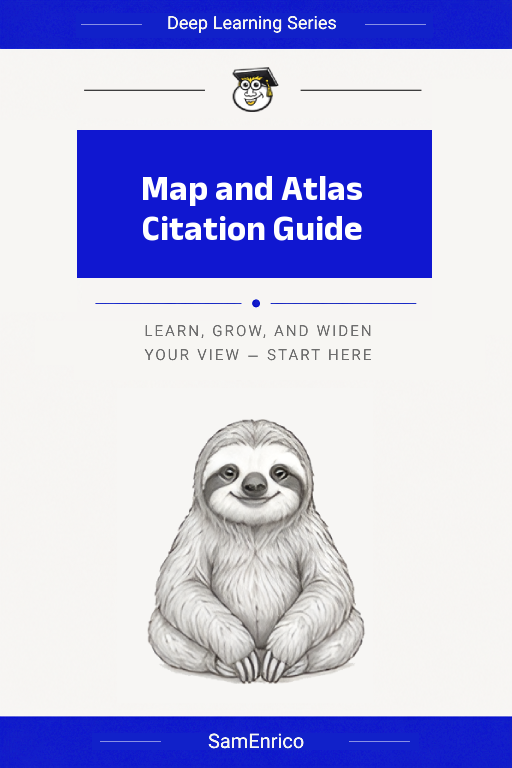
Non-FictionStudent's ShortcutMap Citation
Map and Atlas Citation Guide
Cite physical and digital maps, atlases, and GIS d
by Swann Sommer
Cite physical and digital maps, atlases, and GIS data including scale, publisher, and coordinates.
Formats
About this book
Free sample
Chapter 1: The Invisible Weapon--Maps lie. Not maliciously, not always intentionally, but they lie nonetheless. Every line drawn on a piece of paper or rendered on a screen represents a choice—a decision to include some features, exclude others, exaggerate certain relationships, and simplify complex realities into digestible symbols. The cartographer who draws a border at a river's edge rather than a mountain ridge is making a political argument. The GIS analyst who selects a Mercator projection for a world map is distorting the relative size of continents, making Greenland appear larger than Africa when the opposite is true.
The tourist map designer who enlarges a city's historic district while shrinking its industrial zones is telling you where value lies.These are not innocent choices. They are acts of persuasion, sometimes subtle, sometimes overt. And when you use a map in your research, your writing, your presentation, or your litigation, you are inheriting those choices. You are adopting the cartographer's biases, assumptions, and errors as your own. The only way to disentangle your work from theirs is through the humble, often overlooked practice of citation.This book exists because most people—including seasoned academics, practicing attorneys, professional journalists, and experienced GIS analysts—have no idea how to cite a map properly.
They treat maps as illustrations, as background decoration, as neutral representations of reality that require no more attribution than a photograph of a sunset. This is a dangerous misunderstanding. A map is not a photograph. It is an argument encoded in geometry. And arguments require attribution.Consider what happens when you fail to cite a map.
A graduate student copies a historical map from an online archive without noting the source. The map contains an outdated boundary line that reflects a colonial claim no longer recognized by international law. The student's thesis committee flags the error. The student cannot explain where the boundary came from because she does not remember which archive supplied the map. The thesis is delayed by six months while she retraces her steps.
A GIS analyst at an environmental consulting firm uses a shapefile downloaded from a state government website. He forgets to…
This is the end of the free sample. Get the eBook to keep going. Buy now
Contents
- Chapter 1
- Chapter 2
- Chapter 3
- Chapter 4
- Chapter 5
- Chapter 6
- Chapter 7
- Chapter 8
- Chapter 9
- Chapter 10
- Chapter 11
- Chapter 12
Details
- Author
- Swann Sommer
- Publisher
- SamEnrico
- Language
- English
- Genre
- Non-Fiction, Student's Shortcut, Map Citation
- Released
- 2026-05-30
- Pages (approx.)
- 158
- Available as
- eBook, Audiobook

Read better in the ZLOADR app
Your eBooks on your phone or tablet. Sign in with your SamEnrico account and start reading.
More by Swann Sommer
 Atomic Habits For KindnessSwann Sommer$11.99
 Cultural Body Language DifferencesSwann Sommer$11.99
 The Authenticity at Work HandbookSwann Sommer$11.99
 iPhone Screen Time MasterySwann Sommer$11.99
 Remote Work for InsomniacsSwann Sommer$11.99
 Infection Signs RecognitionSwann Sommer$11.99
 Circadian Master GuideSwann Sommer$11.99
 Greek Orator Memory SecretsSwann Sommer$11.99
 The Poisoned Inkwell: The Deadly Deeds of Delphine LaLaurieSwann Sommer$11.99
 The Skywalker’s Gambit: How the Thunderbird Toppled the Glass TowerSwann Sommer$11.99
 How to Produce Musical Instrument Amplifier TubesSwann Sommer$11.99
 Growing BuddlejaSwann Sommer$11.99
You may also like
 Hong Kong Handover 1997Dunn Johnnie$11.99
 Zumba For Postnatal Recovery CourseNeal Christian$11.99
 Zumba for BeginnersLadner Nikia$11.99
 YouTube Comment Mining GuideHumes Pandora$12.99
 Worry Box MeditationCarlin Rudy$11.99
 Workplace Stress MeditationNguyen Lynn$11.99
 Workplace Stress and Sleep RepairHawley Ivory$11.99
 Workplace Perfectionism CureDelaney Jeffry$11.99
 Workplace Injustice Anger GuideWallen Isabelle$11.99
 Work Addiction and Burnout LinkGreenwood Ester$11.99
 Women in Yoga and WellnessBeattie Galina$11.99
 Women in Stand Up ComedyChun Evangeline$11.99