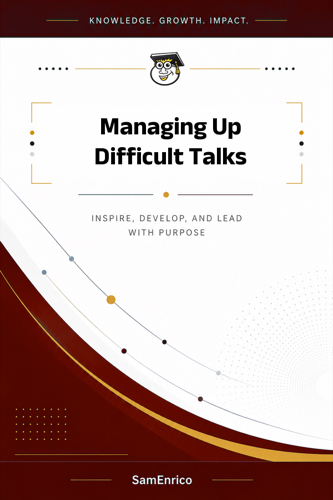
Managing Up Difficult Talks eBook
Speak honestly with your boss about workload, supp
Speak honestly with your boss about workload, support, or disagreements.
Formats
Free sample
Chapter 1: The Silence Tax--–- Priya had not said a single honest word to her boss in eleven months. Not because she was dishonest, but because she had convinced herself that silence was the safer path. Every Monday morning, she would open her laptop, look at her impossible to-do list, and tell herself, "I'll catch up this week." Every Friday afternoon, she would close her laptop, exhausted and defeated, and tell herself, "I'll speak up next week." Next week never came.Instead, Priya did what millions of employees do every day: she smiled in meetings, said "I'm fine" when asked, and quietly drowned. She worked through lunch, skipped her daughter's school play, and answered emails at 11 PM. Her boss, a well-intentioned but overwhelmed director named Marcus, assumed everything was under control because Priya never said otherwise.
When he finally noticed the bags under her eyes, he assumed she was just tired. When a major deadline slipped, he was genuinely confused. When Priya broke down in his office six months into the project, sobbing about the seventy-hour weeks and the impossible expectations, Marcus looked at her with honest bewilderment and said, "Why didn't you tell me?"Priya had no good answer. She had told herself that speaking up would make her look weak, that her boss would think she couldn't handle the work, that she would be passed over for promotion, that everyone else was managing just fine. None of it was true.
The only thing silence had bought her was burnout, resentment, and a damaged reputation for reliability that took years to rebuild.This is the hidden epidemic of the modern workplace. Not layoffs. Not bad bosses. Not even unreasonable deadlines. It is the quiet, daily decision to stay silent about what you really need.
And it is costing you far more than you know.The Cost of Silence Let us put a number on it. Researchers have found that the average employee spends between seven and ten hours per week worrying about, avoiding, or recovering from difficult conversations with their boss. That is nearly one full working day every week. Over the course of a year, that adds up to 365 to 520 hours—the equivalent of nine to thirteen additional workweeks spent not on doing your job, but on dreading a conversation you are not having.That is the Silence Tax. Every hour you spend rehearsing what you would say if you were brave enough, every night you lie awake replaying a snide comment from your boss, every time you complain to a colleague instead of addressing the person who can actually fix the problem—you are paying the Silence Tax.
And the interest compounds.Consider the study conducted by the Harvard Business Review on workplace silence. They surveyed over 3,000 employees across industries and found that 85 percent of workers had at least one significant concern about their work that they had never raised with their manager. Among those, 40 percent said they believed raising the issue would harm their career. Yet when the researchers followed up six months later, the employees who had stayed silent reported significantly higher rates of burnout, lower job satisfaction, and—most ironically—worse performance reviews than those who had spoken up. The silent employees were not protecting their careers.
They were slowly destroying them.Silence is not neutral. Silence is a choice. And like any choice, it has consequences.The Shared Pool of Meaning To understand why silence is so dangerous, you need to understand a concept from one of the most influential business books of the past two decades: Crucial Conversations. The authors, Kerry Patterson and his colleagues, introduced the idea of a "shared pool of meaning." Imagine that every conversation between two people creates a virtual pool of information, assumptions, feelings, and observations. When you and your boss are aligned, the pool is full and clear.
You both know what is happening, why it is happening, and what each of you needs.But when you withhold information—when you do not say that the deadline is impossible, when you do not admit that you need help, when you do not disagree with a flawed strategy—you are draining that pool. Your boss makes decisions based on an incomplete picture. You suffer in silence. And the gap between your reality and your boss's perception grows wider by the day.Marcus, Priya's boss, was not a monster. He was not even particularly demanding.
He simply did not know what Priya was experiencing because she had never told him. Every time she said "I'm fine" when she was drowning, she was not protecting herself. She was actively misleading her boss into thinking everything was on track. When the project finally collapsed, Marcus was not angry at Priya for struggling. He was angry that she had deprived him of the information he needed to adjust course earlier.This is the cruel irony of workplace silence: the very behavior you think is protecting you is actually sabotaging you.
By staying quiet, you are not avoiding conflict. You are merely postponing it, making it worse, and ensuring that when the conversation finally happens—and it will—it will be ten times harder than if you had spoken up when the problem was small.The Three Responses to Workplace Stress Psychologists have long understood that human beings respond to perceived threats in predictable ways. The classic model is "fight or flight." But in the modern workplace, especially in conversations with someone who has power over your livelihood, there is a third response. Let us call them Fight, Flight, and Frame.Fight is the aggressive response. You confront your boss directly, perhaps even angrily.
You say, "This workload is unreasonable" or "You are wrong about this strategy." Fight feels honest, and in some rare circumstances, it is necessary. But with a boss, the power differential makes fighting extremely risky. Even if you are right, you will be labeled as difficult, confrontational, or insubordinate. The fight response is why most employees avoid speaking up at all—they imagine that the only alternative to silence is aggression, and they are right to fear that.Flight is the avoidance response. You stay silent.
You deflect. You change the subject. You say "I'll figure it out" when you know you cannot. You quit the job before you have the conversation. Flight is the most common response to difficult conversations with bosses, and it is the one that pays the Silence Tax.
Flight feels safer in the moment, but it is a trap. Every time you choose flight, you train your brain to see your boss as a threat to be avoided rather than a partner to be engaged. Your amygdala—the fear center of your brain—learns that silence is a successful survival strategy. But in the workplace, survival is not enough. You need to thrive.Then there is Frame.
This is the path this book will teach you. Framing is the deliberate, skillful act of reframing a potentially confrontational conversation as a joint problem-solving effort. When you Frame, you are not fighting and you are not fleeing. You are stepping back, looking at the situation objectively, and saying to your boss, "We have a problem.…
This is the end of the free sample. Get the eBook to keep going. Buy now
About this book
Details
- Author
- Staples Patrina
- Publisher
- SamEnrico
- Language
- English
- Genre
- Non-Fiction, Self-Help, Managing Up
- Released
- 2026-06-06
- Pages (approx.)
- 148
- Available as
- eBook, Audiobook

Read better in the ZLOADR app
Your eBooks on your phone or tablet. Sign in with your SamEnrico account and start reading.
More by Staples Patrina
 Plateau Due To Cheat DaysStaples Patrina$11.99
 20 Minute HIIT WorkoutsStaples Patrina$11.99
 Failure Permission SlipsStaples Patrina$11.99
 Shift Work Employer AccommodationsStaples Patrina$11.99
 Mind Reading Anger RestructuringStaples Patrina$11.99
 The Uncle's Art ForgeryStaples Patrina$11.99
 Breaking The Paycheck CycleStaples Patrina$11.99
 The Radiant Minds of Africa: Black Nobel Laureates in ScienceStaples Patrina$11.99
 The Opium Shadows: How the Soviet-Afghan War Fueled a Global Drug EmpireStaples Patrina$11.99
 How to Start a Plan Printing Business (Beginners Guide)Staples Patrina$11.99
 The Essential Guide to ComedyStaples Patrina$11.99
 Peaches: When to Pick For Eating, Canning & FreezingStaples Patrina$11.99