
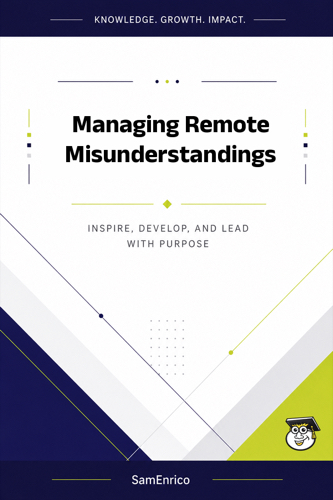
Managing Remote Misunderstandings eBook
Teaches clarifying ambiguous messages and repairin
Teaches clarifying ambiguous messages and repairing digital communication breakdowns.
Formats
Free sample
Chapter 1: The $12,500 Mistake--–- On a Tuesday morning in March, a senior product manager named Elena fired off what she thought was a harmless Slack message to her designer, Marcus. The project was behind schedule. The client was anxious. Elena typed quickly between back-to-back Zoom calls: “Great work on the mockups, genius 🙄 Let’s try actually reading the requirements this time.” She added the eye-roll emoji because she thought it made the message playful. Marcus had pulled two all-nighters to deliver those mockups.
He read the message at 6:47 AM, coffee in hand, and felt his chest tighten. He did not reply. He did not speak in the next day’s standup. Three weeks later, Marcus submitted his resignation. In his exit interview, he cited “a pattern of disrespectful communication.” Elena was floored.
“I was joking,” she told HR. “He knew I was joking.”He did not know. And that joke cost the company $47,000 in recruiting, onboarding, and lost productivity—not to mention the institutional knowledge that walked out the door.This is not a story about a toxic manager or a thin-skinned employee. This is a story about the illusion of transmission, the single most dangerous assumption in remote work. The belief that because you said something clearly, the other person heard it clearly.
The belief that tone travels through text. The belief that an emoji can rescue a sarcastic jab. These beliefs are wrong. And they are costing your organization twelve thousand five hundred dollars per employee per year.The George Bernard Shaw Problem In 1924, playwright George Bernard Shaw observed something that would prove prophetic for the age of Slack, Teams, and email. “The single biggest problem in communication,” he wrote, “is the illusion that it has taken place.” Notice the word illusion.
Shaw did not say the problem was misunderstanding, or noise, or distance. He said the problem is that we walk away from conversations convinced we have been understood when in fact we have not. In remote work, this illusion is not a minor nuisance. It is a structural defect baked into every text-based exchange.Consider what happens when two people stand in the same room. They see each other’s eyebrows lift in surprise.
They hear the sigh of frustration or the chuckle of amusement. They notice a lean forward (engagement) or a lean back (defensiveness). They perceive timing—a quick reply signals confidence; a delayed reply signals thoughtfulness or doubt. These cues are not decorative. They are the architecture of human understanding.Now strip all of that away.
That is what happens when you type a message. The screen flattens everything. Your warmth becomes generic. Your humor becomes ambiguous. Your urgency becomes aggression.
And here is the cruelest part: while the receiver is deprived of your nonverbal cues, you are equally deprived of their reaction. You cannot see them flinch. You cannot hear the sharp inhale. So you assume everything is fine. The illusion completes itself.This is what we call Cue Deprivation Theory: the systematic removal of tone, facial expression, body language, and timing from digital communication, creating an empathy gap where harm is unintentional but damage is very real.The Empathy Gap in Action Let us return to Elena and Marcus.
Elena thought she was being playful. She used the eye-roll emoji specifically to signal that she was not serious. But here is what Marcus saw: a message from a manager who had been criticizing his work for weeks, now calling him “genius” in a context that felt obviously sarcastic. The emoji did not land as playful. It landed as mocking.
Why? Because emojis do not carry tone; they carry interpretation. And interpretation is filtered through history, mood, fatigue, and power dynamics.Research from the Journal of Personality and Social Psychology found that people consistently overestimate their ability to convey tone in written messages. In one study, senders predicted that 78% of their sarcastic emails would be recognized as sarcastic. Only 56% were.
That is a 22-point gap between intention and reception. In another study, participants rated their emotional intent as clear 90% of the time. Recipients agreed only 65% of the time. That gap—25 percentage points—is the empathy gap. It is where relationships go to die.And it is expensive.The Twelve-Thousand-Five-Hundred-Dollar Number Let us talk about money, because money focuses the mind.
Poor communication costs the average organization $12,500 per employee per year. This figure comes from a synthesis of studies by the Holmes Report, the Economist Intelligence Unit, and David Horsager’s research on virtual trust. Here is how the math works:The average professional spends approximately 3 hours per week resolving misunderstandings, clarifying ambiguous messages, or repairing relationships damaged by digital friction.That is 144 hours per year (3 hours × 48 working weeks).The average loaded cost of a professional employee (salary, benefits, overhead) is approximately $87 per hour.144 hours × $87 = $12,528.Round down to $12,500 for simplicity. That number will appear multiple times in this book—in Chapter 5, when we discuss the silent treatment; in Chapter 10, when we explore quiet quitting; and in the Conclusion, as our final reminder. Repetition is how numbers become actionable.
So here is the first repetition: **$12,500 per employee per year.**For a team of ten, that is $125,000 in lost productivity. For a company of one hundred, that is $1.25 million. For a thousand employees, that is $12.5 million. And most leaders have no idea it is happening because the costs are invisible. No one writes a check labeled “misunderstanding.” The money bleeds out in extended email threads, unnecessary meetings, rework, delayed decisions, and the slow erosion of trust that leads people like Marcus to update their Linked In profiles.The Sarcasm Question (A Promise)You may have noticed that the message that destroyed Marcus’s trust contained sarcasm.
You may be wondering: Is this book going to tell me never to use sarcasm at work? The answer is complicated, and we will devote significant attention to it in Chapter 9, “Repairing Cross-Cultural Digital Faux Pas.” For now, here is a preview: sarcasm is the most dangerous form of remote communication because it relies entirely on tone, shared context, and relationship history—all of which disappear when you type. What reads as witty in your head reads as hostile on the screen. Chapter 9 will give you the hard rule, the exceptions, and the cross-cultural considerations. This chapter is about the deeper problem: the illusion that you are being clear when you are not, whether you are being sarcastic, serious, or simply rushed.Why We Overestimate Our Clarity The illusion of transmission is not a character flaw.
It is a cognitive bias called the curse of knowledge. Once you know something—including your own intent—it becomes nearly impossible to imagine not knowing it. You hear your message with all the warmth, humor, and context in your head. The receiver hears only the words.Here is a simple experiment you can run today. Write a Slack message that you believe is perfectly clear.
Then read it aloud as if your least favorite coworker had sent it to you. Read it in a flat, tired voice. Read it in a rushed, annoyed voice. Read it in a sarcastic voice. Notice how the same words shift meaning.
Now ask yourself: how confident are you that the person on the other end will read it in the voice…
This is the end of the free sample. Get the eBook to keep going. Buy now
About this book
Details
- Author
- Sylvester Rudy
- Publisher
- SamEnrico
- Language
- English
- Genre
- Non-Fiction, Self-Help, Clarity
- Released
- 2026-06-07
- Pages (approx.)
- 125
- Available as
- eBook, Audiobook

Read better in the ZLOADR app
Your eBooks on your phone or tablet. Sign in with your SamEnrico account and start reading.
More by Sylvester Rudy
 Anticipatory Grief and GuiltSylvester Rudy$11.99
 The Farmer Overdose SurvivorSylvester Rudy$11.99
 The Feet Under ChairSylvester Rudy$11.99
 Multi Platform Gig ArbitrageSylvester Rudy$11.99
 Psychological Relapse Prevention for Cannabis Use DisorderSylvester Rudy$11.99
 From M'Bera Camp To ViennaSylvester Rudy$11.99
 Stadium Concession SurvivalSylvester Rudy$11.99
 Running Stride Lengthening RoutinesSylvester Rudy$11.99
 The Kingmaker's Gambit: How a Mobster Built a Vegas EmpireSylvester Rudy$11.99
 The Algorithm That Changed Everything: The Untold Story of Andrew Ng and AI’s BreakthroughSylvester Rudy$11.99
 The Codebreakers' Gambit: Alan Turing's Hidden WarSylvester Rudy$11.99
 The Complete Guide to the Total Wellness Cleanse DietSylvester Rudy$11.99
You may also like
 Hong Kong Handover 1997Dunn Johnnie$11.99
 Zumba For Postnatal Recovery CourseNeal Christian$11.99
 Zumba for BeginnersLadner Nikia$11.99
 YouTube Comment Mining GuideHumes Pandora$12.99
 Worry Box MeditationCarlin Rudy$11.99
 Workplace Stress MeditationNguyen Lynn$11.99
 Workplace Stress and Sleep RepairHawley Ivory$11.99
 Workplace Perfectionism CureDelaney Jeffry$11.99
 Workplace Injustice Anger GuideWallen Isabelle$11.99
 Work Addiction and Burnout LinkGreenwood Ester$11.99
 Women in Yoga and WellnessBeattie Galina$11.99
 Women in Stand Up ComedyChun Evangeline$11.99