
Non-FictionInformativeEducational
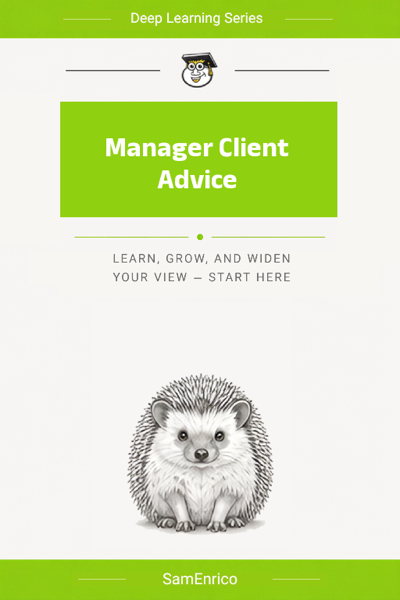
Manager Client Advice eBook
A Coursebook on Manager Client Advice
A Coursebook on Manager Client Advice
Formats
Free sample
Chapter 1: The Nodding Disease--–- The first time I lost a client I thought I was being helpful.I remember the exact moment it started. A senior vice president at a mid-sized logistics company—let’s call her Diane—had just asked me to add a “small” feature to a software implementation we were building for her team. The request was unreasonable. It would have required rebuilding a core integration, delaying launch by six weeks, and blowing the budget by forty percent. I knew this.
My technical lead had warned me. My own boss had said, “Push back if you have to.” And Diane was looking at me across the table, waiting for an answer.“Yes,” I said. “We can do that.”I did not believe it. She did not believe it. But I said it anyway, because I was afraid.
Afraid she would think I was incompetent. Afraid she would call my boss. Afraid she would fire us. So I smiled, nodded, and promised something I could not deliver. The nodding disease had claimed another victim.Six weeks later, the feature was not ready.
The launch was delayed. Diane’s boss was furious. Diane was furious at me. And when she looked back at our conversation, she realized something I had hoped she would never notice: I had known all along that we could not deliver. She had known I knew.
And I had lied anyway, not with words, but with the silent, cowardly affirmation of a nod.She fired us two weeks after that. Not because the feature was late. Because she could no longer trust me to tell her the truth.I tell you this story not because I am proud of it, but because I have never met a client manager who does not recognize themselves in it. You have nodded when you should have pushed back. You have said “yes” when you meant “no.” You have smiled while your stomach churned because you were too afraid to tell a client that their idea was bad, their timeline was fantasy, or their request was destructive.
You have the nodding disease. And it is not your fault—but it is your problem to fix.The Anatomy of the Nodding Disease The nodding disease is not a failure of competence. It is a failure of courage. And courage, unlike IQ or technical skill, is not distributed evenly at birth. It is a muscle.
Most client managers have let that muscle atrophy through years of reinforcement: say yes, keep the client happy, don’t rock the boat, bill the hours, move on to the next meeting. The system rewards the nod. Until it doesn’t.Let me define the disease precisely.The nodding disease is the automatic, fear-driven tendency to agree with a client’s request—or to avoid disagreeing—even when you know that agreement is against the client’s best interest. It is not disagreement. It is the absence of disagreement.
It is silence dressed up as service.Consider the last time a client asked you for something that felt wrong. Maybe they wanted a deadline moved up without removing any work. Maybe they wanted to add a feature that would break existing functionality. Maybe they wanted to pursue a strategy you had seen fail three times before. What did you do?
If you are like most client managers, you did not say no. You said “let me see what we can do” or “I’ll check with the team” or “that’s an interesting idea.” You bought time. You deflected. You nodded without nodding.The nodding disease has three distinct stages. Recognizing where you are is the first step toward recovery.Stage One: The Compliant Nod This is the most common and the most dangerous because it feels like good service.
The client asks. You agree. You deliver—or try to. The compliant nod says: “Whatever you want, I will make happen.”The compliant noder believes that client happiness is the ultimate metric. They confuse agreement with quality.
They think that saying yes builds trust. In fact, saying yes to everything builds resentment. Your team resents you for promising impossible things. The client resents you for delivering mediocre results. And you resent everyone because you are working twice as hard to deliver things that should never have been promised.The compliant nod is driven by fear of conflict.
You tell yourself: “If I just do this one extra thing, they’ll appreciate it.” They will not. They will expect it. And next time, they will ask for two extra things.Stage Two: The Strategic Delay The second stage is more sophisticated but no less destructive. The strategic delayer does not say yes or no. They say “let me get back to you.” They buy time.
They hope the client forgets. They hope someone else solves the problem. They hope the deadline passes and the request becomes irrelevant.The strategic delayer believes they are being prudent. They are not. They are being passive.
The client does not forget. They notice that you never answered. They interpret your silence as incompetence or evasion. And they stop trusting you to make decisions.I have watched account managers lose million-dollar contracts because they would not tell a client “no” or “yes, but here is the trade-off.” Instead, they said “we’ll look into it” week after week until the client realized they were dealing with someone who could not make a decision.Stage Three: The Silent Resentment The final stage is the most painful. The silent resenter has stopped believing that the client will ever listen.
They have stopped believing that their own voice matters. They attend meetings, take notes, execute orders, and go home angry. They have given up.The silent resenter is dangerous not because they cause immediate failure, but because they guarantee slow failure. They will not warn the client when a project is veering off course. They will not push back when a deadline is impossible.
They will not advocate for their team when the client makes unreasonable demands. They will simply execute, watch the train wreck, and say “I told you so” to themselves.If you recognize yourself in any of these stages, you are not alone. Every client manager I have ever coached started somewhere on this spectrum. The question is not whether you have the nodding disease. The question is whether you are willing to cure it.Why Technical Competence Is Not Enough Before we go any further, I need to challenge something you probably believe.
You believe that your technical expertise—your knowledge of the product, the process, the industry, the data—is what makes you valuable to clients. You are wrong.Technical competence creates utility. A utility can be replaced. The market is full of competent people who can build dashboards, write reports, manage projects, and analyze data. Competence is the price of entry.
It is not the source of lasting influence.What separates the trusted advisor from the replaced vendor is not what they know. It is what they are willing to say.I have seen brilliant engineers lose accounts because they could not tell a client that their architecture was flawed.…
This is the end of the free sample. Get the eBook to keep going. Buy now
About this book
Details
- Author
- Valentin Shara
- Publisher
- SamEnrico
- Language
- English
- Genre
- Non-Fiction, Informative, Educational
- Released
- 2026-05-06
- Pages (approx.)
- 120
- Available as
- eBook, Audiobook

Read better in the ZLOADR app
Your eBooks on your phone or tablet. Sign in with your SamEnrico account and start reading.
More by Valentin Shara
 Remote Succession Crisis GuideValentin Shara$11.99
 Folate Not Folic Acid GuideValentin Shara$11.99
 Shift Work Headache ManagementValentin Shara$11.99
 Self Esteem for New Mothers WorkbookValentin Shara$11.99
 Peg System for Memorizing CodesValentin Shara$11.99
 The Fire Above: Benjamin Franklin’s High-Altitude Balloon and the Secret of Volcanic AshValentin Shara$11.99
 The Vanishing Plague: How a Forgotten Disease Reshaped HumanityValentin Shara$11.99
 Understanding ErythroplakiaValentin Shara$17.99
 Federal Resume Writing ServiceValentin Shara$12.99
 Mentoring Junior RefugeesValentin Shara$12.99
 How to Become a Motorboat-mechanic HelperValentin Shara$11.99
You may also like
 Hong Kong Handover 1997Dunn Johnnie$11.99
 Zumba For Postnatal Recovery CourseNeal Christian$11.99
 Zumba for BeginnersLadner Nikia$11.99
 YouTube Comment Mining GuideHumes Pandora$12.99
 Worry Box MeditationCarlin Rudy$11.99
 Workplace Stress MeditationNguyen Lynn$11.99
 Workplace Stress and Sleep RepairHawley Ivory$11.99
 Workplace Perfectionism CureDelaney Jeffry$11.99
 Workplace Injustice Anger GuideWallen Isabelle$11.99
 Work Addiction and Burnout LinkGreenwood Ester$11.99
 Women in Yoga and WellnessBeattie Galina$11.99
 Women in Stand Up ComedyChun Evangeline$11.99