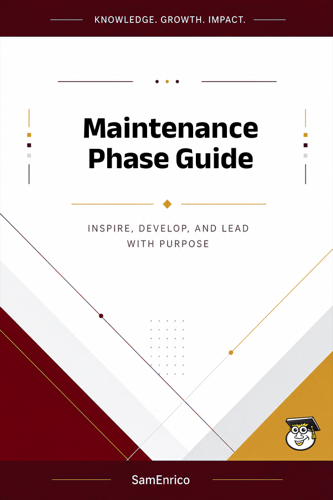
Maintenance Phase Guide eBook
Teaches pausing weight loss to reset metabolism.
Teaches pausing weight loss to reset metabolism.
Formats
Free sample
Chapter 1: The 95% Lie...-- Every dieter knows the script. You start with hope, fueled by a new plan, a new app, a new version of yourself. You lose weight—sometimes quickly, sometimes slowly, but always with that rising sense of victory. You imagine the "after" photo, the compliments, the freedom. Then, somewhere between three months and three years later, the scale starts creeping back up.
A pound. Five pounds. Ten. Soon, you are heavier than when you started, suffocated by shame and convinced that the only logical explanation is that you are broken. You lack willpower.
You are lazy. You are the problem.This chapter exists to tell you something radical, uncomfortable, and ultimately liberating: you are not broken. Your body is doing exactly what it evolved to do. The diet industry has spent trillions of dollars convincing you that failure is a moral failing. But the science of metabolic adaptation tells a different story—one where the maintenance phase, not the diet, is the secret weapon you were never taught to use.The Statistical Inconvenience That Changed Everything In 1994, a researcher named Dr.
Rudolph Leibel and his colleagues at Columbia University published a study that should have shattered the diet industry. They studied individuals who had lost 10% or more of their body weight and then maintained that loss. What they found was astonishing: these successful dieters had resting metabolic rates 15-25% lower than people of the same weight who had never dieted. Their bodies were burning significantly fewer calories—not because they were lazy or damaged, but because their biology was actively fighting to regain the lost weight.This phenomenon, now called adaptive thermogenesis or metabolic adaptation, is the body's ancient survival mechanism. It evolved over tens of thousands of years to protect us from starvation.
When food was scarce, those whose bodies slowed down their metabolism survived. Those whose bodies kept burning calories at normal rates starved to death. The adaptation that kept our ancestors alive is now the very thing that makes permanent weight loss so elusive.Fast forward to today, and the statistics are staggering. The National Weight Control Registry, which tracks individuals who have lost significant weight and kept it off for over a year, reports that only about 5% of dieters achieve long-term success. That means 95% of people who lose weight regain it—and often more than they lost.
This is not a failure rate. It is a predictable biological response to calorie restriction.Consider what this means in human terms. If you gathered one hundred people who started a diet today, only five of them would keep the weight off five years from now. The other ninety-five would be back where they started or worse. And every single one of them would blame themselves.
They would call themselves weak. They would swear that next time would be different. But next time is never different, because the problem has never been willpower.The maintenance phase exists precisely because of this statistical reality. It is not a break from the work of weight loss. It is the work itself.
And understanding why requires us to confront a truth that most diet books will never tell you: your body has a memory for fat.The Fat Thermostat: Why Your Body Fights Back Imagine your home has a thermostat set to 72 degrees. In the summer, the air conditioning works hard to bring the temperature down. In the winter, the furnace works just as hard to bring it up. No matter what happens outside, the thermostat's job is to maintain that 72-degree set point. Your body has a similar system, and Dr.
Jason Fung—the nephrologist and author whose clinical work with thousands of patients revealed this pattern—calls it the "Fat Thermostat."Your fat thermostat is set to a particular weight range that your body considers "normal." This range is influenced by genetics, hormones, dieting history, and environmental factors. When you lose weight through calorie restriction, you are essentially trying to turn down the thermostat without changing the underlying settings. The body responds exactly as a thermostat would: it fights back.How does it fight back? Through at least four distinct mechanisms:First, your resting metabolic rate drops. This is the energy your body burns just to stay alive—breathing, circulating blood, maintaining body temperature, growing and repairing cells.
When you lose weight, you would expect your metabolic rate to drop somewhat because there is less of you to maintain. But metabolic adaptation goes beyond that predictable drop. Your body actively suppresses metabolism below what would be expected for your new weight, effectively "turning down the furnace" to conserve energy.Second, your hunger hormones surge. Ghrelin, the primary hunger hormone, spikes dramatically during and after weight loss. One study published in the New England Journal of Medicine found that after weight loss, ghrelin levels remained elevated for over a year—long after participants had stopped dieting.
This means your body is constantly sending hunger signals, even when you have eaten enough.Third, your satiety hormones plummet. Leptin, the hormone that tells your brain "I'm full, stop eating," drops significantly when you lose weight. Your fat cells produce leptin, so when you have less fat, you have less leptin. But again, the drop is more severe than simple math would predict. Your brain perceives this low leptin level as a starvation signal, increasing hunger and decreasing energy expenditure.Fourth, your body becomes more efficient at storing fat.
When you do eat, your body preferentially directs calories to fat stores rather than using them for energy. It is preparing for the next famine. Every meal becomes an opportunity to rebuild the lost fat reserves.Together, these four mechanisms create a powerful biological push toward weight regain. The longer and more severely you restrict calories, the stronger this push becomes. This is why chronic dieters often find that each subsequent diet produces less weight loss, requires more suffering, and leads to faster regain.
They are not losing their willpower. They are losing the metabolic battle that their own body is winning.The Concrete Analogy: Why Pausing Is Not Quitting Let me offer you an image that will stick with you throughout this book. It comes from the world of construction, not physiology, but the parallel is exact.Imagine you are pouring a concrete foundation for a new building. The concrete is wet, heavy, and unformed. You have to wait—sometimes days or weeks, depending on the climate—for that concrete to cure.
Only when it has fully hardened can you begin building the walls. If you start construction too early, the weight of the walls will crack the foundation. The entire structure will be compromised, and you will have to tear it down and start over.Your metabolic foundation is no different. When you finish a period of calorie restriction—what we will call "the cut" throughout this book—your metabolism is not stable. It is suppressed, your hormones are out of balance, and your body is actively fighting to regain weight.
If you immediately return to your old eating habits, the foundation cracks. The weight comes back, often faster than you lost it, and you find yourself back at square…
This is the end of the free sample. Get the eBook to keep going. Buy now
About this book
Details
- Author
- Mcclanahan Gaynell
- Publisher
- SamEnrico
- Language
- English
- Genre
- Non-Fiction, Health & Wellness, Diet Breaks
- Released
- 2026-06-05
- Pages (approx.)
- 136
- Available as
- eBook, Audiobook

Read better in the ZLOADR app
Your eBooks on your phone or tablet. Sign in with your SamEnrico account and start reading.
More by Mcclanahan Gaynell
 Time Blocking for Asana UsersMcclanahan Gaynell$11.99
 Body Scan Meditation for MBSRMcclanahan Gaynell$11.99
 Workplace Anger Thought RestructuringMcclanahan Gaynell$11.99
 Peruvian Chef In New YorkMcclanahan Gaynell$11.99Peruvian Chef In New YorkMcclanahan Gaynell$11.99
 Mongolia Horse Expedition TrailMcclanahan Gaynell$11.99
 NamUs Medical Examiner BacklogMcclanahan Gaynell$11.99
 Atomic Habits For Paper TrackerMcclanahan Gaynell$11.99
 The Symphony of the Sun: Black Composers Who Shaped Western MusicMcclanahan Gaynell$11.99
 The Battle of Kleidion: Basil II’s Bloody RevengeMcclanahan Gaynell$11.99
 How to Produce Needles and HooksMcclanahan Gaynell$11.99
 Growing CalophyllumMcclanahan Gaynell$11.99